

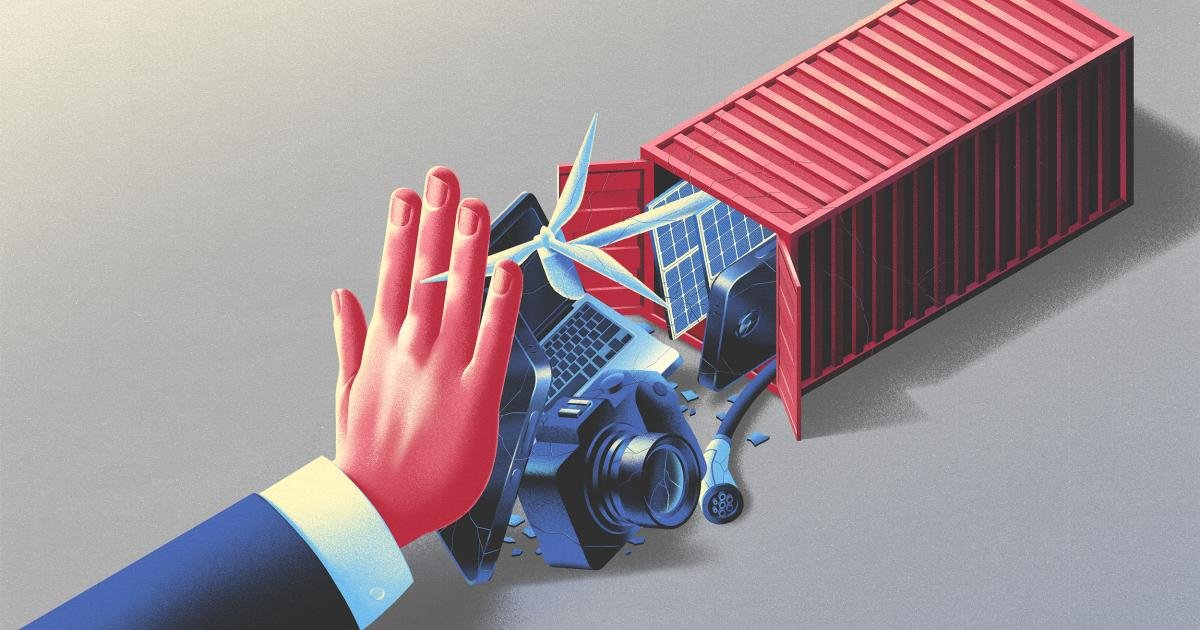
At the annual meeting of the World Economic Forum in Davos this past January, dozens of senior officials from around the world sat alongside multinational CEOs, fresh off their private jets, and applauded Canadian Prime Minister Mark Carney for what they saw as speaking truth to power. Carney gave an address inspired by a 1978 essay by Vaclav Havel, who was then a Czech poet and Soviet dissident and later served as his country’s first president in the postcommunist era. The essay, titled “The Power of the Powerless,” sought to explain how the communist system survived. In it, Havel imagined a greengrocer who, like all the shopkeepers around him, places a sign in his window that reads “Workers of the World, Unite!”—even though none of them believe in the communist system. Havel called this “living within a lie” and argued that the Soviet dystopia could come to an end when that archetypal shopkeeper decided he could no longer play along and took the sign down.
Carney was there to tell his fellow leaders that they, too, were living within a lie. For decades, they had advertised their belief in an American-led international order and a U.S.-dominated global economic system that they did not, in fact, believe in—and Canada was done pretending. “We are taking the sign out of the window,” Carney declared, claiming that “great powers”—and in particular the United States—had weaponized economic integration to the detriment of his country and others like it.
Carney was casting himself as Havel’s greengrocer, challenging an empty myth and shaking off an oppressive but dying system. But this got things exactly backward. In the current fight over the global economic order, the person who most resembles Havel’s protagonist is not Carney but rather the main target of his ire: U.S. President Donald Trump. It was Trump who called foul on the prevailing economic order a decade ago, riding into office on a wave of anger at the status quo. It was Trump who charted a new path built on a more balanced approach to trade. It was Trump who took the sign out of the window.
Trump’s agenda represents a necessary first step toward what should be Washington’s larger, more ambitious goal: replacing a defunct old trading system—predicated on illusions and vulnerable to abuse—with a new one built on the principles of balance, transparency, and sovereignty.
A FLAWED INHERITANCE
The postwar trading system arguably began at the Bretton Woods Conference in New Hampshire, in 1944. The object of that gathering was to stabilize the international monetary system, support postwar reconstruction and development, and promote global economic growth and international trade. The agreement established the International Monetary Fund and an institution that later became the World Bank. Nearly four years later, the final piece of the new global economic structure was proposed in Cuba with the signing of the Havana Charter, which sought to establish the International Trade Organization. The U.S. Congress never approved the ITO, however, because American leaders correctly feared that doing so would cede too much sovereignty to an international bureaucracy. Eventually, the proposed ITO morphed into the General Agreement on Tariffs and Trade, which the United States did join. The system the GATT fostered was flawed, but it was composed of countries that were generally democratic and had at least some commitment to market principles in their economies. Notably, it did not include any geopolitical adversaries of Western democracies.
But after the collapse of Soviet despotism, hubris warped this system. Many economists and business leaders, dazzled by the triumph of market forces over communism, came to see the rise of what they called “free trade” as a victory of good over evil. The result was the emergence of a new, extreme economic orthodoxy that, when put into practice, over time hollowed out working classes in developed countries all over the world while enriching elites, and that helped developing countries only as long as they managed to avoid playing by the rules.
Short-sighted leaders in the United States aided and abetted this process throughout the 1990s and early 2000s. In 1994, Congress passed legislation that helped establish the World Trade Organization, which supplanted the GATT. The WTO featured a binding dispute-resolution system that transformed the trade body into a tribunal that often created new obligations for members. A year earlier, responding to prodding from the George H. W. Bush administration and under the leadership of President Bill Clinton and Republicans, Congress enacted the North American Free Trade Agreement. This agreement essentially added Mexico to an existing U.S. free trade agreement with Canada, despite Mexico’s fundamentally weaker regulations and lower wages, which encouraged rapid offshoring. Congress shortly thereafter approved “permanent normal trade relations” with China, giving it irreversible “most favored nation” treatment, and cleared the way for China to join the WTO in 2001—all of which led to the “China shock” that ultimately destroyed almost five million U.S. jobs and contributed to 25 years of relatively slow economic growth in the United States. This hyperglobalism marked the beginning of the end of the postwar regime that had been created at Bretton Woods.
The promise of free trade rested on the fundamental principle that a country should export in order to import: that is, to use trade to improve the standard of living of its own citizens, as well as those of its trading partners. Yet by the 1980s, most countries had concluded that running a trade deficit was bad and running a trade surplus was good. A consistent trade surplus made a country richer by allowing it to buy assets abroad, including equity, debt, real estate, and technology. A consistent deficit, by contrast, made a country poorer by transferring ownership of its assets overseas in exchange for current consumption. Only the United States and some other anglophone countries failed to reach this judgment. By the early 1970s, the United States had gone from consistent trade surpluses to trade deficits. By the early 2000s, those deficits had become very large. And in recent years, they have become massive: from 2020 to 2024, the U.S. trade deficit in goods grew 40 percent, to $1.2 trillion.
As the trade deficit grew, the United States lost millions of good jobs.
As a result of these deficits, the United States has transferred trillions of dollars of wealth overseas. By 2025, the net international investment position of the United States was negative $27 trillion: in other words, foreign interests own $27 trillion more of U.S. assets than the United States owns of theirs. This represents an increase of more than $20 trillion in just the last two decades. In surrendering this wealth, the country also surrendered American children’s future claim to income from it. The renowned investor Warren Buffett has likened the situation to a farmer selling off his land to finance current consumption. He may live well for a while, but eventually he will have neither his farm nor anything to consume.
Along with this wealth transfer, the United States has seen slower economic growth. Since 2001, it has grown at an annual rate of about 2.1 percent. From the end of World War II until the year 2000, that number was nearly 3.2 percent. Before 2000, the United States could expect annual GDP growth of more than three percent during about 14 of every 20 years. Since 2000, the country has experienced just three years of growth over three percent, and one of those was the aberrant post-pandemic recovery year. Essentially, the country has not seen historically normal growth in over 19 years—and the Congressional Budget Office now projects an average annual growth rate of just 1.8 percent between 2027 and 2035. Many factors have contributed to this slowdown, but the trade deficit is a major driver. It’s simple arithmetic: negative net exports subtract directly from GDP.
As the trade deficit grew, the United States also lost millions of good jobs, primarily in manufacturing. In 1999, this sector employed around 17.3 million people—around the same number as in 1970. Today, the number is around 12.6 million. Productivity gains accounted for some of this decline, but they hardly explain all of it. Meanwhile, wages stagnated. Real median household income, for example, has grown by only about 17 percent during the past quarter century (from about $72,000 to $84,000 in 2024 dollars); it grew twice as much in the quarter century before that. One can drive through hundreds of American towns and cities and witness the hollowing out of previously thriving industrial communities—a natural result of the loss of jobs and the outflow of wealth. And the consequences for American workers go beyond mere economic effects. Today, the roughly two-thirds of the country’s workforce that does not have a college degree, a proxy for working-class wage earners, lives eight fewer years than college graduates, on average—a gap that was as small as two and a half years as recently as 1992. This phenomenon results largely from what the economists Anne Case and Angus Deaton have termed “deaths of despair”: fatalities that result from suicide, drug overdoses, and alcohol abuse that pervade postindustrial American communities.
THE FINE PRINT OF FREE TRADE
To be sure, many factors other than trade have contributed to this socioeconomic malaise. And trade has had some salutary effects. The system born at Bretton Woods played a role, along with U.S. military power, in winning the Cold War, ushering in a period of relative peace, and solidifying Washington’s global leadership. Trade with the United States helped Europe and Asia rebuild after the calamity of World War II. But by the dawn of the twenty-first century, the relatively measured postwar trading order, which to some extent balanced national economic growth with international development, had mutated into the hyperglobalized system of the post–Cold War era, which dispensed with such restraints, exposing the myths and faulty assumptions on which the system had always relied.
First among these was the false promise that if the United States opened its markets and exposed its industries and workers to global competition, other countries would do the same. Both exports and imports would increase, and standards of living would rise for all. The unstated assumption was that, when organizing their economies, all countries would play by the same rules. In reality, as the economist Michael Pettis has extensively documented, “free trade” became a euphemism for the United States acting as the world’s consumer of last resort. If other countries used industrial policy to create excess capacity at home, they could always depend on the United States to buy it.
As a result, trade negotiations in the 1980s and 1990s became odd rituals at which officials from around the world would pay lip service to the ideal of free trade and insist on open markets in the United States and European countries—while maintaining barriers to their own. Strange concepts crept in, such as “special and differential treatment” for any self-proclaimed “less developed country.” Countries proclaim themselves to be “developing” in order to avoid new restrictions; that is what Saudi Arabia does, even though its per capita annual GDP, adjusted for purchasing-power parity, is higher than that of many prosperous Western European countries. Eventually, it became clear that the rules did not apply equally, and that some countries could raise tariffs (and protect their markets in other ways) while others could not. The reason this was necessary also became clear: everyone agreed, quietly, that free trade did not truly help countries develop—unless they were allowed to break the rules.
The trouble was not only that, in practice, free trade involved inconsistency regarding tariffs. It was also that tariffs themselves were misunderstood as posing the largest obstacle to trade, well past the point at which that was the case. By the 1970s, average tariffs were quite low in most developed countries and had been substantially reduced in many developing ones. Far more detrimental to the cross-border movement of goods were the nontariff barriers that countries imposed, including distortionary tax systems, such as value-added taxes that raised import prices and subsidized exports, state-influenced banking systems that provided low-interest loans for export industries, environmental and health and safety regulations that were based not on science but on the need to protect domestic industries, weak labor laws designed to help manufacturing bosses at the expense of workers, policies that devalued currencies to boost exports and impede imports, and extensive direct and indirect subsidies that gave an unfair advantage to domestic production.
For decades, bureaucrats tried to negotiate over these practices. But by the 1990s, it had become clear that, because they sat at the heart of countries’ regulatory regimes and societal structures, they were essentially nonnegotiable. International trade talks more or less ceased. Indeed, the world has now gone 25 years without genuine multilateral trade negotiations, after decades in which rounds of talks occurred every few years. In the WTO’s early years, the United States and European countries made disproportionate concessions in negotiations to induce less-developed nations to participate. Over time, however, this became more difficult. More and more poorer countries joined, and richer countries had fewer and fewer concessions to offer. And the increasingly judicial nature of the organization removed incentives to compromise: Why negotiate when you can sue?
The imbalances produced by free trade became ever more entrenched as countries began to rely on industrial policy to perpetuate persistent trade surpluses. Germany, for example, ran small surpluses in the years following reunification in 1990, averaging about 0.5 percent of its annual GDP. But that changed after the country adopted the euro in 1999 and made major reforms to its labor laws between 2003 and 2005. The euro did not strengthen as a result of German trade surpluses in the same way that a national currency would have, because the currency’s value reflected the trade balances of other countries in the eurozone. This made German exports relatively cheaper and more competitive globally. It also increased the cost of imports to German consumers. The labor law reforms tilted the playing field to favor management over labor, reducing unemployment benefits and making structural changes that reduced wage growth, lowering production costs and domestic consumption at the same time. As a result, for the past two decades, Germany’s surplus has averaged a staggering nearly five percent of its GDP.
Perhaps the starkest example of a country that talked free trade but walked industrial policy was Japan. During the 1970s and early 1980s, Tokyo aggressively manipulated its currency to keep it weak, offered large subsidies to Japanese companies, provided manufacturing industries with interest-free loans, and largely kept its home market closed. Japanese goods, including machine tools, steel, electronics, automobiles, and semiconductors, flooded world markets. The principal victim of this successful industrial policy was the United States. As Japan’s companies grew, American ones suffered. One of my fondest memories of my time as U.S. trade representative involves a meeting I had with senior Japanese officials in 2017. They showed me a series of charts demonstrating how China was taking advantage of the free trade system by using currency manipulation, subsidies, and state-owned enterprises to decimate other economies. I smiled and told them that, in my role as deputy U.S. trade representative in the 1980s, I had used very similar charts to explain Japan’s behavior.
Still, the Kabuki theater called “the rules-based international trading system” could have kept going for another decade or two. The old system theoretically provided cheap goods, even as it cost the United States its industrial resilience and destroyed American jobs. But the nature of the problem changed dramatically in the early 2000s, when China came on the scene. The communist government used all the tools Japan did and added a few of its own, including economic espionage and technology theft. Chinese officials applied a level of focus and organization, as well as a degree of manipulation and a volume of subsidies, that had not been tried before. A recent IMF study found that China’s subsidies to certain key sectors are equal to about four percent of its annual GDP—about $800 billion a year. For perspective, that is only a little less than the entire annual GDP of Switzerland. In short, the countries victimized by free trade went from death by a thousand cuts to death by quick butchery.
BALANCING ACT
Abuses of this sort are what Trump is referring to when he says that the United States is tired of getting ripped off. His solution has been to start crafting an American industrial policy. Last year, he imposed tariffs on nearly every country in the world, levying relatively low duties on countries with which Washington had a surplus, higher ones on those that run moderate surpluses with the United States, and even higher ones on the countries with the most aggressive and predatory industrial policies. In February, the Supreme Court ruled that Trump had erred by relying on the International Emergency Economic Powers Act to establish his tariffs. I agree with the three justices who dissented and argued that the law grants the president the power to impose tariffs in response to the national emergency he declared last year, which stems from trade imbalances with foreign countries. The majority disagreed, but the decision does not seem to significantly change the leverage the president has in dealing with the trade issue, and the administration is working to use other statutes through which Congress explicitly delegated tariff authority to the executive branch.
But the tariffs are only one part of Trump’s strategy. He has also entered into agreements with a number of countries to open new markets to U.S. exports of agricultural and other products, and he has secured pledges from many countries to make significant new investments in American industries. To reduce U.S. dependence on hostile countries for critical minerals, he has established a nearly $12 billion Strategic Critical Minerals Reserve, invested billions of dollars in public-private partnerships to develop mines and processing facilities, and reached agreements with U.S. allies to jointly develop such resources. The result is a coherent defensive program that responds to the distortionary economic policies of other countries and builds economic security for the United States.
These moves could bring the United States closer to a more ambitious goal: a new global trade order, agreed to by Washington’s major liberal democratic trading partners and enshrined in international agreements and U.S. law. Taking the sign out of the window and rejecting the old system were essential; the next step should be building a new one. The primary objective of this new order must be to provide for economic and national security. This means preventing the transfer of U.S. wealth to any geopolitical adversary. It also means maintaining government programs to ensure that critical and strategic industries can thrive and become the best in the world. A system of international rules that limits subsidies and protection when it comes to national defense (and sectors adjacent to it) is not in any country’s national interest. The United States must be able to produce advanced fighter planes and bombers, missile systems, and sophisticated air defenses. But it must also be able to produce semiconductor chips, create the steel and aluminum that form the castings and forgings from which those tools are built, and construct the factories.
Tariffs are only one part of Trump’s strategy.
The second objective of a new trading system should be to ensure strong economic growth—and, critically, to maximize its effect on the whole country, fairly distributing the benefits by creating fulfilling, high-paying jobs for the vast majority of its citizens. The benefits flowing to labor should be at least as great as those flowing to capital. A new trade system should also prioritize lowering the cost of living for ordinary Americans, as long as doing so would not jeopardize the other objectives. Finally, a new system must be perceived as fair. It will survive only if working people believe it helps them. It cannot entrench a small, permanent elite.
The way to build a new trade order that achieves those objectives is to lean on the broader principle of balanced trade. This does not mean attempting to achieve balance in every bilateral trade relationship: in some cases, longer-term bilateral trade imbalances are beneficial to both sides. But every country should agree to maintain an overall balance in its international trade, not on an annual basis, since exigencies might make a deficit in any one year benign, but averaged over a reasonably short period—say, three years.
Under such a system, with clear benchmarks, the benefits of trade would be maximized for all participants. All would be free to change policy to achieve the objectives necessary for political and societal cohesion. But they would not be allowed to externalize the cost of those policies. Eliminating pervasive imbalances would have global benefits and would ensure that resources could be more efficiently distributed around the world. It would penalize predatory and distortive practices, such as China’s massive domestic misallocation of resources, which has harmed the economies of other countries by making it difficult for them to properly allocate their own resources.
Participants would establish objective methods of officially determining each other’s exports and imports. Countries that achieved balance would be subject to a low-tariff regime by the other countries in the group. Those that breached the agreement by running surpluses over a period would face higher tariffs from the other members until they came into alignment and achieved balance. The least developed countries would be free to run deficits if they determined that this would assist their short-term development needs. Countries outside the new regime would be subject to much higher duties.
Participation, in principle, would be open to all. Countries that have traditionally run surpluses would have to make a choice: either agree to balance their trade or face higher tariffs that would assure their surpluses would disappear anyway. Most would likely join. But it is hard to imagine that countries such as China would ever agree to a regime requiring balanced trade. And even if China were willing to join, the other members would need to determine whether the inclusion of an aggressive, totalitarian, Marxist-Leninist country would be in their interest or create intolerable vulnerabilities. For example, is it in any country’s interest to have critical supply chains run through a geopolitical competitor? Participants would have to address similar questions regarding the inclusion of Iran, North Korea, and Russia.
A new system should lean on the principle of balanced trade.
There are at least two other possible enforcement mechanisms the new system could use besides tariffs. Countries could require any company wanting to import a good or service into its home country to buy a certificate from a domestic exporter of an equal value of any goods or services. Buffett, among others, has suggested such a system as a method of achieving balanced trade. In practice, however, it might be unwieldy and too bureaucratic. Another idea would be to allow member countries’ central banks to impose a “market access fee” on all incoming investments, thereby reducing the value of foreign countries’ surpluses. This, over time, would slowly devalue the deficit country’s currency and lead to balance. But this approach, which has been proposed by some members of Congress, is difficult to explain and might look like a tax on incoming investment, which would likely prove unpopular. Compared with these alternatives, tariffs are flexible and easy to enforce, and every country already has a legal structure to deploy them. They are the simplest mechanism.
In practice, members would maintain their current basic trade commitments. The fundamental notions of most-favored-nation and national treatment would persist. These concepts—which assure that countries treat all other countries alike when it comes to trade and treat foreign companies the same as domestic ones—are the bedrock of the old system, and they would still apply to participants in the new one. Participants would also need to apply rules related to transparency and fair competition, such as requirements to publish regulations and the protection of patents. Further negotiations could determine which other current commitments fit into the new scheme.
A new international trade regime based on commitments to maintain balance would lead to a better distribution of resources across the global economy, generate broadly shared benefits for participating countries, and ensure predictability. The development of sectors within each economy would be subject to the laws of supply and demand and, where appropriate, to national governments making changes needed for societal cohesion. This system would stop the flow of wealth to Washington’s rivals and would put pressure on the beggar-thy-neighbor industrial policies of its allies. Balanced trade would allow governments to adopt practices designed to create high-paying jobs without forcing other countries to pay for them.
Establishing a new international system is always difficult. In this case, surplus countries would resist, and some companies and groups in deficit countries would echo their arguments. China would oppose such an agreement not only because it would disadvantage Beijing’s predatory economic model but also because it would encourage cohesion among Western democracies. But Chinese opposition to change should not be a reason to maintain the status quo. And a new, cooperative system would be a far better outcome than the ad hoc steps that global players—not only the United States but also Mexico, the European Union, and others—are currently taking to reduce their trade deficits and neutralize the unfair practices of others.
Trump has removed the sign from the United States’ window. There is no going back. The path forward is clear.
Loading…
