

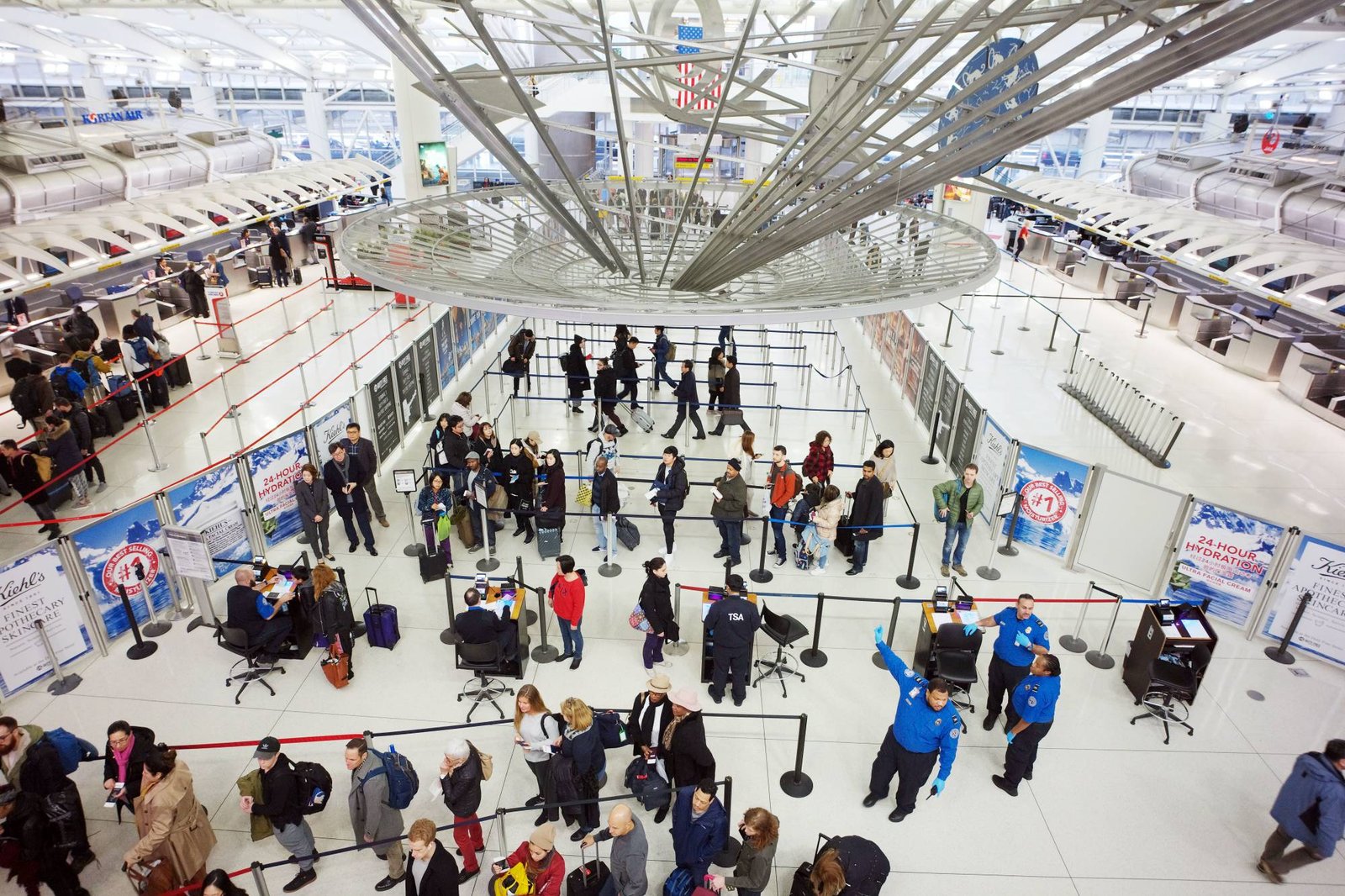
The Transportation Security Administration has quietly been pitching airports and industry on a privatization program that would represent a significant overhaul in how TSA’s private security screening program works today.
The concept, called “TSA GoldPlus,” would involve private contractors managing both the employees and the technology that screen airline passengers and luggage for banned items and other security threats. Meanwhile, TSA itself would provide “oversight” to ensure the systems meet federal security standards, according to briefing materials.
TSA has been briefing larger airports on the concept in recent months, according to multiple industry sources. That comes as the agency’s budget request suggests TSA is looking to expand privatization to only the smallest U.S. airports in the near term.
TSA has also been pitching the concept amid a Department of Homeland Security shutdown that forced approximately 47,000 transportation security officers to work unpaid for weeks.
A February 2026, TSA-branded briefing flier found at Orlando International Airport and shared with Federal News Network describes TSA GoldPlus as a “new public-private partnership aimed at modernizing aviation security at select airports across the country.”
“Long-term Screening Partnership Program contracts will redirect funds into investable partnerships where leading industry operators manage both technology and screening workforce,” the flier states. “Industry partners can manage equipment and introduce innovations, while travelers enjoy a smooth, predictable, and bespoke experience.”
Scott Robinson, a former TSA employee and founder of Against Giants Labor Advocates, shared the TSA GoldPlus flier and other program references. Robinson’s firm provides specialized representation and advocacy for TSA officers and DHS employees.
He noted that acting TSA Administrator Ha Nguyen McNeill has been asked about TSA’s privatization plans in Congressional hearings dating back to at least January, but neither she nor the agency have publicly disclosed the GoldPlus concept.
“TSA officers deserve to know what is being planned for their workforce,” Robinson said. “The record we assembled shows that significant decisions about the future of federal airport screening were being made in procurement documents and at industry conferences while officers worked without pay and Congress was not told the program existed. That raises legitimate oversight questions regardless of where one stands on privatization policy.”
TSA did not respond to a request for comment on this story.
During an April 16 House Appropriations homeland security subcommittee hearing, McNeill was asked about TSA’s privatization plan. She pointed to the Trump administration’s proposal to privatize smaller airports, but declined to provide further specifics, citing a forthcoming legislative proposal.
“In terms of the details, there is a legislative proposal that is being developed right now, and we’d be happy to come back and brief you once that proposal is submitted,” McNeill said.
Meanwhile, multiple industry sources confirmed they were familiar with TSA GoldPlus, but they said the outlook for the concept is unclear.
“We’re hoping TSA will provide additional information and details so airports can make informed decisions about whether to participate in the program,” one industry official said. “Right now, they don’t have enough background to know exactly what it is to make an informed decision about how they want to proceed.”
‘Accelerate innovation’
TSA has been contemplating the GoldPlus model dating back to at least September 2025, when the agency released a request for information on third-party testing equipment that references the concept.
“This testing will support current TSA acquisitions and new GoldPlus public-private screening mode acquisitions, enabling broader access to qualified technologies for both government and private operators,” the notice states.
TSA officials were also scheduled to present on GoldPlus at a recent airport conference in Chicago.
The concept would go beyond the privatization proposal in TSA’s fiscal 2027 budget request, which would expand the existing Screening Partnership Program (SPP) model to approximately 250 of the smallest commercial airports across the country. Just 20 airports use private screeners under SPP today.
Under the current SPP model, TSA-approved contractors employ screeners who also operate equipment approved by the agency.
“The real difference [with GoldPlus] would be with regard to the screening technology and how that is procured, deployed and maintained,” one industry official. “Even though it would be operated by the qualified screening provider under contract to TSA, it would be provided by either a third-party provider or a third-party provider in partnership with a [SPP] company.”
Meanwhile, the Trump administration has not been secretive about a broader desire to privatize TSA. The White House’s fiscal 2027 budget overview states that the SPP expansion “begins the process of privatizing” TSA’s airport screening.
Privatizing TSA is also a core goal of Project 2025, of which White House Office of Management and Budget Director Russell Vought is a primary author.
McNeill last year said “nothing is off the table” when asked about privatizing TSA operations. She previously served as TSA chief of staff during the first Trump administration. Before rejoining the agency last year, McNeill was an executive at BigBear.ai, which is among multiple firms that have been testing new artificial intelligence-driven airport screening technologies.
TSA has been pitching GoldPlus as a way to “accelerate innovation,” according to the Orlando briefing flier. TSA and industry have been experimenting with new passenger screening concepts, including off-premises remote screening technologies.
Last year, TSA sought industry feedback on technologies that could “reduce reliance on manual labor,” “incorporate AI-driven threat detection and remote screening,” and “improve passenger satisfaction,” according to the RFI.
TSA has also sold GoldPlus as a way to upgrade airport screening technology “without lengthy federal budget cycles,” according to the flier.
That comes as TSA’s schedule for replacing legacy screening technology with computed topography (CT) machines is projected to stretch out to the 2040s.
The GoldPlus flier, meanwhile, lays out an ambitious timeline that would see airports go from “pre-application” to “new screening operations” in less than one year. The program would “deliver advanced security technology and a superior checkpoint experience at little-to-no additional cost to airports or taxpayers,” TSA’s flier pledges.
But multiple industry officials said there is plenty of skepticism about whether TSA can deliver on the GoldPlus premise.
Keith Jeffries, vice president with K2 Security Screening Group and former TSA federal security director for Los Angeles International Airport, said he’ll be watching to see whether any large airports ultimately opt into pursuing the concept.
“I think there’s one airport that has shown interest. I don’t know how far down the path they are,” Jeffries said. “There are probably others that say, ‘Yeah, that sounds good.’ But many of the airports are saying, from what I’ve heard, ‘This all sounds too good to be true.’”
A complicated undertaking
The ongoing partial government shutdown has amplified longstanding calls to privatize TSA, with proponents arguing privatization would insulate airport screening from funding lapses.
But opponents argue privatization would lead to the same security concerns that led the creation of TSA in the first place. Congress created the agency to replace a patchwork of private airport screening operations across the country.
“I would not personally want to fly if I knew the whole entire system was privatized, because it’s just not safe for the American people,” Johnny Jones, the secretary-treasurer for the American Federation of Government Employees’ TSA Council 100, said during a press call in March. “Whenever you put profit before people and security, because that’s all privatization is – the bottom line is for profit.”
A former Department of Homeland Security official said “it’s no surprise” the Trump administration is aggressively moving to privatize TSA. In addition to quietly advancing the GoldPlus plan, DHS under former Homeland Security Secretary Kristi Noem has also sought to strip TSA airport screeners of their union rights. That directive is being challenged in federal court.
“They’ve been pretty clear about that from the beginning, that they thought that that was a better option, particularly under the previous secretary,” the former DHS official said. “They did a lot of talking about it. The fact that it hasn’t really manifested itself into a concrete plan or budget proposal points to the fact that it’s a fairly complicated undertaking to move in that direction from where we are today.”
The former official noted there could also be lingering concerns about a concept like GoldPlus creating another tangle of varying airport security systems.
“Do you really want it so that every airport has a slightly different approach?” the official said. “How are you going to impose standards across that and make it so it’s fairly uniform in terms of cybersecurity and management of a system like that?”
But Jeffries said aviation security officials have long discussed how TSA could deepen its relationship with the private sector to improve screening operations. He said GoldPlus is yet another concept aimed at pursuing that question.
“Could TSA learn some other things from private industry? There’s a strong argument. I’m not saying that they don’t already, but if they do, you don’t hear much about it,” Jeffries said. “With TSA obviously being out there for a long time now, where does the agency go from here? How can we make it better? How do we improve the customer experience?”
Copyright
© 2026 Federal News Network. All rights reserved. This website is not intended for users located within the European Economic Area.
