

When U.S. President Donald Trump and Chinese leader Xi Jinping meet in Beijing in mid-May, the visit will mark the next step in trying to steady the world’s most consequential relationship. The last time the two leaders met face-to-face, in South Korea late last year, Trump described the meeting as a convening of the “G-2.” It may have been just an offhand remark, but the reference—suggesting that Washington and Beijing would jointly set the terms of the regional and even global order—reverberated around the region. U.S. allies such as Australia and Japan immediately wondered whether Washington was abandoning them and granting Beijing greater influence.
In the past, neither China nor the United States embraced the G-2 label. U.S. officials balked at giving China symbolic parity, while Beijing suspected Washington was trying to get China to accept international burdens that it did not want to shoulder. But this time, whether intentional or not, Trump’s use of the term G-2 exposed an uncomfortable but increasingly unavoidable truth: in Asia, China and the United States must work together to provide stability even as they fiercely compete. Beijing and Washington must share greater responsibility for managing geopolitical risks, coordinating economic policy, and reducing the possibility of miscalculation and miscommunication around flashpoints such as the Taiwan Strait.
But the two countries need help. Their relationship is too unsteady and the breadth of the region’s challenges too large for China and the United States to ensure regional peace alone. An emerging G-2 must acknowledge the regional institutions that already play an important role in de-escalating conflict. The Association of Southeast Asian Nations and its related forums and summits have long helped blunt the sharper edges of great-power politics by diffusing influence, institutionalizing dialogue, and offering face-saving off-ramps during crises. Organizations such as ASEAN and its offshoots provide what a G-2 cannot: regional buy-in, an inclusive framework for managing tensions, and diplomatic practices that make restraint more durable.
An enduring peace in Asia is best served by combining U.S.-Chinese engagement with ASEAN’s diplomatic processes—what might be called a “G-2 Plus.” Such an arrangement would neither deny the reality of great-power competition nor assume that it can be resolved. Instead, it would channel the rivalry into existing multilateral institutions that have a track record of effectively facilitating dialogue and lowering the odds of conflict. In a region where nationalism is rising and geopolitical flashpoints are multiplying, such an approach would keep East Asia stable and calm.
KEEPING THE PEACE
In the immediate postwar period, Asia was the most dangerous place in the world. From the end of World War II to 1979, it accounted for roughly 80 percent of global battle deaths. Yet since then, the region has been notably peaceful. There has not been a major interstate war, despite rising military budgets and China’s growing clout. Today, Asia is far more peaceful than Europe and the Middle East, each of which is convulsed by ongoing wars.
This long peace rests on the region’s ability to contain three fundamental destabilizing forces: power, poverty, and distrust. As classical realists in international relations theory argue, states have an impulse to dominate others. In Asia, a balance of power between the U.S. alliance network and a rising China has constrained this impulse and generated a relatively stable equilibrium. At the same time, poverty and underdevelopment erode state capacity, fuel insurgencies, and introduce new sources of cross-border friction such as refugee flows and terrorism. But Japan’s industrial ascent powered regional growth from the 1970s onward, and China’s explosive economic rise and infrastructure investments through the Belt and Road Initiative have lifted millions out of poverty and better connected the region.
Distrust, however, is harder to manage. The anarchic nature of international politics, in which no overarching authority guarantees any country’s security, means that even defensive moves can be misinterpreted as offensive. This fuels classic security dilemmas in which one state’s efforts to improve its security can leave others feeling less secure, prompting reactions that increase the danger for everyone. Asia is vulnerable to these dynamics, particularly in the Taiwan Strait and the South China Sea, where signaling frequently blurs the line between deterrence and provocation.
ASEAN offers a politically acceptable space for U.S.-Chinese engagement.
ASEAN-centered multilateralism has played a quiet but crucial role in building trust across the region. Institutions such as the ASEAN Regional Forum and the East Asia Summit, which regularly bring together leaders from across the entire Indo-Pacific, provide venues to discuss mounting economic, political, and security challenges. They have cultivated a culture of dialogue and embedded confidence-building measures into the region’s diplomatic routines, which have helped manage, if not altogether resolve, the region’s most dangerous disputes.
Critics often deride ASEAN as ineffective because it has failed to solve many regional conflicts. Cambodia and Thailand, for instance, are once again engaged in deadly border clashes. But ASEAN’s true value lies in its ability to instill confidence in regional diplomacy and prevent tensions from hardening into conflict. Since its establishment, the so-called ASEAN way of dialogue, consultation, quiet diplomacy, and noninterference has helped member states overcome the deep mistrust that once earned Southeast Asia the moniker “the Balkans of Asia.”
ASEAN’s diplomatic culture of consultation, which requires reaching consensus on decision-making, has often been criticized as too slow, cautious, and rigid. Yet this same culture has enabled ASEAN to keep dialogue alive even when political conditions make meaningful cooperation difficult. This is evident in ASEAN’s ability to sustain channels of communication with regimes such as Myanmar’s military junta, which many outside powers are reluctant to work with. ASEAN’s disaster-management mechanisms, including a legally binding agreement on how to coordinate responses and offer emergency assistance, have also facilitated collective action after major humanitarian crises such as Typhoon Haiyan, which wreaked havoc in the Philippines in 2013. Such cooperation fosters trust, generates goodwill, and helps regional militaries operate together.
Paradoxically, ASEAN’s seeming weakness can also be one of its strengths. Because it poses no threat to either Beijing or Washington, ASEAN offers a politically acceptable space for engagement when bilateral ties are strained. Its value lies not in resolving great-power distrust but in preventing that distrust from hardening into diplomatic paralysis. By keeping channels open, especially at the moments when direct engagement becomes politically costly, ASEAN helps ensure that competition does not slip into confrontation.
NOT JUST THE TWO OF US
The forces that have kept East Asia peaceful for half a century are under real strain. A looming arms race between China and the United States threatens to unsettle the regional balance of power. U.S. semiconductor export controls and China’s countermeasures on critical minerals are already splitting supply chains, weakening the interdependence that has underwritten regional stability. And new security groupings, such as the trilateral pact between Australia, the United Kingdom, and the United States (AUKUS) and the revitalized Quad, comprising Australia, India, Japan, and the United States, have reassured some U.S. allies and partners but risk sidelining others—especially smaller states in Southeast Asia that increasingly worry that they will be forced to live with great-power bargains struck over their heads.
Embedding a G-2 within ASEAN-led processes offers a more viable alternative than leaving decision-making power to China and the United States alone or relying chiefly on new U.S.-centered groupings such as AUKUS or the Quad. A G-2 without other checks would be likely to invite resistance from U.S. allies and partners wary of great-power bargains, whereas working with ASEAN would reassure smaller states that they can play a role even if China and the United States must take the lead. Such an arrangement would also provide diplomatic cover for both Beijing and Washington, making coordination appear less like a great-power condominium and more like an inclusive mechanism for stabilizing the region.
A G-2 Plus would entail a framework for crisis management, economic coordination, and multilateral consultation that is anchored in sustained U.S.-Chinese engagement and ASEAN’s diplomatic processes. The logic behind it is straightforward. China and the United States would provide the capacity to control escalation and address major regional challenges, while ASEAN supplies the regional legitimacy and pressure to encourage Beijing and Washington to exercise strategic restraint. If the two great powers were to regularly meet in multilateral settings, it would clarify the signals they want to send to each other and the region, reduce the likelihood of misinterpretation that could spiral out of control, and create predictable pathways to follow to reduce tensions. ASEAN’s inclusive processes, which require consultation and broad regional buy-in, raise the political costs of escalation by subjecting unilateral moves to wider regional scrutiny, making it harder for either side to act without alienating the broader region.
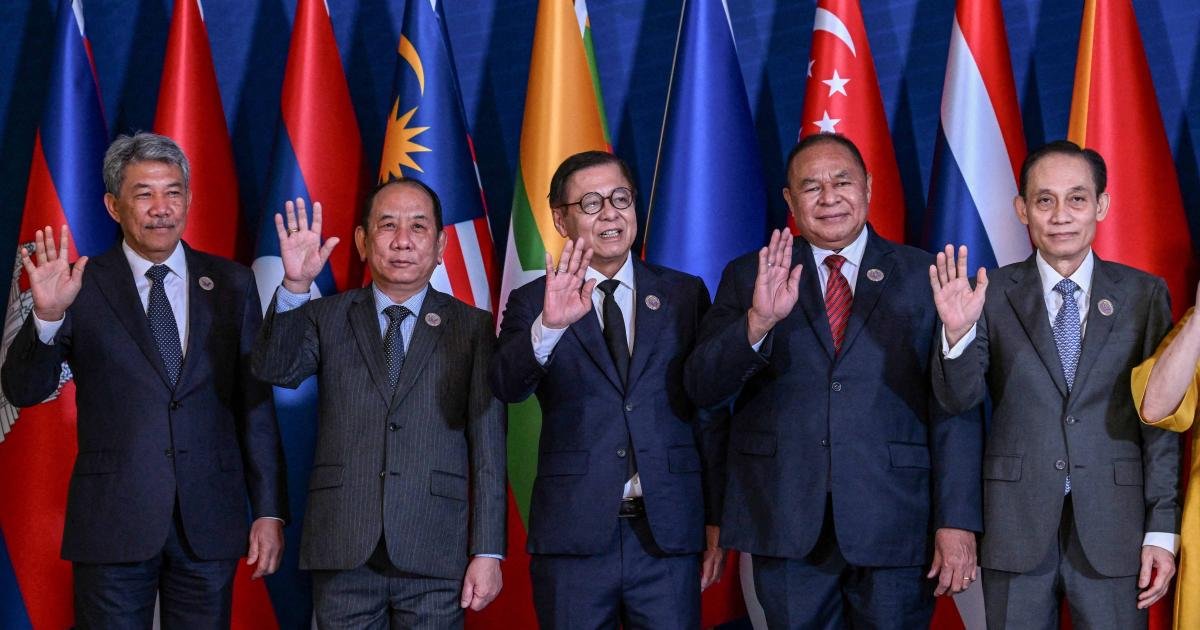
Chinese and U.S. officials could use ASEAN-led summits and ministerial meetings as standing venues for crisis coordination. ASEAN has already shown it can serve this function. At the height of the U.S.-Chinese trade war in 2025, for instance, the first face-to-face meeting between U.S. Secretary of State Marco Rubio and Chinese Foreign Minister Wang Yi took place on the sidelines of an ASEAN-led meeting. Singapore and other ASEAN capitals have also hosted numerous U.S.-Chinese Track 1.5 and Track 2 dialogues precisely because neither side wants to be seen as entering the other’s territory amid intensifying rivalry.
Involving ASEAN would also bring together more sources of support and encourage shared responsibility for providing regional public goods, including disaster relief and economic coordination to reduce supply chain disruptions. These are not symbolic gestures. Rather, they are practical ways to anchor the U.S.-Chinese rivalry in rules, routines, and expectations that would make restraint more sustainable.
UNHEATED RIVALRY
The competition between China and the United States is structural, not a matter of choice. It stems from a shifting balance of power, conflicting strategic interests, and mutual suspicions that no leader can simply wish away. But structural competition does not inevitably mean that one side wins and one side loses. The United States outlasted the Soviet Union in the Cold War, for example, yet Russia remains a disruptive power decades later. Trying to win the U.S.-Chinese rivalry outright, rather than manage it, could raise the likelihood of a military conflict.
A G-2 Plus arrangement would benefit both China and the United States. Washington would be able to compete with China without unnerving allies or appearing to abandon the region to great-power bargaining, while Beijing would be encouraged to take on a larger stabilizing role without having to persuade its neighbors that it seeks regional leadership, not hegemony. And a G-2 Plus could strengthen ASEAN itself. Making ASEAN-led forums the political setting for great-power coordination would reinforce the organization’s centrality, raise its diplomatic relevance, and give it a larger stake in shaping the region’s response to crises. In the long term, it could create a virtuous cycle: ASEAN would become more valuable precisely because the region’s two strongest states keep using it as a platform for managing tensions they cannot resolve alone.
China and the United States do not need to become partners, but they need to avoid becoming enemies in ways that drag the region down with them. The task is not to end the rivalry but to strictly manage it to prevent competition from escalating into military confrontation. Regional scrutiny and political guardrails could avoid competition that plays out only through arms races, coercive signaling, and exclusive blocs. Building on the existing strengths of ASEAN would be the best place to start.
Loading…
