

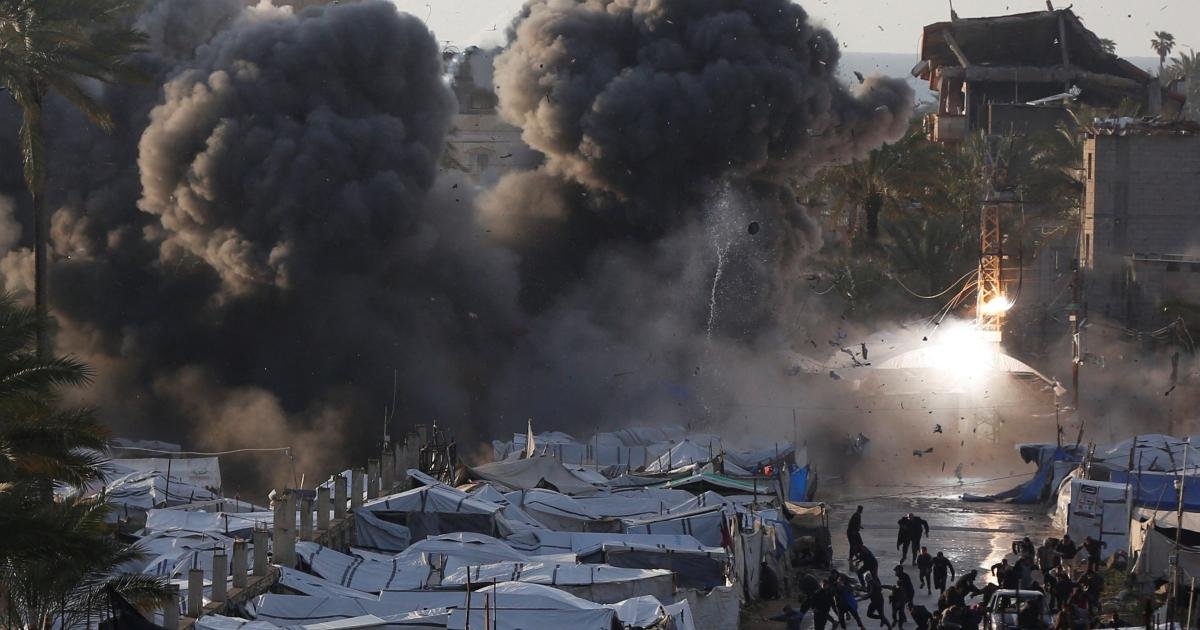
Rebuilding Gaza is one of the greatest city-making tasks in modern history—perhaps all history. Roughly 60 million tons of rubble bestrews an area as large as a midsize American city. Haaretz reported in July 2025 that over 70 percent of buildings have been leveled, a degree of destruction comparable to that in Dresden after its firebombing in World War II. And Gaza faces challenges that Dresden did not, including a festering, unresolved conflict and fragmented political authority.
These challenges have not stopped various governments and organizations from rolling out plans for rebuilding the enclave, and rightly so. As it stands, the Gaza Strip is borderline unlivable. But unfortunately, all the rebuilding proposals released thus far share the same fatal flaws: they were devised by central planners armed with abstract ideas about how best to organize the strip rather than informed by what Palestinians actually want and need.
Egyptian officials, for instance, put forth a master plan for the strip that is both sweeping and inflexible—with fixed “tourist villages,” places for “industrial craft,” and high-density residential areas, all divided into distinct zones. This top-down scheme, seemingly designed with minimal local input, is unlikely to be terribly helpful to the roughly two million Palestinians who live in Gaza now or to its future residents. Similarly, in January 2026, U.S. President Donald Trump’s son-in-law and part-time envoy, Jared Kushner, presented the broad outlines of a master plan to turn Gaza into both a tourist destination and a place where locals can thrive. But his proposal, like the Egyptian one, appears to be the product of people who do not live on the ground and don’t have to contend with the enclave’s actual conditions. Somewhat better was the “Phoenix Plan” put forward by a self-described “voluntary, interdisciplinary consortium” of Palestinian experts. It is centered more on Palestinian property rights, local identity, and community action. Yet it is still regulation-heavy, with a strong emphasis on preemptively designating zones for specific purposes. Moreover, the Phoenix Plan shows remarkable fidelity to European planning fads—with bike lanes and rail systems that make minimal sense in the Gaza Strip.
Instead of grand plans, what Gaza really needs to do is empower Palestinian landowners and regulate them as little as possible. Rather than expropriating land and deciding how it should be used, the enclave’s new governing authority should work to make sure displaced people get their land back (even if its structures have been destroyed), safeguard property owners from exploitation, and then essentially get out of the way. Palestinians should have the right to hold and rebuild on their land, sell it to developers, or pool it with their neighbors’ land to create bigger plots that they can use as they wish. Outside actors and central authorities should primarily provide technical and monetary assistance.
There are exceptions. Gaza’s new central authority (whatever it ends up being) will need to build public infrastructure. It should also create a special economic zone to draw in foreign investment with lower taxes, limited regulation, and heightened security. These tasks will require the strip’s governing entity to acquire some private land with eminent domain. But the previous owners must be justly compensated, and expropriation should be kept to an absolute minimum. In general, it is Gazans—not outside governments—who know best how to turn Gaza into a place that is more pleasant and livable. In other words, to ensure that the strip is rebuilt for the needs of Gazans, it must be rebuilt by Gazans.
HISTORY LESSONS
At the end of 1945, Tokyo lay in ruins. Allied forces had firebombed the city during the final two years of World War II, destroying over 250,000 of its buildings—about a fourth of the city’s total. Roughly one million people were homeless. The new Japanese governments faced few tasks as urgent as understanding how to rebuild the capital.
Initially, it opted to for a centralized approach. Ishikawa Hideaki, the head of planning of the Tokyo Metropolitan Government, developed what the historian Carola Hein has called “a plan for monofunctional towns containing 200,000 to 300,000 people, set apart by greenbelts (an inheritance from air defense planning during the war), and structured by a ring- and radial-shaped road network.” Hideaki’s plan aimed to replace the sprawling megacity with more manageable and serviceable planned subunits. In doing so, he assumed that the city had a permanent, optimal size and that residents should not be able to reshape it—much as an architect would approach designing a complex building.
But Hideaki’s initiative quickly ran into funding trouble and public opposition, forcing the state to back off. This fortuitously turned rebuilding into a grassroots initiative. The government oversaw some infrastructure improvements, but otherwise, individual landowners and the private sector were free to reconstruct as they wanted. Using a mix of self-funding and, eventually, government assistance (in the form of mortgages at long-term fixed interest rates), some residents and businesses re-created what they had lost whereas others used the devastation as an opportunity to build something new. Many residents, for example, took advantage of the country’s land readjustment system—a procedure by which people shift their property’s boundaries to combine lots or to obtain a better balance between land devoted to streets and land devoted to private property. The goal of the readjustment system was to consolidate plots with odd shapes into more buildable ones and to make lots more accessible. Japanese residents who went through readjustment used these new, reshaped lots to build stores, restaurants, and high-rises or sold the plots to developers who did so.
Ground-up rebuilding might help address some of Gaza’s deeper political issues.
This process proved remarkably effective. Because locals led the reconstruction, Tokyo’s new spaces reflected residents’ desires and knowledge, not the vision of distant bureaucrats. Its neighborhoods blossomed and evolved as the city’s needs shifted: Shinjuku, for example, became a bohemian playground in the 1960s and then a gleaming downtown with the world’s busiest rail station. Tokyo again became the economic heart of Japan. In fact, it became one of the most productive and beloved metropolises on the planet.
Gaza is unlikely to have the same miraculous trajectory. Unlike postwar Japan, the strip remains the site of military operations. A larger proportion of the population has been displaced, and its governance remains highly fractured, with zones of Hamas and Israeli control. Moreover, around 30 percent of private land in Gaza remains unregistered, making it difficult for authorities to establish rightful ownership. But Gaza can still learn much from Tokyo’s experience. Its leaders should make identifying and restoring property rights a top priority, and they should then adopt a Tokyo-style land readjustment system so that Palestinians can pool their property, much as the Japanese did. Such a system would need to be accompanied by rules designed to prevent abuse, including laws that require a supermajority of landowners to sign off on any proposed sale or redevelopment. The enclave will also need experienced land readjustment officers to oversee the process and help landowners understand markets. But these are solvable problems. Governing authorities, for example, might hire officers from places where readjustment is widely practiced. (The Indian state of Gujarat is full of experienced land readjustment staffers.) These officers could be either public employees or publicly licensed private professionals and be compensated by international entities. They would help train locals to eventually take their place.
Gaza, of course, will need a working governing entity to make the reconstruction process function. Creating one might ultimately be the biggest barrier to progress. But if it is fully implemented, Trump’s 20-point peace plan, approved by the UN Security Council last November, could be enough to facilitate grassroots reconstruction. Under Trump’s proposal, the enclave would be governed by a “technocratic, apolitical Palestinian committee” that would, in turn, be supervised by a “Board of Peace” made up of politicians from a variety of countries. The board could play an important role in building the strip by procuring financial resources for reconstruction, which the United Nations has estimated will cost roughly $70 billion. The technocratic committee, however, would do the bulk of the work: adjudicating land rights, helping private actors fund and manage construction, and, in some cases, overseeing private construction projects.
TAKE EXCEPTION
The rebuilding of Gaza should be controlled mostly by ordinary people, ideally with abundant financial support from outside donors. But public officials will need to be more actively involved in some areas. For instance, the process of clearing the mountains of rubble that currently blanket Gaza will have to be managed from the top down. Their task will be not just to move the rubble but also to find ways to repurpose it. Some of this debris, for example, could be used to make roadways and manufacturing facilities. It could also be used to erect seawalls that would protect Gaza’s beaches.
Gaza’s authorities will also need to take the lead in developing many public facilities—including arterial roads, hospitals, ports, and airports. Doing so will require the use of eminent domain, and part of the work of a new Palestinian governing entity will be determining how to use this authority in the least intrusive way. Independent land value assessment can help ensure that people who lose their land are justly compensated.
But Palestinian officials will want to deviate from bottom-up planning for another, less obvious initiative: the creation of a special economic zone—an area where business tax rates are lower, security is tighter, and regulations laxer than in the rest of the territory. These zones are often controversial among development experts because they can artificially nudge businesses and resources toward one part of a city to the detriment of others. But it makes sense to have such a zone in Gaza. To have a meaningful economic future, the enclave will need substantial foreign investment in firms and factories, and a special economic zone is the best—and perhaps the only—way to get it. Foreign investors will be highly reluctant to plow their money into Gaza if they fear that their assets will come under attack from armed groups or be destroyed in military operations. But Gaza’s government might be able to make sure that a small piece of land, perhaps at the enclave’s southern tip, is safe enough to invest in.
Palestinian officials will need to use eminent domain to create this zone. But they should keep the area’s physical footprint to a minimum. And officials should avoid trying to create other, designated neighborhoods. Officials should not, for example, attempt to establish any districts dedicated to shopping and dining, entertainment, or apartments. They should not, in other words, do what the Lebanese government did when rebuilding Beirut in the aftermath of the country’s civil war. Rather than let the city’s residents take the lead, Lebanon chartered a joint-stock company, called Solidere, that it tasked with controlling the process. Solidere then seized property from more than 120,000 people—about ten percent of Beirut’s population—and tried to turn much of the city into a fancy, pre-planned metropolis. (Instead of compensating them with cash, it gave them Solidere shares.) The company did succeed in constructing nice apartment buildings, upscale stores, and fancy restaurants. But these efforts ultimately helped tourists more than Beirut’s residents, and the company has been accused, in the words of a report by the International Centre for the Study of Radicalisation, of “exacerbating socio-economic divisions” and creating a “playground” for the “uber wealthy.”
By contrast, when India’s Kutch District was reconstructed after an earthquake in 2001, the process was largely community led, with financial assistance primarily dedicated to building new infrastructure such as surfacing roads, rebuilding water supply systems and sewers, and primary schools. Households could opt to relocate or rebuild in place. Land pooling developed block by block, and these blocks were connected with a top-down network of major streets that linked each neighborhood to a districtwide labor market. By 2003, about 900,000 houses had been repaired, and about 110,000 had been entirely rebuilt.
BUILD BACK BETTER
The path to rebuilding Gaza is not easy, and it will require far more than just good urban planning. But devastated places have managed to rebuild in the past, largely thanks to smart development policies. Their experiences show that when locals are empowered and central authorities step back, cities can not only re-create what they lost. They can build back better than before.
The same thing could happen in the Gaza Strip. In fact, a ground-up rebuilding effort in Gaza might even help address some of the enclave’s deeper political issues. Over the past 20 years, Palestinians have had to contend not just with Israeli occupation but also with increasingly undemocratic leadership. Palestinians, in both Gaza and the West Bank, have not had the chance to vote for their government in 20 years. Overcoming this internal state of affairs is as necessary for Palestinian self-determination as getting the Israelis out, and giving Gazans control over their own space would be a major step in the right direction. As the political theorist Alexis de Tocqueville observed long ago, a citizenry with property rights soon begins to demand—and defend—other rights. Space that the state cannot simply seize becomes space in which citizens can organize. Successful protest movements from across the world have long relied on private property to gain force; during South Korea’s struggle for democracy, for example, organizers were able to stage their famous, successful 1980 sit-in at Myeongdong Cathedral in Seoul because even South Korea’s authoritarian government was hesitant to trample on the property of the Catholic Church. The road to a freer and more successful Gaza, then, might just begin with giving its residents the right to the land on which their future will be built.
Loading…
