

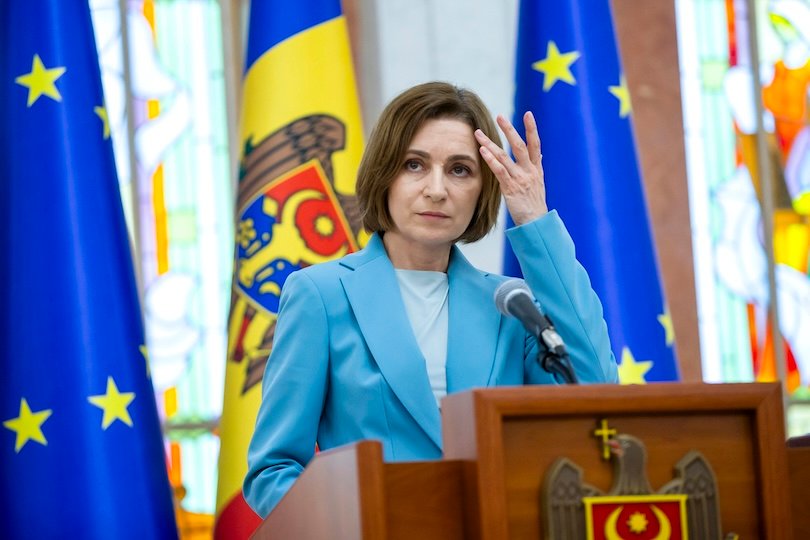
Resolving the Republic of Moldova’s separatist issue and joining the European Union are the primary objectives of President Maia Sandu and her administration. Yet, the war between Russia and Ukraine is a constant reminder for Chisinau that there are serious, ever-present day threats to the country’s stability. Russian drones, water pollution, and energy security are daily threats and concerns for the Moldovan population and government; these challenges could also delay Moldova’s preparations for European Union membership. While Moldova has not become a target of the hostilities, incidents continue to occur. Specifically, suspected Russian uncrewed aerial systems (UAS, commonly known as drones) and missiles have been detected flying through Moldovan airspace, while some drones have crashed on Moldovan territory – a reminder that the frontlines of the war are not far away.
While some threats come from above, others stem from being next to Ukraine. An alarming incident occurred in mid-April, when the Moldovan government declared an environmental emergency after the waters of the Dniester River (râului Nistru in Romanian) were polluted by a Russian attack on Ukraine’s Novodnistrovsk hydropower plant, which resulted in a major oil spill into the river. Moldova’s Parliament subsequently passed a resolution blaming Moscow for polluting the Dniester River.The damage at the Novodnistrovsk hydropower plant is not the first time in recent weeks that Russian attacks against Ukrainian infrastructure have affected Moldova: Russian attacks against Ukraine’s energy industries also affect electricity flows to neighboring Moldova. Recently, an attack against power plants in southern Ukraine damaged the 400 kV Vulcănești–Isaccea overhead power line, a main artery for electricity flow between the two states. This line can provide up to 60-70% of Moldova’s energy consumption (excluding separatist Transnistria), according to the Ministry of Energy. The attack forced Chisinau to declare a 60-day emergency in the energy sector.
While continuing to be linked to Ukraine via electricity arteries is necessary, Moldova also needs to invest in other energy sources as backups to reduce dependency. According to Moldova’s Ministry of Energy, by the end of October 2025, total installed capacity from renewable energy reached 932.81 MW, an increase of 353.41 MW from the end of 2024. Solar energy remains the primary green energy, but there are also strides in wind, biogas, and hydro power. To prevent new energy crises, more investment in green energy is necessary. (President Sandu recently declared that renewable energy production increased during her presidency from 4% to 21%).
Moldova has a complex relationship with energy security, another outstanding issue that must be resolved before joining the Union. After the war in Ukraine commenced, the Moldovan government managed to effectively cut its dependence on Russian gas. However, energy challenges persist, as Russia has stopped sending gas to the separatist Transnistria region – the industries in the separatist region converted the gas into electricity, which Chisinau bought at a low price. Buying electricity from Ukraine, Romania, and other suppliers helps diversification, but the higher prices are a challenge for a country like Moldova.In early 2025, the country suffered an energy crisis, and the situation remains complex today, with additional energy shocks in recent months, including around Easter. The war in Ukraine, the consequences of the conflict in the Strait of Hormuz, and the still low salaries Moldovans receive will likely contribute to future energy emergencies. The European Union has provided financial aid packages to help Moldova (and Ukraine) address energy challenges, but a new round of strategic thinking by Chisinau is necessary.
The other recent development, not a challenge but rather a noteworthy revelation, was the apparent leak of a Moldovan document titled “Basic approaches in the process of the gradual reintegration of the Transnistrian region.” The 14-page report appears to have been written by Chisinau as a proof-of-concept or idealized scenario rather than an actual new state strategy. The document was likely drafted by Chisinau for European diplomats rather than for local consumption (it is in English) and contains some noteworthy statements. In an analysis for the Carnegie Endowment’s Russia Eurasia Center, Vladimir Solovyov summarizes it by explaining “in some ways, it is a plan—most significantly in that it establishes the goal of peacefully reintegrating Transnistria and lists the steps Chișinău believes need to be taken”.
Regarding foreign policy, Moldova is generally well-positioned. The country recently formalized its withdrawal from the Commonwealth of Independent States; meanwhile, until the end of May, the European nation is the Council of Europe’s Committee of Ministers’ president. At home, challenges include reforming the judicial system, combating corruption, promoting economic and industrial development, and addressing the country’s brain drain. The leaked document is not a new strategy or blueprint, but rather an updated statement to reassure Brussels that Chisinau has plans to resolve the Transnistria issue so it does not become an EU problem (while not the focus of this analysis, the European Union has also engaged with separatist Transnistria, particularly via trade, to encourage them to resolve the issue).
At the same time, there are issues beyond Moldova’s direct control, specifically the Russian war in Ukraine. The Moldovan government has invested in a radar system to improve control of its airspace; however, air defenses are necessary to shoot down invading drones before they pose a threat to the Moldovan population. Moldova diplomatically supports Ukraine in the conflict (and has hosted tens of thousands of refugees), but Chisinau can also invest in improving its military for defensive purposes.
It is important to clarify that while Moldova’s constitution prevents it from joining a military alliance like NATO, the government can (and must) carry out defense procurement projects to upgrade the armed forces. The Moldovan military received in recent years a fleet of Piranha armored personnel carriers and also radars, but more upgrades are required, including an air defense system.As for the country’s recent energy crises (or one long, continuous crisis, depending on your point of view) are complex and will not be easily solved, given the country’s energy ties with Ukraine, the situation in Transnistria, and Moldova’s own budgetary constraints.
In sum, it is unclear whether EU governments will accept Moldova if it does not have full control over its territory, particularly since the separatist region is deeply connected to, and supported by, Moscow.
