

For decades, scholars and politicians have marveled at the fact that democracies do not fight one another. “The absence of war between democracies comes as close as anything we have to an empirical law in international relations,” wrote the political scientist Jack Levy in 1988. “Democracies don’t attack each other. They make better trading partners and partners in diplomacy,” U.S. President Bill Clinton declared in 1994. “There are no clear-cut cases of one democracy going to war against another,” the political scientist Michael Doyle wrote in 2024, “nor do any seem forthcoming.”
The lack of war among the world’s many democracies is, indeed, impressive. But it is not the first time a group of like-minded countries have been at peace for an extended time period. From 1598 to 1894, most of East Asia—China, Japan, Korea, the Ryukyu Kingdom (now part of Japan), and Vietnam—was largely devoid of internal fighting. According to research we recently published in The Journal of Conflict Resolution, these states fought one another only 22 times over this 300-year era—or just four percent of the nearly 200 wars and conflicts they engaged in over the course of that period. And the key to this peace, we argue, was a shared ideology: Confucianism. China, Japan, Korea, Ryukyu, and Vietnam were all Confucian states, and so they had a joint political philosophy that emphasized harmony and made it easy for them to engage in diplomacy. They established an interconnected system of regional governance centered on China, the most powerful state, that helped ensure security and prosperity. They also traded frequently.
The democratic peace has much in common with the Confucian peace. The world’s liberal states speak a shared political language that emphasizes cooperation, making diplomacy easier. They have institutions that bring them together and manage conflict, centered, again, on a single country (in this case, the United States). Like the Confucian states, democratic states have strong trade linkages.
The era of democratic peace might be reaching its terminus. Public faith in the value of the liberal international order and democratic ideals appears to be waning. The United States is squabbling with its partners to an extent not seen in at least a century. But the fact that both Confucianism and democracy yielded eras of stability is, ultimately, good news for humanity. It suggests that multiple kinds of ideologies can produce harmony and counteract a temptation to rely on a realpolitik approach. If today’s great powers can find a new shared ethic, they might be able to overcome their substantial differences and keep the peace.
PEACE AND HARMONY
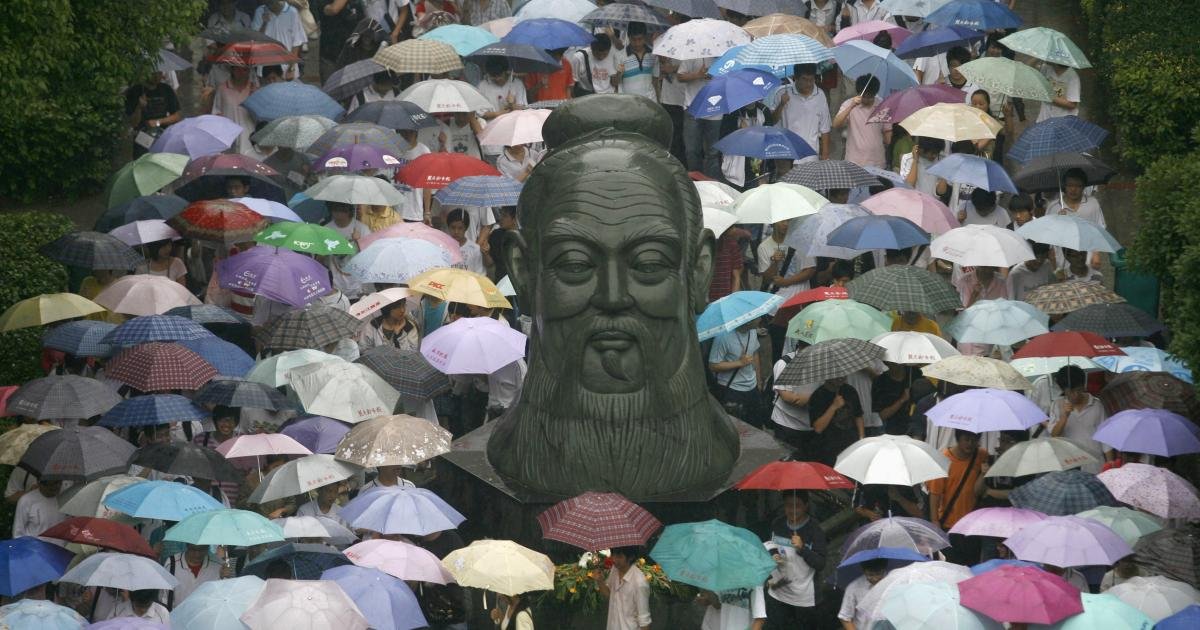
Confucianism may be relatively unknown to most modern Americans and Europeans. But it is an old and influential philosophy. Named for Confucius, a Chinese scholar who lived from 551 to 479 BC, it argues that societies should have a hierarchical social order with a ruler-subject relationship that mirrors the dynamic between fathers and sons. Politicians schooled in Confucian thought over the ensuing centuries were thus told that they had the right to govern their people. Subjects, in turn, were told to exhibit respect, obedience, and care for their leaders.
But Confucius also demanded that leaders be virtuous and promote harmony or risk losing the mandate of heaven—the divine right to rule. His followers thus emphasized benevolence (ren) and virtue (de) over self-interest and aggression. As a result, the spread of Confucian thinking from China to Japan, Korea, the Ryukyu Kingdom, and Vietnam helped produce an era of peace. Elites across these countries were educated in Confucian classics, read and wrote the same language, and conversed with one another across borders. Importantly, they were all recognized as Confucian by their peers. This mutual recognition granted them membership in a wider regional order. Qing China, Joseon Korea, and Tokugawa Japan, for example, all shared a Confucian moral universe in which war between culturally kindred states carried a particular stigma. Each of these courts saw conflict among them as not merely destructive but as a moral and governing failure.
The Confucian commitment to hierarchy also fostered stability. Rather than ruthlessly compete to lead the region, Korea, the Ryukyu Kingdom, Vietnam, and even Japan embraced the centrality of China. Beijing was the richest and most powerful government in the neighborhood, and so it was treated with deference by nearby Confucian states—the father in their father-son relationship. In 1712, for example, a Qing surveyor made an error that could have doubled the size of Korea’s territory and started a war between China and Korea. But Korean officials, bound by the Confucian logic of deference, quietly corrected the mistake themselves rather than exploit it, choosing not to trouble the Chinese emperor with what they described as a “trivial” matter.
The democratic peace has much in common with the Confucian peace.
Confucian values did not always stop conflict. China and Vietnam, for example, fought from 1788 to 1789, when the Qing dynasty invaded the latter country to restore a deposed Vietnamese leader to the throne. The Qing lost. But just one year later, they formally recognized the victorious Vietnamese ruler as king, and Vietnam’s tributary relationship resumed. This offered Vietnam diplomatic legitimacy and access to trade.
Likewise, Japan’s 1624 withdrawal from the Chinese-led order—prompted by the Tokugawa Shogunate’s desire to establish its own tributary system—did not yield a protracted conflict. Neither China’s Ming nor Qing dynasties recognized this system; they also rejected Japan’s pretentions to equality. But the Confucian system, underpinned by its emphasis on face-saving and harmony, proved flexible enough to accommodate both countries. The Edo government was still able to indirectly trade with China and others. The only Confucian entity Japan attacked during this period was the Ryukyu Kingdom, which was attacked by Japanese warlords, not the Edo government directly. And even after the Ryukyu Kingdom was turned into a Japanese tributary, it retained tight political connections to China’s dynasties, to the point where both China and Japan could claim a degree of control over the kingdom. This system of dual sovereignty—where Ryukyu was a tribute to two countries—was so valuable in terms of trade and peace that Japanese leaders instructed their own officials to deny that Japan exercised suzerainty over Ryukyu whenever Chinese officials came to make inspections. The Chinese were not fooled, but they accepted the situation to ensure a peaceable and lucrative relationship with the Japanese.
Japan used a similar kind of ambiguity to manage relations with Korea. Korean officials made multiple diplomatic missions to the Tokugawa shogunate, which, to Japan, indicated that Korea had become its tribute. The Koreans, by contrast, saw them as exchanges between equals. Each side, in other words, interpreted the encounters in ways that suited their own interest, which avoided conflict.
Japan, of course, did eventually go to war with almost all its neighbors. But that came after the Confucian system was cracked open by outside interventions. During the eighteenth and nineteenth centuries, expansionist Western empires became more willing to make war to establish trade and territorial concessions inside East Asia, putting the Confucian system under enormous strain. China, Korea, and Vietnam held fast to the Confucian system and resisted making changes to the order, refusing regular diplomatic exchange and trade with outside powers until it was forced upon them. Japan, however, opted to defect from the system altogether. It abandoned Confucian practices and adopted Western models of governance. It became increasingly belligerent and eventually turned into a colonial power itself. At the end of the nineteenth century, it invaded and seized Taiwan. Soon, it took control of other parts of China’s empire, followed by Korea and Vietnam. The Confucian peace, carefully crafted over centuries, was finished.
AGREE TO DISAGREE
The 50 years that followed the Confucian peace were extraordinarily turbulent. The globe saw increased fighting both within its various regions and among them, culminating in two world wars. But since the second of those wars, parts of the planet have experienced another era of tranquility, this time driven by democracy.
The values of liberal democracy are, of course, very different from those of Confucianism. But they are also effective at promoting comity. Liberal democracies generally value compromise, cooperation, and human rights, and so they have built institutions designed to manage disputes peacefully. As European states democratized during the twentieth and twenty-first centuries, for example, they integrated their economies and polities, eventually creating the European Union. The body has remarkable power over its members, to the point where violent conflict among them is almost unthinkable. Disputes that once would have prompted war between European countries are now adjudicated by EU courts, the European Parliament, and the European Commission.
As with the Confucian peace, the democratic peace also features a hegemon: Washington. It is widely recognized by democracies in Asia, Europe, and North America as the central provider of security and prosperity. It has worked to create multilateral institutions that anchor these states to it and that keep them all at peace with one another. The United States, for example, established the North Atlantic Treaty Organization, whose 32 members have all committed to defend one other in the event of attack. It is the world’s premier military alliance, as it affords members enormous security. As a result, countries have clamored to join—just as they signed up to be part of the Confucian Chinese-led order.
There are limits to the democratic peace. Its participants, for example, are not exactly peaceful toward nondemocracies. Checks and balances and open debate can make it harder to initiate wars, but the United States, especially, has had no compunctions about attacking and invading autocracies, most recently Iran and Venezuela. Yet this, too, is in line with the Confucian peace. During the order’s 300-year history, Confucian states went to war with Europeans, tribes along state peripheries, and steppe peoples with vigor.
Since the end of World War II, parts of the planet have experienced another era of peace.
The democratic peace is not entirely like the Confucian peace. It is based on nominal equality. Its members generally do not forcefully intervene directly in the domestic affairs of other democracies—although there have been clear exceptions, including U.S. Vice President J.D. Vance’s recent trip to Hungary to support Prime Minister Viktor Orbán in his failed reelection bid. The two eras might also end differently. The Confucian peace was broken up by the incursion of European countries. The democratic peace, meanwhile, might fracture because of the authoritarian rulers rising within it. U.S. President Donald Trump, for instance, has threatened to pull Washington out of NATO, which could lead to its collapse. Many European populists, following the example of the United Kingdom, have spoken of breaking away from the EU.
Still, the parallels are clear, and they make it apparent that ideologies can, indeed, produce peace. If a value system promotes harmony, and if it is shared by a number of states, those countries can build institutions and establish practices that let them manage differences. The most powerful member-states could provide security.
As China rises in the international arena, these lessons are worth appreciating. China and the United States are very different countries with distinct ideologies and political systems, and so they may not be able to find any shared set of ethics. But if the two countries can find some philosophical common ground, they could be able to foster a more durable peace. At their forthcoming summit, for example, Trump and Chinese President Xi Jinping could agree to something as simple as an endorsement that war among great powers should be avoided at all costs. Such a commitment would not do away with the U.S.-Chinese contest. But it could be the start of a shared basis of understanding that reduces the possibility of conflict.
Loading…
