

A US$3 billion finance facility, a warship keel-laying and a new AUKUS shipbuilding hub landed in the same fortnight, one of the clearest signs yet that Canberra wants to build, fund and commercialise its own defence technology rather than simply buy it.
On 28 August 2026, the Australian government stood up a new A$4.2 billion (approximately US$3 billion) Defence Industry Growth Facility, administered by Export Finance Australia through the national interest account.
The facility offers loans, bonds, guarantees and equity – not grants – to Australian defence businesses chasing three things: export growth, factory expansion and development of new capabilities that align with defence priorities.
Finance facility
Minister for Trade and Tourism Don Farrell said, “The Defence Industry Growth Facility responds to the needs of our defence sector,” framing it as a way to help local firms “thrive in international markets while delivering sovereign defence capabilities at home”.
Minister for Defence Industry Pat Conroy went further, calling sovereign capability “essential for our nation’s security”.
The facility replaces the 2018-era Defence Export Facility, a roughly A$3.8 billion scheme that backed real, if modest, wins. Examples included an A$90 million loan that let radar-maker CEA Technologies build a Canberra manufacturing plant and create around 200 jobs, and finance that helped Austal land an A$80 million patrol boat order from Trinidad and Tobago.
The new version widens that mechanism, adding domestic-capability projects and equity finance to what had been an exports-only tool and, crucially, is designed to “crowd in” private capital rather than replace it, since commercial banks are often wary of defence sector compliance risk.
Shipbuilding
The facility landed in the same week as two other milestones. The government confirmed the Henderson defence precinct in Western Australia as its preferred site for continuous naval shipbuilding and for sustaining Australia’s future, conventionally armed, nuclear-powered submarines under AUKUS. Canberra backed the site with an initial commitment reported at around A$12 billion and a projected 10,000 direct jobs over two decades.
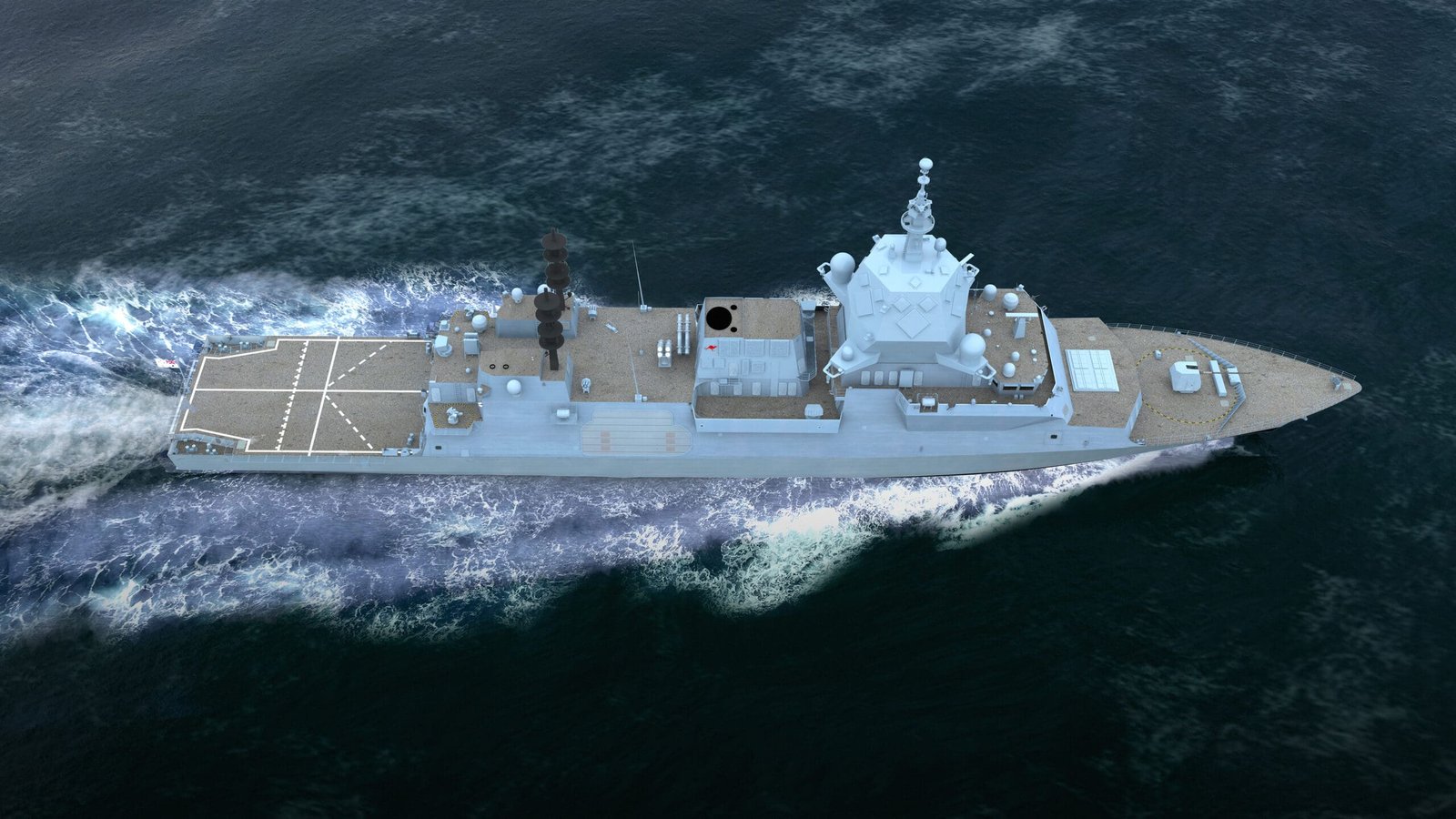
Days earlier, on 24 August, shipbuilders at Osborne Naval Shipyard in South Australia laid the keel of the future HMAS Hunter, the first of six frigates. More than 2,500 people now work at Osborne building these Hunter-class warships.
These announcements sit inside a much larger frame: the 2026 National Defence Strategy (NDS) and its companion Integrated Investment Program (IIP) released on 16 April 2026. The strategy commits roughly A$425 billion over the coming decade, with cumulative defence spending projected to reach A$887 billion by 2033-34. This represents a target of 3% of gross domestic product (GDP).
Funding is split roughly 41% on maritime, 22% on enterprise and enabling, 17% on land, 14% on air, 5% on cyber and 2% on space. It also flagged a new medium-range air defence programme as a 2026 priority.

The AUKUS submarine programme remains Australia’s largest-ever defence undertaking, estimated at A$268-368 billion over 30 years. This year alone brought an A$3.9 billion investment to begin full-scale construction of the AUKUS submarine construction yard at Osborne in February, followed by a further A$4.6 billion expansion in July, taking the total Osborne commitment to A$8.5 billion so far.
In May, Australia, the UK and the USA agreed a deployment framework for US Navy Virginia-class submarines in Western Australia, and streamlined Australia’s own path to acquiring three Virginia-class boats.
Separately, under Project Sea 3000, Australia signed contracts in April 2026 with Japan and Mitsubishi Heavy Industries for three Upgraded Mogami-class general-purpose frigates. As Japan’s largest-ever defence export, this is the first step towards eleven new frigates, with the IIP earmarking up to A$20 billion for the programme.
People and pipelines
Money and steel are only half the story, for the other half is people and pipelines. The 2026 Defence Industry Development Strategy focuses on workforce growth, extending the Defence Industry Internship Program with more than A$17 million in funding, and investing nearly A$30 million to expand the Schools Pathway Program.
The more structural bet, though, is Defence Trailblazer, a research initiative established in December 2022 and led by the University of Adelaide with UNSW Sydney. It is backed by an A$50 million government grant matched by university and industry funds totalling more than A$240 million. Its brief spans three areas: autonomous systems; advanced technologies such as quantum, cyber and hypersonics; and workforce development.
Its scorecard is substantial: more than A$140 million in co-investment from 200+ industry partners, 277 collaborative research projects, 87 start-ups and scale-ups supported through prototyping and commercialisation, and more than 800 students and professionals upskilled. Economic consultancy ACIL Allen estimates the programme will add A$875 million to GDP, and support 1,000 new jobs over the next two decades.
Defence Trailblazer concludes in December 2026, with its legacy handed to the Australian Defence Industry Incubator (AUSDII). This is a not-for-profit modelled on international counterparts such as the US Defensewerx, NATO’s DIANA and Ukraine’s Brave1. It has been built to keep validating and scaling early-stage Australian defence and dual-use companies once the university-led programme winds down.

One example shows how that translation pipeline is already working with industry. Lockheed Martin Australia’s Advanced Systems & Technologies facility – the company’s first and most advanced multidisciplinary research and development (R&D) site outside the USA – runs a Southern Shield strategy that coordinates a national R&D effort to demonstrate and de-risk advanced capabilities called for in the NDS.
Six Trailblazer-linked projects under that banner target hypersonics and space sensing technology. Dr. Tony Lindsay, the facility’s director, said, “The Southern Shield R&D strategy is designed to provide a core innovation system that can be applied to multiple programmes required to achieve the vision of Australia’s future integrated force.”
Dr. Sanjay Mazumdar, Executive Director of Defence Trailblazer, called it proof that the initiative’s R&D and workforce portfolios are already delivering “momentum for advanced hypersonics and space sensing technologies” through an integrated-systems approach.
Taken together, the growth facility, Henderson, the Hunter keel-laying and the Trailblazer-to-AUSDII handover mark a shift from strategy documents to money moving and steel being cut.
The open question is whether Australia can scale a genuinely sovereign defence R&D and manufacturing base – talent, start-ups and shipyards alike – quickly enough to meet its own 2033 targets.
by Gordon Feller
