

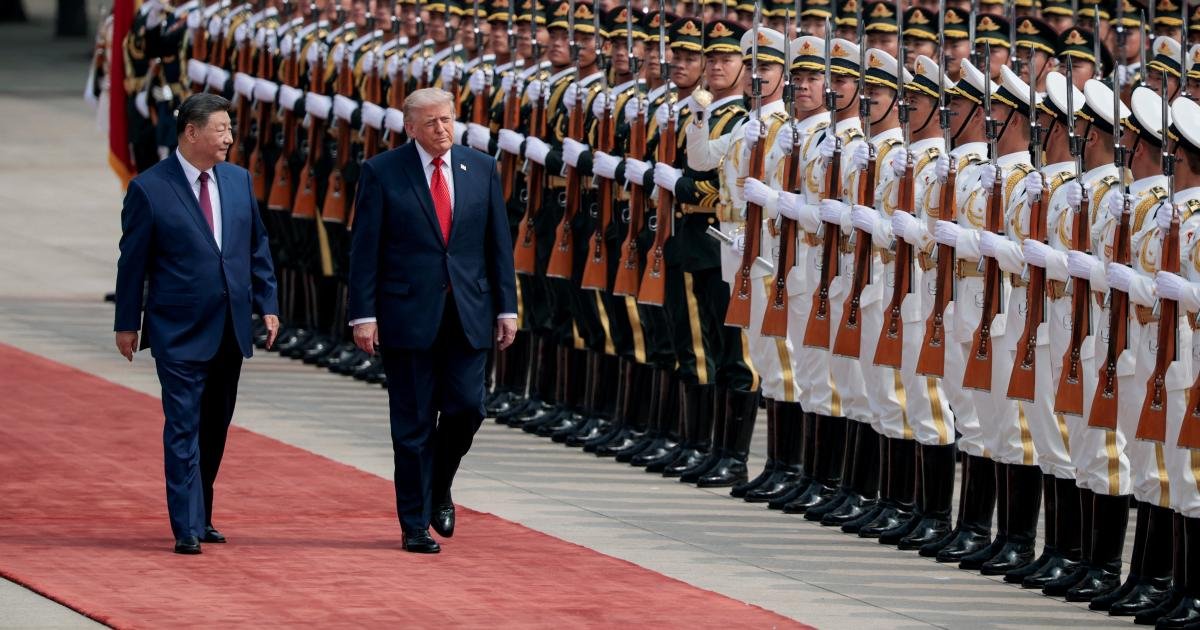
When Chinese leader Xi Jinping and U.S. President Donald Trump met in Beijing, in May, they agreed that their two countries should build a constructive relationship of strategic stability. Although many observers in Washington responded skeptically to this new framework, dismissing it as empty words, it marks the first time in more than a decade that China and the United States established a consensus about how to define the relationship that leaders on both sides broadly recognize. Strategic stability does not refer to nuclear détente; rather, it suggests a new equilibrium in which both sides can avoid further deterioration of the relationship and even expand cooperation where interests align.
Leaders in Beijing do not expect that this new framework can resolve most of the differences between China and the United States or that it can stop new frictions from emerging. In June, for example, the U.S. Department of Defense placed more Chinese companies—including private-sector giants Alibaba, Baidu, and BYD—on its list of firms involved in civil-military fusion activities, barring the Pentagon from contracting with them. In retaliation, China placed ten U.S. entities on its dual-use export control list, which prevents any company from supplying them with items that have the potential for both military and civilian use. But Beijing hopes that a consensus built around strategic stability can help China and the United States manage their differences more effectively and that it will prevent the worst outcomes: military conflict or a new cold war. So far, ongoing friction has not derailed the overarching consensus established in May. By keeping sanctions and countermeasures relatively limited, Beijing and Washington have avoided dangerous escalation and kept the relationship moving forward.
The goal of the new diplomatic framework between Beijing and Washington is a pragmatic one. It aims to build a floor under U.S.-Chinese relations rather than try to achieve an unlikely grand bargain that would resolve all conflict. It also represents a changing approach in Beijing to dealing with the United States. Unlike in the past, when China rejected U.S. frameworks focused on competition, it is now willing to recognize that the fundamental nature of U.S.-Chinese relations is competitive. Allies or partners, after all, would not set strategic stability as the overarching goal of their relationship; only competitors, or even adversaries, need to do so. Beijing’s willingness to accept a formulation to manage, rather than exclude, competition shows that it is gaining confidence and seeing itself more as an equal to Washington. Adopting this confident mindset could lead China to act with more restraint in its dealings with the United States—which could in turn bring a further degree of calm to the relationship.
It now appears plausible that bilateral relations have turned a corner and entered a more stable phase. Although fundamental challenges remain that could cause new turbulence, the peak tensions of the past eight years may well be receding. The upcoming leaders’ summit in late September, when Xi and Trump are scheduled to meet in Washington, is a chance to further move the relationship forward. The two leaders can now add more concrete measures to support this new framework of strategic stability, including taking steps to reduce economic friction, increase military-to-military communications, improve crisis management mechanisms, expand citizen exchanges, and offer reassurances about Taiwan, thereby defusing tensions that could escalate into potentially catastrophic military conflict. With Xi and Trump likely to meet again multiple times in the next few months, the new framework is the first chance in years to lay the groundwork for enduring stability in bilateral ties.
BEYOND STRATEGIC COMPETITION
For a long time, leaders in both Beijing and Washington sought to define the bilateral relationship in terms of some kind of partnership. In 1997, when Chinese leader Jiang Zemin visited the United States, Beijing and Washington announced aims of “a constructive strategic partnership oriented toward the twenty-first century.” In 2005, the George W. Bush administration urged China “to become a responsible stakeholder” in the international system; Chinese leader Hu Jintao responded in 2006 that the two countries were not only stakeholders but “should also be constructive partners.” But between 2009, when President Barack Obama and Hu agreed to “steadily grow a partnership” to address common challenges, and the Trump-Xi summit earlier this year, the countries’ leaders were unable to reach a new consensus on how to position the relationship.
The United States moved away from seeing the relationship as a partnership earlier than China did. During Trump’s first term, the United States began to define U.S.-Chinese relations in terms of “strategic competition.” At first, China tried to accept the competitive element in bilateral relations. Beijing acknowledged that some competition was inevitable while hoping that the relationship could remain positive overall. But as U.S.-Chinese relations deteriorated sharply in the final year of Trump’s first term and continued to worsen into the Biden administration, Beijing began to see “strategic competition” as a narrative designed to foreclose China’s rise. It felt that the U.S. approach threatened its development prospects, leading Beijing to push back more forcefully against the concept. In July 2022, during a phone call with President Joe Biden, Xi told his counterpart that it was a mistake to make competition the defining feature of the relationship.
To policymakers and analysts in China, the framework of strategic competition turned all U.S.-Chinese interactions into something akin to the Cold War competition between the United States and the Soviet Union. They saw the United States’ actions such as export controls on semiconductors as concrete manifestations that the United States was trying to suppress China, to undercut its political system, and to constrain its development. Although official statements from Washington discussed bilateral ties in terms of cooperation, competition, and confrontation, in practice competition and confrontation snuffed out any potential for cooperation.
After almost a decade in which China rejected and criticized strategic competition, transitioning to a relationship of constructive strategic stability reflects Beijing’s recalibrated assessment of both countries’ positions and roles in the international system, as well as the new realities of U.S.-Chinese relations. China is looking at bilateral relations from a position of greater equality and with more confidence, and it is less anxious that competition will undermine its national development prospects. Instead, Beijing believes that competition can be effectively managed without presenting an existential threat.
MORE THAN ONE MAN
Whether strategic stability succeeds as the basis of a new phase in U.S.-Chinese relations depends on whether it is rooted in the personal wills and agendas of Trump and Xi or it arises from structural forces that are more powerful than any individual leader. Many observers in both Beijing and Washington view the emerging consensus as a contingent result of the interests of the two men currently in charge. Trump, for instance, has taken it upon himself to change the direction of U.S. policy. His unexpected turn toward embracing a more stable relationship with China coincides with other unexpected turns in his second-term agenda, including adopting a cold and even hostile attitude toward European allies and launching a war against Iran despite frequently decrying U.S. military involvement overseas.
But these shifts also obscure more durable structural factors in the U.S.-Chinese relationship that have pushed the two countries toward more stability, and which make it more likely that the new diplomatic framework can survive. The current rapprochement is the fourth time in the past eight years that a period of tension between China and the United States has given way to an announcement of some kind of stable state.
Ongoing friction has not derailed the consensus established in May.
After China and the United States first aggressively confronted each other on trade and technology, culminating in the trade war in 2018, the two countries reached the Phase One trade agreement, in January 2020, which stabilized ties. The COVID-19 pandemic, which broke out soon afterward, severely inflamed tensions, sending the relationship to its lowest point since before U.S. President Richard Nixon first visited China, in 1972. In November 2022, Biden and Xi met in Bali and announced that they wanted to restabilize U.S.-Chinese relations, but just months later, in February 2023, recriminations over a Chinese object floating over the United States—described by Beijing as a civilian meteorological airship and by Washington as a spy balloon—interrupted such efforts. That November, Biden and Xi smoothed over ties for a third time at their San Francisco summit. This set the tenor of relations until April 2025, when Trump’s so-called Liberation Day tariffs spawned a new trade war. Across this period, the United States went through three different presidential terms under both Democratic and Republican administrations, yet U.S.-Chinese relations repeatedly swung back to a stable state.
Structural factors independent of any individual leader’s views encourage stability in the relationship. This includes the prohibitive cost of total economic decoupling and the catastrophic consequences of potential military conflict. Put differently, since the beginning of Trump’s second term, it has become clear to both sides that the bilateral relationship is simply too big to fail. The two sides occupy such important positions in global and international affairs, each with enough power to cause enormous damage, that neither wants to see the other become an enemy. The intense clashes between China and the United States over tariffs and rare earths in 2025 revealed that each side could exploit the other’s vulnerabilities, reminding them both that the two countries are highly interdependent and need to act prudently in an economic confrontation. Moreover, as nuclear powers, Beijing and Washington are aware that they cannot afford the prospect of a steadily deteriorating relationship that increases the risk of military conflict.
If U.S.-Chinese relations again become more volatile after the next U.S. president takes office, it will test the resilience of the relationship. Yet the structural forces at play are unlikely to have changed. Even if future American leaders announce a new approach to the U.S.-Chinese relationship, therefore, in the end it is likely that they will come to the same realizations as their predecessors and seek stability.
TANGLED UP IN RED
Other critics argue that the consensus on strategic stability is, at most, a temporary truce. In their view, both sides will use this time to shore up their weaknesses, seek new sources of leverage, and prepare for a future confrontation. The United States could find alternate suppliers for the rare-earth elements it needs, for instance, and China could find new sources of semiconductors or develop its own advanced chips.
But despite intense trade and geopolitical frictions, global supply chains have proved more resilient—and more deeply intertwined—than most observers anticipated. U.S. restrictions on Chinese technology have fragmented global supply chains, but they have not severed them. Attempts to route production away from China have merely dispersed Chinese enterprises across a wider array of countries and partners while retaining their irreplaceable role in most supply chains. In 2023, for instance, as the Biden administration sought to limit U.S. battery supply chains’ reliance on China, Chinese firms such as CATL actually expanded their market share by increasing production and supply networks in Asia and Europe, and CATL licensed its technology to Ford to produce batteries on U.S. soil. Even if China and the United States patch up their vulnerabilities in chips and rare earths, respectively, the two countries’ broader connections ensure that other areas of interdependence will remain.
The rapid development of technologies such as artificial intelligence will make it particularly difficult for either the United States or China to eliminate the other’s sources of leverage. New technologies create new vulnerabilities. With the possibility of artificial general intelligence on the horizon, the frictions in the U.S.-Chinese relationship are unlikely to be concentrated in the same fields and to manifest themselves in the same ways as today. The likelihood of either China or the United States creating what Chinese martial arts novels call an “iron shirt”—a training regimen that makes someone impervious to blades and bullets—is very low. As both countries acquire more powerful, faster, and less predictable technological capabilities, what is needed to preserve stability is likely to change. Attempts by either side to achieve an overwhelming advantage or to ensure absolute security could instead heighten the other’s insecurity and intensify bilateral competition, ultimately forcing both countries to accept some mutual vulnerability and a different strategic equilibrium. The two countries are already realizing that they will have to manage the enormous challenges that AI presents, especially safety risks, whether through joint action or parallel efforts.
U.S.-Chinese relations have stabilized four times over the past eight years; this also means that, viewed from the opposite perspective, the relationship has repeatedly devolved into confrontation. With each successive clash producing renewed grievances and hostility, a palpable fatigue has set in on both sides. Lowering their ambitions to the limited goal of stability makes it possible to dampen volatility, achieve tangible progress, and work with the reality of interdependence in more productive ways.
THE EAST IS RISING
One of the most significant changes underlying the acceptance of strategic stability is China’s growing confidence. When the first Trump administration began pushing for more decoupling, in 2018, many Chinese policymakers and citizens alike worried that escalating tensions with the United States would harm China’s progress and end the prospect of China developing into a stronger and wealthier country. In contemporary China, development is linked to openness: the more international cooperation there is, the faster technological development proceeds. The United States’ embrace of strategic competition challenged this basic premise. The outbreak of the COVID-19 pandemic and the war in Ukraine, which further drove countries apart and into blocs, made decision-makers and ordinary citizens worry even more.
But after eight years of on-and-off trade and technology wars with the United States, China’s economic fundamentals have remained stable. Real estate markets are struggling and traditional industries are mired in distress, but high-tech industries have advanced by leaps and bounds and the manufacturing sector, particularly advanced manufacturing, has become stronger. China’s inability to obtain semiconductors from the United States has forced it to strengthen its own chip industry. The mainstream view in China now is that U.S. government restrictions on high-tech sectors have forced China onto a better path toward more self-reliance and innovation, rendering Washington’s containment policies ineffective and ultimately counterproductive.
Structural factors have pushed the two countries toward more stability.
China’s successes are mounting. In early 2025, the Chinese firm DeepSeek released a large language model that achieved near-parity with U.S. frontier AI models at a fraction of the cost. In April of that year, China successfully retaliated against Trump’s tariffs, forcing Washington back to the negotiating table. In those negotiations and later talks, China’s rare-earth dominance gave the country a chokepoint over U.S. supply chains. These episodes have increased China’s confidence and made its policymakers and strategists less worried about discussing competition as part of China’s relationship with the United States.
Western commentators often believe that a confident China will become more assertive. The opposite is true. When China’s leaders believe that they can manage their external environment and that the country’s core interests and development prospects are not threatened, they are more willing to show restraint, engage in consultation, and focus on solving problems at home. In the 1990s and the first decade of the twenty-first century, for example, as China’s economy grew rapidly, it shelved disputes in the South China Sea with its neighbors. It was only after the Obama administration’s “pivot to Asia,” when Beijing felt that the United States was uniting countries in the region against China, that it adopted a tougher approach to resolving disputes in the South China Sea.
In 2026, a more confident China did not exploit the difficulties that the United States faced in the war with Iran, but instead quietly promoted peace talks behind the scenes. Likewise, now that China is less worried that the United States has either the intention or the ability to block China’s development prospects, it is more willing to accept a bounded competition with the United States. From a position of confidence, Beijing can engage the United States pragmatically on an issue-by-issue basis, looking to find specific policies to manage an inevitable amount of competition.
A NEW BALLAST
The fundamental requirement of the new framework of strategic stability is maintaining peace. That requires that the Chinese and U.S. militaries establish more mature measures for crisis avoidance, crisis management, and confidence building. The two sides can reduce the likelihood of conflict at low cost by setting up regularized military-to-military exchanges and fleshing out and expanding existing maritime and air encounter protocols. They can also coordinate on issues related to outer space, such as preventing near-earth-orbit collisions, regulating space traffic, and building trust around their respective strategic intentions. Addressing concerns in more politically sensitive domains, such as nuclear weapons and the military application of artificial intelligence, will require a more gradual approach. Although the Trump administration has shown heightened interest in discussing nuclear arms control with China, Beijing believes that formal negotiations are premature because of the vast disparity between U.S. and Chinese nuclear capabilities.
Progress does not need to be confined to top leaders. More exchanges at all levels between China and the United States are another low-cost way of solidifying a framework of strategic stability. The United States and China could increase opportunities for engagement by easing visa restrictions and reviewing and reducing sanctions, removing entry or exit bans, and limiting other travel restrictions on institutions and citizens, as well as allowing more of the other side’s news media to operate there. Trump could take the opportunity to explicitly remind Chinese students that they are welcome to study in the United States, and Beijing could formulate clearer policies to guide scholars and students about the boundaries of acceptable research in China and guarantee openness, safety, and academic freedom for any scholarship falling outside those boundaries.
Taiwan remains a dangerous flash point that could set back progress toward a relationship of strategic stability. Taiwan is the only issue that could trigger a deliberate military conflict between China and the United States, and pressure is increasing. Continued rule of the island by the more pro-independence Democratic Progressive Party, combined with Beijing’s strong desire to advance national unification and uncertainty about what kind of Taiwan policy the United States is going to pursue, has inflamed tensions on all sides. A new equilibrium can emerge only through an arrangement in which no party is completely satisfied yet each can live with the result.
The goal is to build a floor under U.S.-Chinese relations.
As long as Beijing believes that cross-strait integration remains achievable, it has no reason to resort to military force. The United States could shift its declared policy to align more closely with Beijing by recognizing Chinese sovereignty over Taiwan or by explicitly opposing Taiwan’s independence, which would reassure Beijing that the prospect of peaceful unification remains viable. This would allow China and the United States to reach a consensus that realizes the U.S. objective of a peaceful resolution to the dispute yet also maintains the ability of the people in Taiwan to preserve their political and social systems. By keeping the prospect of peaceful unification alive, the core concerns of all three parties can be accommodated as much as possible.
Washington’s decision to pause $14 billion in arms sales to Taiwan, reached during Trump’s May summit with Xi, defused a rapidly escalating flash point in U.S.-Chinese relations. But it presents a new challenge to the nascent framework of strategic stability. Although Beijing certainly welcomed the delay, the pause has also raised expectations for future U.S. policy regarding Taiwan. Should the Trump administration eventually resume arms transfers—an outcome deemed likely by most Washington observers—Beijing will fiercely oppose the move, potentially jeopardizing the strategic stability framework. This scenario represents a concrete and salient threat that both countries must manage in the period ahead.
A relationship of strategic stability is not a concept that one side imposed on the other or that will benefit Beijing but hurt Washington. It is the result of joint efforts by both countries, which makes it a rare opportunity. The next step is to build out this basic framework, breathe life into it, and make it sustainable. The September summit and additional scheduled leaders’ meetings this year offer a timely window of opportunity to make further small steps toward solidifying this baseline of stability. Some believe that this goal is too modest. But if two major powers such as China and the United States can keep fluctuations in the relationship within a manageable range and avoid any kind of war, it would be far more than a modest achievement.
Loading…
