

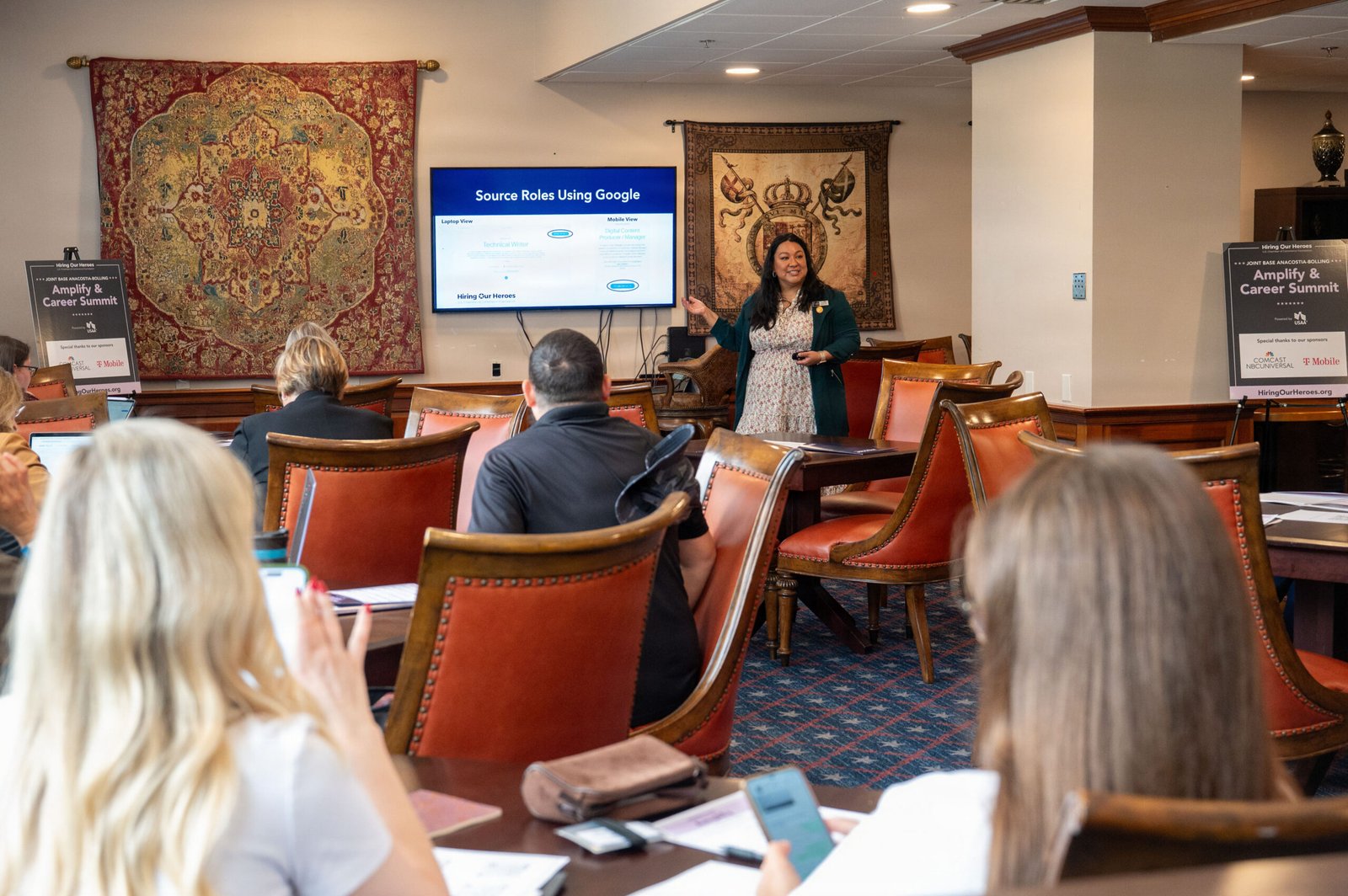
New Air Force, Pentagon, and White House initiatives are taking a new swing at an issue that has long frustrated military families: barriers to spouse employment.
Unemployment and underemployment have plagued military spouses for years, with the unemployment rate among military spouses holding steady at around 20 percent—despite initiatives to promote spouse preferences for hiring on base, support for remote work, and advocacy for making professional licenses more portable across state borders.
Improving spouses employment is not a “charitable initiative,” but a major retention and readiness incentive, argued Lyndsey Akers, a consultant with AFA’s United Forces & Families program.
“When military spouses have greater access to meaningful and sustainable careers, we strengthen the economic stability of military families,” Akers said at AFA’s Air, Space & Cyber conference last week. “We support the conditions that enable continued service, and we connect employers with an experienced, adaptable, and often overlooked talent pool.”
Top-down interest from the White House’s new Military Spouse Commission is driving renewed interest in the topic.
Deputy Assistant Secretary of Defense for Military Community and Family Policy Stephen Simmons said at the conference that the nation “has admired” the problem for too long; but “we haven’t done enough about it, and to get an issue the attention it needs, usually, first off, you have to elevate.”
Cindy Wilsbach, wife of Air Force Chief of Staff Gen. Kenneth S. Wilsbach and a senior writer for presidential correspondence at the White House employee, said the new commission President Donald Trump’s interest.
“It was marching orders from the leader of the free world to say, ‘We see the military spouse family and we recognize there are some longstanding generational problems that we need to get after,’” Cindy Wilsbach said during a panel discussion.
Both Wilsbachs are members of the commission, as are all the service chiefs, their spouses, and their senior enlisted advisors, and their spouses, including:
- Chief of Space Operations Gen. Douglas A. Schiess and his wife Debbie Schiess
- Chief Master Sergeant of the Air Force David Wolfe and his wife, Dr. Doniel Wolfe
- Chief Master Sergeant of the Space Force John F. Bentivegna and his wife Cathy Bentivegna
“With the four spouses here going to be involved with the Military Spouse Commission, we’ve got an opportunity to make some real change to laws that prevent us from hiring people fast enough and putting people into jobs and places and moving positions around,” said CMSAF David Wolfe during a panel discussion.
Cindy Wilsbach said the commission won’t try to reinvent efforts already underway but instead “will add to the work that’s being done,” while raising the profile of the issue to give advocates access to the President and other high-level decision-makers.
Photo by Jud McCrehin, Air & Space Forces Association
Global Military Spouse Connection
One program that’s newly in place and starting to grow is the Air Force’s Global Military Spouse Connection, which started in June as a pilot program for just a few installations.
Officials say the program is meant to serve as a “bridge” between Active-Duty military spouses who have PCSed to a new location and local hiring managers.
“Using career field administrators, GMSC creates a structured, active pipeline to connect the military spouse talent pool with employment opportunities,” according to an Air Force release.
“We are assisting hiring managers in finding the best-qualified individual,” said career field administrator Wyteeshia McRoberts, in a statement. “We’re not contacting them to do favors. We are looking at resumes, seeing what they qualify for and making recommendations for the right jobs.”
CMSAF Wolfe highlighted the program in his Sept. 14 keynote address to the conference, noting how the program “went from idea to first action in only 60 days,” and promising rapid expansion. On Sept. 22, the Air Force announced the program was already available for spouses moving to the following locations:
- Luke Air Force Base, Ariz.
- Goodfellow Air Force Base, Texas
- Laughlin Air Force Base, Texas
- Mountain Home Air Force Base, Idaho
- Travis Air Force Base, Calif.
- Patrick Space Force Base, Fla.
- Ramstein Air Base, Germany
- RAF Croughton, U.K.
- RAF Mildenhall, U.K.
- RAF Lakenheath, U.K.
- RAF Feltwell, U.K.
- Kadena Air Base, Japan
SpouseWorks
While the Department of the Air Force has launched the new connection program, the Office of the Secretary of Defense is focused on better publicizing the programs it already has, said Simmons.
Until recently, spouses looking for Pentagon help to land jobs, scholarships, or fellowships were on their own navigating a confusing sea of acronyms: SECO, MyCAA, MSEP.
SECO stood for Spouse Education and Career Opportunities, but wasn’t visible enough to leaders or community members, Simmons said. So his team rebranded to “SpouseWorks” and changed the organization. Before, the program “was buried in one of our directorships through no fault of their own,” Simmons said. “But in my mind, … it needed to report directly to me, so we turned it from a sub-office to a directorship.”
Other programs were folded in, so that now there are also SpouseWorks Fellowship and SpouseWorks Scholarship programs. “We’re trying to make it very simple and easy to use.”
SpouseWorks offers training, education, and professional development; career coaches; and a job board. Simmons said the goal is to be a one-stop shop for military spouses and a resource for employers seeking high-quality employees.
Early returns are promising. “We’re up well over 50 to 80 percent usage year over year,” he said. “And we’re only about halfway through the first year of the SpouseWorks rebrand.”
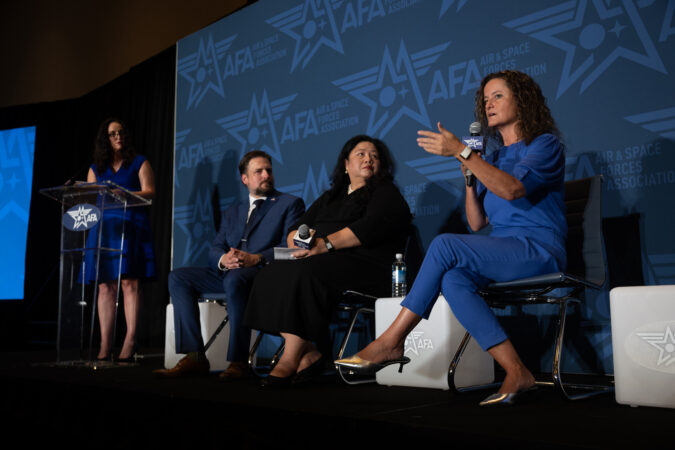
Photo by Craig Hudson, for Air & Space Forces Association
Challenges Remain
Headwinds continue, however. “I wish we could say that we had a lot of consistency, but what happens is with every change of leadership, somebody has a bright idea and then a great program goes away,” said Sue Luangkhot Hoppin, president of the National Military Spouse Network. “We don’t dot the Is and cross the Ts and we don’t necessarily solidify the programs before we move on to the next one.”
Lack of consistency from base to base, due to different commanders’ priorities, is also a challenge, he said. Elevating the issue to department leaders can raise the profile and relieve operational commanders of an extra burden.
One policy change that had unintended consequences for families was the widespread rollback of remote work options for federal civilians. Because of frequent PCS moves, remote work is an ideal option for many military spouses. “Remote work is a lifeline for a lot of military spouses,” Luangkhot Hoppin said. “It allows them to work even if they have childcare issues. But if they have to go back to the office, all of a sudden they need to have access to affordable child care, and that’s become an issue.”
Liz O’Brien, senior vice president at the U.S. Chamber of Commerce Foundation, argued that remote work is only a piece of the equation, noting that during the COVID-19 pandemic, when remote work options surged, spouse unemployment stayed stubbornly high. Childcare is one of the biggest barriers to better spouse employment, O’Brien, Luangkhot Hoppin, and Simmons agreed. Simmons sees an “intrinsic relationship” between the two; without ready and available childcare, many spouses can’t work. If they have to wait months for childcare openings to materialize, their window for employment can begin to close down.
Simmons said the Pentagon is working multiple fronts to reduce the wait times for childcare, both through expanded capacity at its Child Development Centers as well as through partnerships with the Armed Forces YMCA, private industry, and support for informal childcare support.
“Year over year … our childcare wait lists are down 25 percent, which is phenomenal,” Simmons said. And the tie to spouse employment is clear. “As a result, you see that wait list drop, you also see the spouse employment drop.”
