

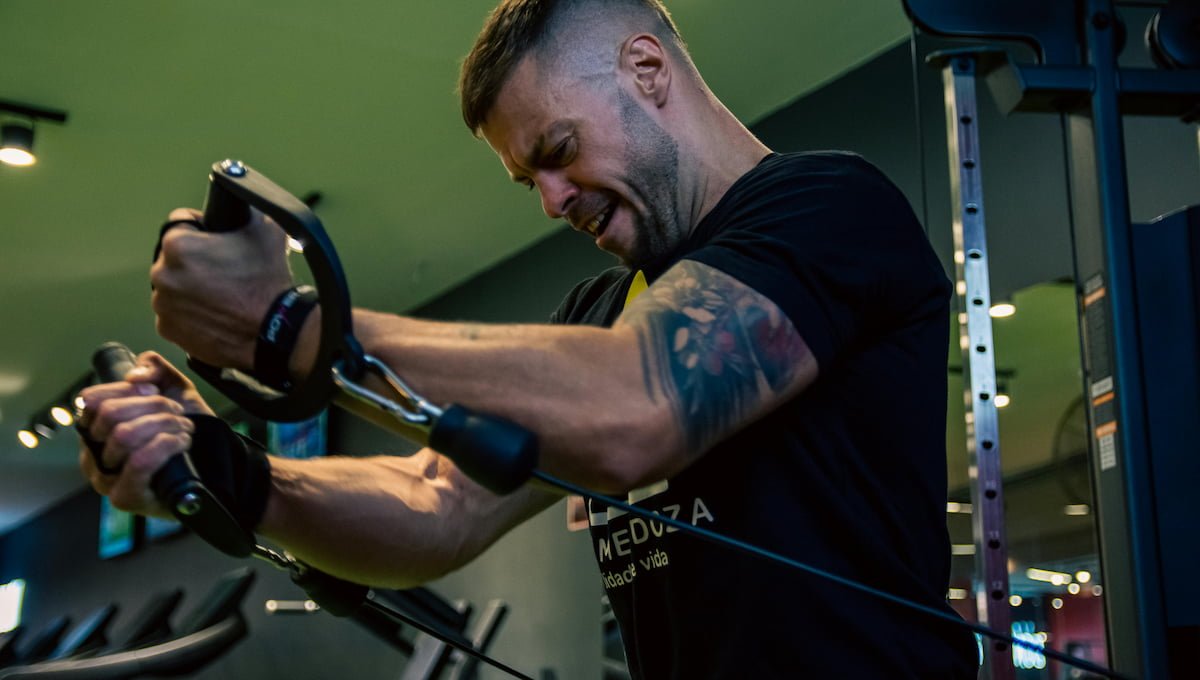
Cable exercises can be a great addition to the rest of your chest training.
They offer continuous resistance throughout the entire range of motion and an effective option for hitting your pecs in new ways after your initial barbell and dumbbell work.
The Biomechanics of Pectoral Growth
Building a thick, well defined chest is all about stressing the pectoralis major.
This fan shaped muscle originates along your sternum, collarbone, and upper ribs, converging into a single strong tendon that attaches to the humerus bone of the upper arm. The primary anatomical actions of the pectoralis major are horizontal adduction, internal rotation, and flexion of the shoulder joint.
To maximize muscle protein synthesis and trigger localized growth, resistance exercises must force the humerus to move inward toward the center of the trunk against dynamic opposition.
For beginners, stabilizing heavy dumbbells while maintaining strict form presents a significant neuromuscular challenge. Cable systems supply guided paths of motion that reduce the stabilizing burden on secondary joint structures. By targeting specific fiber orientations across the sternal and clavicular heads, cables offer you a highly efficient way to train for rapid strength adaptations and physical muscle gains.
| Training Resistance Type | Dynamic Resistance Direction | Peak Tension Position | Stabilizer Fatigue Risk |
| Standard Free Weights | Strictly Vertical (Downward Gravity) | Bottom Stretched Range | Moderate to High |
| Cable Pulley Systems | Variable (Follows Cable Path) | Continuous Throughout Entire Movement | Low to Moderate |
| Fixed Resistance Machines | Guided Axis Path | Fixed Machine Profile | Very Low |
Exercise 1: Standing Low to High Cable Fly
The standing low to high cable fly specifically targets the clavicular head of the pectoralis major, commonly referred to as the upper chest. To perform this exercise correctly, set the cable pulleys to their lowest position near the floor.
Take a firm grip on the handles, step forward into a strong staggered stance to create initial tension, and keep your palms facing forward or slightly upward. Drive your arms upward and inward in a sweeping motion, bringing the handles together near eye level while maintaining a soft, fixed bend in the elbows.
Clavicular head muscle fibers run diagonally from the collarbone down across the chest to attach to the upper arm. Muscle activation studies show that shoulder flexion combined with horizontal adduction aligns perfectly with the diagonal orientation of upper chest fibers. Traditional incline dumbbell presses hit this area well, but they frequently overload the anterior deltoids if the incline angle is set too high. Low to high cable flies isolate upper pectoral fibers with surgical precision by establishing a force vector that directly mirrors muscle fiber direction.
Maintaining torso stability during this movement is critical for preventing lower back compensation. Beginners often make the mistake of leaning backward to swing the weight upward, which changes the angle of pull and diminishes upper chest activation. Squeezing the glutes, bracing the core, and keeping the chest proud throughout the entire set guarantees that mechanical tension remains firmly focused on the target muscle groups.
Exercise 2: Standing High to Low Cable Fly
The standing high to low cable fly targets the lower costal and abdominal heads of the pectoralis major. To execute this movement, set the cable pulleys to their highest position on the dual cable towers. Grasp the handles, step forward into a stable split stance to anchor your body, and start with your hands wide in line with the high pulley vector. Sweep your arms downward and inward toward your lower hips, driving your hands together in a smooth arching motion over your lower torso.
Costal and sternal muscle fibers sweep downward from the humerus toward the lower sternum and upper abdominal sheath. Directing resistance from a high anchor downward across the torso creates maximum alignment with these lower pectoral fibers. Doing high to low flies from a standing position engages your core and stabilizer muscles while ensuring the lower chest performs the totality of the work against an uninterrupted load profile.
Proper execution requires keeping the elbows locked in a slightly flexed position throughout the entire movement. Allowing your elbows to bend and extend turns the fly into an inefficient triceps exercise, shifting tension away from the lower chest. Beginners should focus on controlled eccentric movements, taking three seconds to allow the cables to pull the arms back up toward the high pulleys before smoothly contracting the lower chest to bring the handles together.
Exercise 3: The Cable Fly on Bench
While standing fly variations offer fantastic freedom of movement, placing a flat bench between the cable stacks allows for maximum localized isolation of the sternal head. Position a flat bench right between two low to mid level cable pulleys, lie flat on your back with your feet firmly planted on the floor, and grip the handles with your arms extended wide to the sides with a gentle bend in the elbows. Pull the cables upward and inward toward the midline of your chest, squeezing your pectoral muscles tightly as your hands converge directly over your sternum.
Biomechanical analyses confirm that bench supported fly movements isolate the chest by removing the triceps brachii from the movement chain and eliminating body sway, placing the full workload directly on pectoral fibers. Standard flat dumbbell flies overstretch the anterior shoulder capsule at the bottom while dropping resistance to zero at the top peak contraction. The cable fly on a bench maintains strict horizontal resistance across every single inch of movement. Crossing your hands slightly over one another at the terminal end of the rep allows for even higher peak contraction, engaging inner sternal fibers that traditional dumbbells simply fail to reach.
The rigid bench support allows beginner lifters to push closer to muscular failure without worrying about losing balance. Beginners should maintain contact between their head and upper back against the bench padding, keep their wrists neutral, and execute reps with absolute control to maximize local mechanical stress.
| Exercise Name | Target Pectoral Region | Primary Movement Execution | Stance or Support Type |
| Standing Low to High Cable Fly | Clavicular Head (Upper Chest) | Upward and Inward Sweep | Standing Staggered Stance |
| Standing High to Low Cable Fly | Costal Head (Lower Chest) | Downward and Inward Sweep | Standing Split Stance |
| Cable Fly on Bench | Sternal Head (Mid Chest) | Pure Horizontal Adduction | Flat Bench Support |
Programming and Progression Strategy
Integrating these three cable exercises into a beginner hypertrophy routine requires a structured approach to volume, intensity, and progressive overload. Beginners adapt rapidly to training stimuli, meaning that high quality reps and proper exercise mechanics matter far more than sheer weight on the stack. Hypertrophy research demonstrates that performing between eight and twelve repetitions per set with moderate loads optimizes both mechanical tension and metabolic stress, creating the ideal recipe for localized muscle growth.

A beginner chest program should be performed twice per week, allowing at least forty-eight hours of recovery between sessions to maximize muscle protein synthesis. Rest periods between sets should range from ninety seconds to two minutes, providing enough recovery time for ATP restoration without losing muscular pump. Tracking performance markers such as load, repetitions, and execution quality ensures continuous adaptation over time.
3 Huge Benefits of EZ Bar Curls for Beginners that Want Bigger Biceps
Progressive overload does not always mean adding another plate to the cable stack every week. For beginners, progress can mean improving movement control, slowing down the eccentric phase, or achieving a stronger peak contraction at full extension. Master the movement mechanics first, and the physical muscle tissue growth will naturally follow.
| Program Variable | Beginner Guideline | Rationale |
| Weekly Frequency | 2 Sessions per Week | Maximizes protein synthesis cycles |
| Repetition Range | 8 to 12 Reps per Set | Balances tension and metabolic stress |
| Set Volume | 3 Sets per Exercise | Delivers sufficient hypertrophy stimulus |
| Rest Interval | 90 to 120 Seconds | Allows optimal energy system recovery |
| Eccentric Tempo | 2 to 3 Seconds | Increases time under tension safely |
Key Takeaways
| Metric or Focus Area | Essential Takeaway |
| Continuous Tension Benefit | Cables provide uninterrupted resistance across the entire range of motion, unlike gravity bound dumbbells. |
| Upper Chest Activation | Perform the standing low to high cable fly to target the clavicular pectoral fibers. |
| Lower Chest Activation | Perform the standing high to low cable fly to align resistance with the lower costal fibers. |
| Mid Chest Isolation | Perform the cable fly on a bench to eliminate body sway and maximize sternal contraction. |
| Ideal Training Volume | Execute 3 sets of 8 to 12 repetitions per exercise twice weekly for maximum beginner hypertrophy. |
Bibliography
- Akagi, R., Tohdoh, Y., Hirayama, K. and Takahashi, H., 2014. Relationship between pectoralis major muscle size and bench press 1RM total load in trained young men. Journal of Strength and Conditioning Research, 28(6), pp.1651-1658.
- Campos, G.E., Luecke, T.J., Wendeln, H.K., Toma, K., Hagerman, F.C., Murray, T.F., Ragg, K.E., Ratamess, N.A., Kraemer, W.J. and Staron, R.S., 2002. Muscular adaptations in response to three different resistance-training regimens: specificity of repetition maximum training zones. European Journal of Applied Physiology, 88(1-2), pp.50-60.
- Coratella, G., Tornatore, G., Longo, S., Esposito, F. and Cè, E., 2020. Specific pectoralis major heads activation during different chest press exercises. Journal of Human Kinetics, 75(1), pp.49-56.
- Rodriguez-Ridao, D., Alvarez-Barbany, J.R., Raya-Gonzalez, J., Muvic, I. and Villa-Vicente, J.G., 2020. Effect of chest press inclination on electromyographic activity of pectoralis major and anterior deltoid. International Journal of Environmental Research and Public Health, 17(6), p.1982.
- Schanke, W., Mikesky, A., Conner, S. and Wallace, J.P., 2012. Electromyographic analysis of chest exercises for pectoral muscle recruitment. Medicine and Science in Sports and Exercise, 44(5), p.344.
- Schoenfeld, B.J., 2010. The mechanisms of muscle hypertrophy and their application to resistance training. Journal of Strength and Conditioning Research, 24(10), pp.2857-2872.
- Schoenfeld, B.J., Ogborn, D. and Krieger, J.W., 2017. Dose-response relationship between weekly resistance training volume and increases in muscle mass: A systematic review and meta-analysis. Journal of Sports Sciences, 35(11), pp.1073-1082.
- Welsch, E.A., Bird, M. and Mayhew, J.L., 2005. Electromyographic activity of the pectoralis major and anterior deltoid muscles during three upper-body exercises. Journal of Strength and Conditioning Research, 19(2), pp.449-452.
