


After having been part of the German Empire, hence the presence of a German small arms facility part of the Mauser company, in 1920 Gdansk became a free city. Soon after later the Polish Government decided to move that facility, and in 1923 the construction of a new factory started in Radom, some 50 km south of Warsaw
The production of parts for the Polish state rifle factory started in1925, therefore last year the company celebrated its 100th anniversary, after having changed several names and having produced arms for different customers, including the Wehrmacht during World War II and the Warsaw Pact from the 1950s to the late 1980s. And now for the Polish defence and law enforcement forces and foreign customers, Ukraine being the most prominent one.
And the war in Ukraine led what is nowadays known as Fabryka Broni “Łucznik” Radom to increase production to satisfy first the needs of the Polish armed forces, then those of the Kiev army which is defending its country.
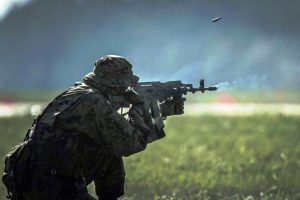
Modernisation started over a decade ago, when a new facility was built; at that time the main weapon being produced was the M96 Beryl in 5.56×45 mm calibre, the successor of the M88 Tantal, a derivative of the Soviet AK-74 Kalashnikov in 5.54×39 mm calibre, while in the handguns field the Vis 35 in 9×19 mm calibre. In 2007 the Polish MoD decided it was time to develop an assault rifle of Polish design to replace the Beryl, and tasked the Wojskowa Akademia Techniczna (WAT), the Military University of Technology, and Fabryka Broni, to work on that project. The weapon was named MSBS Grot, MSBS standing for Modułowy System Broni Strzeleckiej or Modular Small Arms System. Two models were developed, the “C” model, for conventional, and the “B” model, for bullpup, the rifle being designed in the two rifle NATO calibres, 5.56×45 and 7.62×51 mm. As for handguns, also at the end of the first decade of this century Fabryka Broni started designing a new semi-automatic pistol to replace the existing pistols. Both the new rifle and the pistol started to be produced in 2018. Four years later Russia would invade Ukraine, bringing Poland at the forefront of a new Cold War.
This had a considerable impact on the Radom-based company, which production increased dramatically in the last four years; during World War II company workers smuggled weapons to arm the Polish resistance, and some of them were executed by the Germans who controlled the factory. “Now they support those resisting the invader, serving the Polish Army and NATO,” Radomir Bałazy, Fabryka Broni sales director underlined. EDR On-Line visited the company during a study tour on the Polish Defence Industry organised by Polska Agencja Inwestycji i Handlu (PAIH), the Polish Investment and Trade Agency [1].
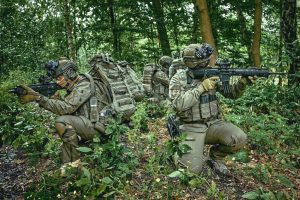
“In the 2022-2025 timeframe the State invested 108 million PLN, around 25 million Euro, in the expansion of the weapons factory production capacity,” Mr. Bałazy underlined. The facility is built on a 46,000 m2, the covered area being 16,500 m2. In 2021 Fabryka Broni produced 20,000 small arms, between assault rifles and pistols, that number being quadrupled by 2025, when 80,000 firearms left the Radom company, mostly destined to Polish armed forces and police services. “This year we set up a new production hall to further increase our output if necessary, and our target for 2026 is to reach the 100,000 goal,” the sales director stated, the company starting now to produce the latest version of the MSBS Grot assault rifle, the A3. Currently its military portfolio includes the MSBS Grot family of assault rifles, the Grot 762N, the Beryl family as well as the MPS and the Vis 100 handguns; Although no figures were provided, EDR On-Line understood that the production of the civilian versions of the assault rifles and pistols is pretty reduced, most of the effort being to deliver the most needed firearms to the services.
The result of the aforementioned investments was visible while visiting the production halls. Most if not all of the machining is done by CNC (Computerized Numerical Control) machines which, once programmed for a specific set of operations and fitted with the relevant tooling, operate autonomously under the monitoring of specialised workers, one of them being responsible for more than one machine.
This does not mean that the human element is less relevant than in the past; this was made clear by a panel hosting the photographs and names of employees who recently suggested improvements in the production process and were rewarded based for example on the time spared thanks to their proposals. Something frequent during the initial phase of production of a new weapon, although even when the process is established some further improvements can always be made.
While the aim of Fabrika Broni is to develop small arms fully “Made in Poland”, all CNC machines come from abroad, mostly from Austria, the Czech Republic, Germany, and Switzerland. Personnel is formed either at the company that produces the machine or in Radom, the experts from that company running specific courses at Fabrika Broni. Usually, one employee oversees two to three machines, a peculiarity being that each machine is given a female name, which helps identifying them. The P1 Department, responsible for mechanical processing, employs around 200 personnel, over the overall 700 working in the company; to ensure the required output they work on three shifts.
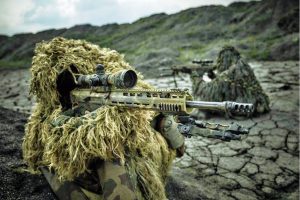
Overall, in the company we find around 100 CNC machines, most of them in Department P1, the automation process being still ongoing. Fabryka Broni production responsible underlining how the time from the arrival of a new machine and its availability for production is short thanks to the cooperation between machine company personnel, FB maintenance teams and operators, recruiting of skilled personnel being still ongoing. Some recently acquired machines allowed to bring on a single station what was previously done on seven different CNC machines, reducing manpower and production time. Two key machines were acquired from GFM of Austria: these are the cold radial forging machines, which hammers’ impact force can be trimmed up to 1,000 kN, and they are used for producing barrels ranging from the 4-inch one of the MPS 9 mm handgun to the 20-inch one of the Grot 7.62N 7.62 mm designated marksman rifle. That said, some conventional machines remain in service, as not all mechanical processing is cost-effective on CNC machines. Department P2 hosts all heat and chemical processes and is followed by Department P3 where weapons assembly is carried out, mostly manually. This hall is still undergoing modernisation, some old machine being still visible.
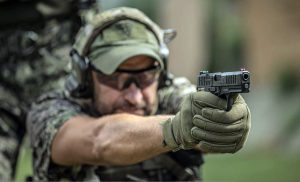
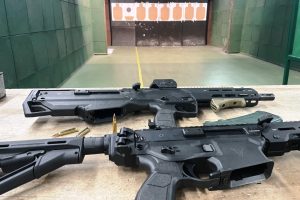
The Quality Control Department works across the whole production process, verifying the compliance of single parts during the whole manufacturing process, barrels being fire tested even before they are assembled into a weapon. The firing range, which hosts different firing lines with different ranges, sees weapons submitted to the final tests before a further cleaning process and packaging. Usually, a rifle is fired three times, each time with five rounds, to assess operation, accuracy, and grouping. Moreover, all weapons being delivered to the Polish military and paramilitary units go through a further quality check, an office run by specialised military personnel being hosted in the factory.
The Research and Development department is fully separated from production, it is hosted in a different building, and obviously remained off-limits to us. It is here that what we will see in future MSPO exhibitions is being developed.
Photos courtesy Fabryka Broni and P. Valpolini
[1] PAIH is the first point of contact for exporters and investors operating in dozens of markets globally. It provides free consulting to grow and promote Polish businesses. Among its missions, PAIH supports Polish companies in promoting their brands on export markets.
