

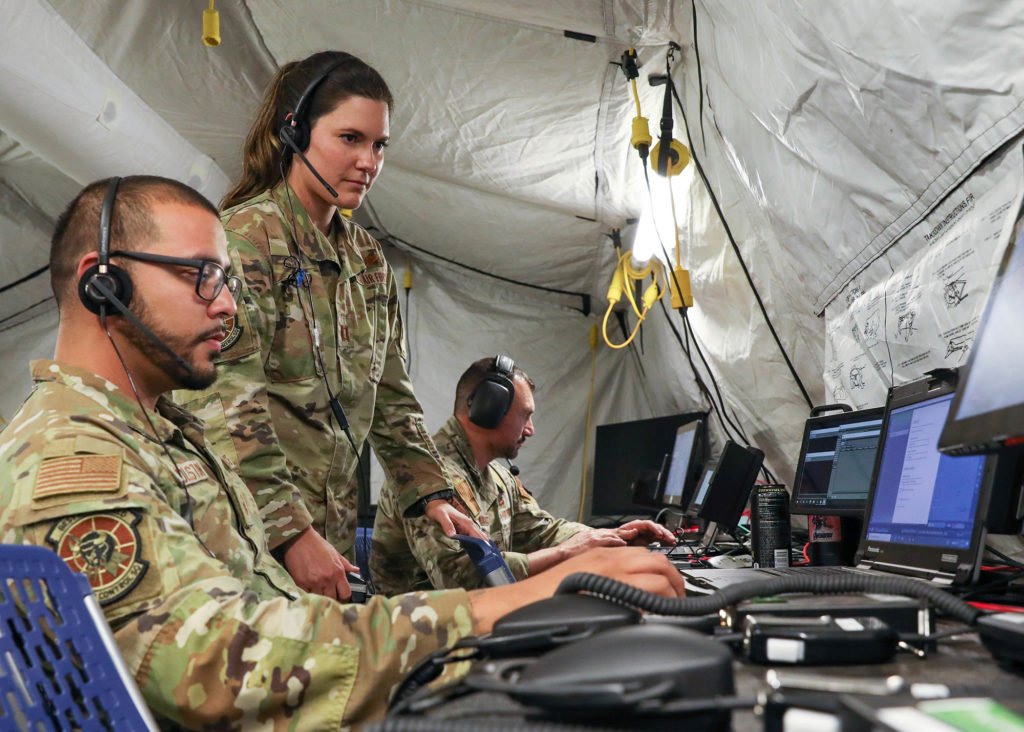
NATIONAL HARBOR, Md.—The first of 70 single-pallet-sized tactical operations centers are slated to begin shipping to Air Force units by the end of the year following a recent announcement by the company that made it and the Air Force entity responsible for its development.
The Tactical Operations Center-Light is the Air Force’s next-generation method for conducting ground-based air battle management Several years ago, the service contracted with Lockheed Martin and L3Harris to build the first 16 prototypes of the TOC-L, which started delivering in 2023.
In 2025, though, the Air Force tapped Booz Allen Hamilton for a $315 million rapid prototyping contract to scale and produce the second iteration of the TOC-L, dubbed MR2 for Major Release 2 or Material Release 2.
The initial 16 MR1 prototypes let Airmen to get their hands on a prototype system and test it out. MR2 is the kit that will be in place to run air battle management in the near term.
“Material Release 1 is, ‘hey, how do we get the capability they need now so they can fight tonight?” Brig. Gen. Joshua Williams, program acquisition executive for command, control, communications, and battle management, told reporters Sept. 16 at AFA’s Air, Space & Cyber conference. “Material Release 2 is focused on deeper integration, improved edge connectivity, and more mature support.”
The system connects to all major aircraft and capabilities the Air Force deploys and can work backward-compatible through the DAF Battle Network, Patrick Hamilton, vice president for defense technology at Booz, told Air & Space Forces Magazine at the conference.
“This is the next-generation C2 system that the Air Force is going to deploy that hopefully will be in place for the next 30 to 40 years for the new C2 fight,” Hamilton said.
Because the TOC-L system can incorporate software changes more readily than legacy ground systems such as the Control and Reporting Center, it can more quickly add in capabilities, applications, and other items from the DAF Battle Network as it grows and more options are added.
“That is the fundamental difference to the prior prototype,” Hamilton said. “Now you’ll be able to, in the future, iterate as future improvements go online in the Battle Network.”
Operational Air Force units have spent the past year taking and testing TOC-L systems “downrange,” Col. Bai Lan Zhu, senior materiel leader for the Advanced Battle Management System, told reporters during the conference media session.
The total number of TOC-Ls to flow across the entire Air Force is still evolving, Zhu said.
“The exact quantities are something that the operational community is going to refine over time,” she said.
The first wave of TOC-Ls will begin shipping to units by or before December. The company plans to deliver 70 units under the current contract, Hamilton said.
The new system can also draw from at least three “enclaves” of data, letting users fuse information from both classified and unclassified sources more easily.
“So, if you have something coming in, let’s say from an FAA unclassified radar, and you want to put that on the situational awareness [common operating picture] that the user is looking at, which is in a secret enclave, you need the ability to move that data up,” Hamilton said.
The TOC-L provides that ability.
The system can also render those enclaves unclassified when powered off, based on National Security Agency data-at-rest standards.
In the past, system users would spend hours at the end of each mission or shift physically removing a series of drives, labeling them and storing them according to protocols, only to have to rebuild the setup the next day, Mike Lewis, Booz’s chief engineer for TOC-L, told Air & Space Forces Magazine.
“There are a lot of logistics and risk in that type of scenario, so with data at rest being unclassified, it’s a real key to making this tactically relevant from a speed perspective and from a cyber perspective,” Lewis said.
Fewer Pieces, Fewer People
TOC-L replaces the Cold War-era Control and Reporting Center, previously centered around the trusty but bulky AN/TPS-75 radar system.
The legacy system required as many as six C-17 Globemaster IIIs to transport all of its components, using radar dishes, heavy vehicles, and nearly two dozen power generators.
The CRC would require hundreds of Airmen to set up and operate and could take between 24 and 72 hours to set up and tear down.
TOC-L is a feather by comparison.
It fits on a single pallet, with one additional pallet to hold its generator; can be transported inside a single C-130 Hercules; requires about 10 Airmen to operate; and can be set up or torn down in less than an hour.
The TOC-L can squeeze into such a small frame and use far fewer people, partly because of advances in electronics and partly because it can tap into the DAF Battle Network and other networks to access radar and other feeds instead of carrying its own radars into the fight.
The shift in allowing nonproprietary equipment to hook into the TOC-L system also drastically trims down the amount of hardware needed to operate the system’s crucial functions, Hamilton told Air & Space Forces Magazine.
“We’re going to collect iterative feedback from ABMS and the user community as it deploys all over the world,” said Hamilton. “And I think over the next 12 to 24 months, that will start to define what [Material Release 3] will look like and what we hear from the user community, what they prioritize for.”
