

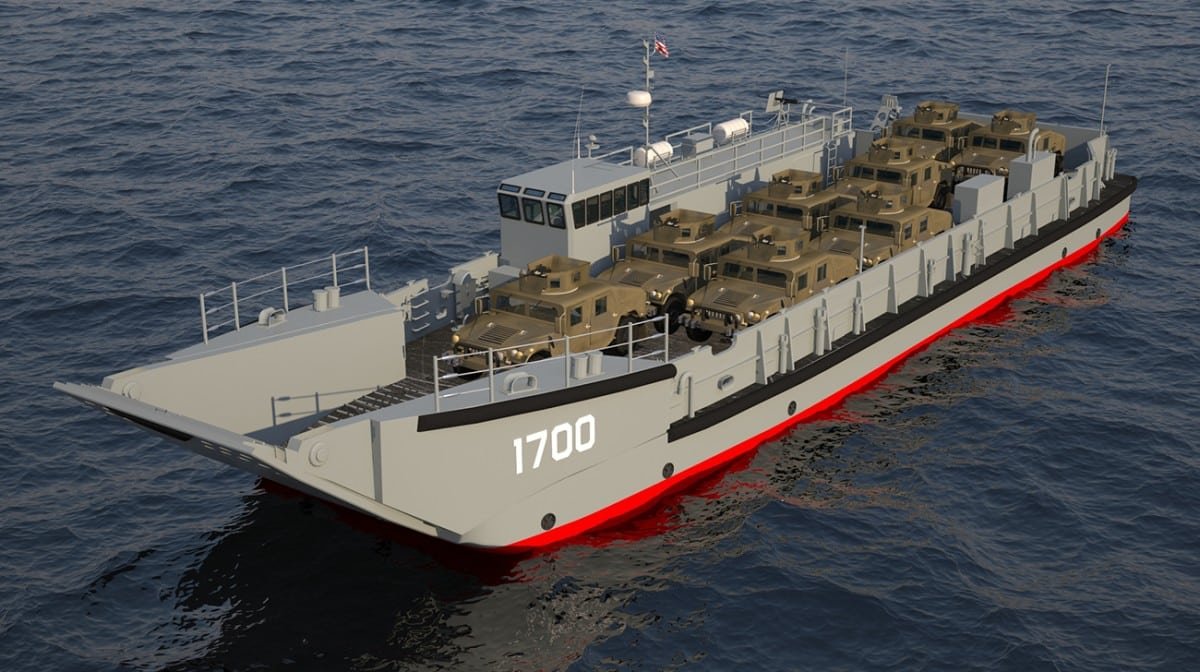
The U.S. Navy has awarded three prototype agreements to Conrad Shipyard, Master Boat Builders, and Saronic to accelerate LCU 1700 production.
U.S. Navy press release
The U.S. Navy has awarded three competitive Prototype Other Transaction (OT) agreements to Conrad Shipyard, LLC of Orange, Texas; Master Boat Builders, Inc. of Coden, Alabama; and Saronic Technologies of Brownsville, Texas, to build Landing Craft, Utility (LCU) 1700 class craft.
“By selecting three distinct shipyards, the Navy is expanding its shipbuilding industrial base capacity and building a resilient “second source” of supply for landing craft,” said William F. Mahan, who is performing the duties of Assistant Secretary of the Navy for Research, Development and Acquisition. “Other Transaction prototype authority allows the Navy to move at the speed of relevance.”
This innovative acquisition approach, funded by the One Big Beautiful Bill Act (OBBBA), leverages prototype authorities under 10 U.S.C. § 4022 to expedite the delivery of critical littoral capabilities, validates production-ready Technical Data Package (TDP), and rapidly expands parallel supply lines.
The LCU 1700 is the replacement for the legacy LCU 1610 class, which averages over 50 years of active service. The newly constructed craft will feature improved reliability, increased payload capacity, extended operational reach and compatibility with the Navy’s amphibious warfare ships. Deliveries are scheduled to begin in late 2028 and continue through 2029.
In August, the Navy took delivery of its first LCU 1700 class landing craft, LCU 1710, from Austal USA. The competitive awards announced today aim to establish a resilient, multi-source industrial base, introducing state-of-the-art construction processes across three shipyards. By validating the TDPs through actual fabrication, the Navy ensures a low-risk transition to high-rate production for the remainder of the LCU 1700 program.
-End-
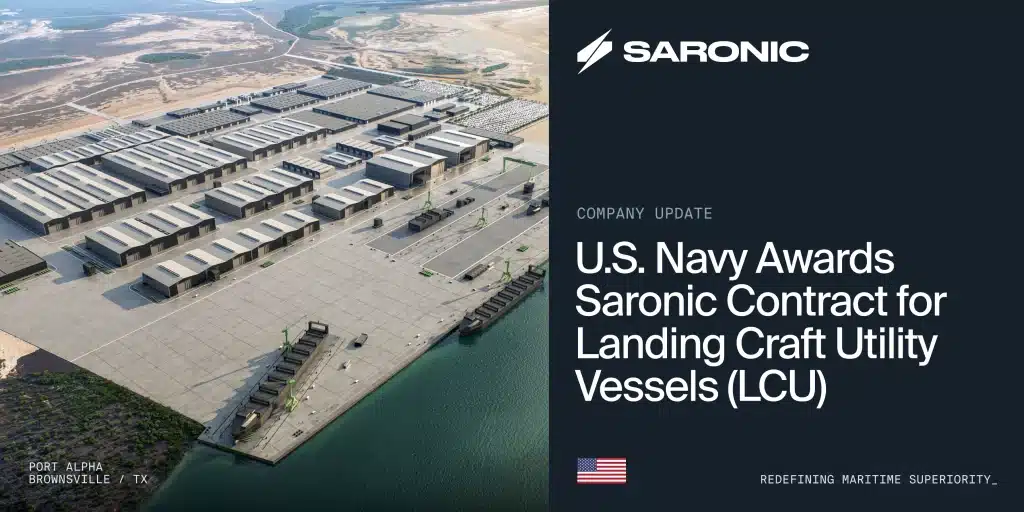
Naval News comments:
The U.S. Navy’s decision to award three prototype agreements to Conrad Shipyard, Master Boat Builders, and Saronic marks a significant step toward expanding the industrial base for the LCU 1700 program. By bringing in a mix of traditional shipbuilders and technology-focused companies like Saronic, the service is actively pursuing increased production capacity and supply chain resilience for its amphibious warfare logistics.
This multi-yard approach is designed to mitigate manufacturing bottlenecks, accelerate delivery timelines, and test alternative production methodologies for essential utility and landing craft vessels. Furthermore, these developments will directly influence operational logistics and future deployment nodes, including support capabilities around key infrastructure like Port Alpha. Port Alpha is the planned next-generation, multi-billion-dollar shipyard facility being developed by Saronic. Port Alpha represents the company’s broader industrial push to inject high-capacity, advanced manufacturing into the U.S. defense supply chain. The inclusion of non-traditional defense entities highlights an evolving strategy within naval procurement, blending established shipbuilding expertise with agile commercial innovation to support fleet readiness.
