

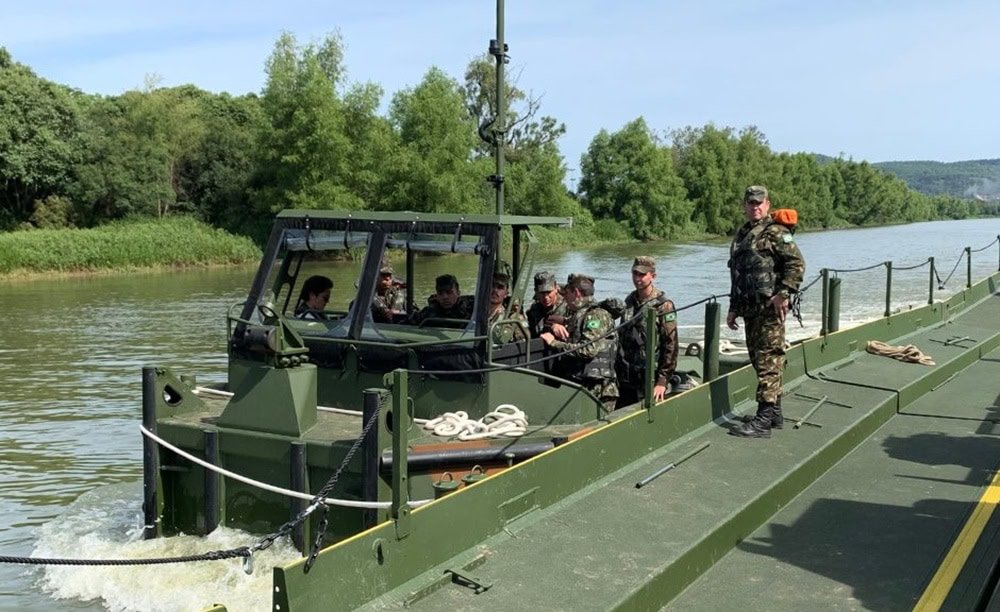
It was announced on 8 September 2026 that the Australian Army is fielding three next-generation Bridge Erection Boats (BEB) manufactured by local firm Birdon Group, which is located in Port Macquarie, New South Wales.
The three Australian vessels manufactured at Birdon’s BEB manufacturing facility incorporate enhancements derived from years of operational experience from multiple customers and operating environments.
For example, the new boats include upgraded systems and armour kits, plus integration of MMT’s bridge automated positioning technology for enhanced precision control.
The new BEBs reflect an evolution on the original 2003 design that is in service with the Australian Army. The country acquired 24 of these vessels under its Bridge Erection Propulsion Boat (BEPB) programme.
BEBs have also been procured by the militaries of Brazil, the Netherlands, Sweden and the USA. In fact, more than 540 BEBs have been produced at Birdon’s sites in Australia and the USA.
BEBs are employed to position and maintain floating military bridge sections for river and other waterway crossings. The vessels are 7.2m long and have a 3.25m beam. They are powered by dual NAMJet waterjets specifically designed to operate in shallow or debris-filled water.

The boats have a high power-to-size ratio, and they offer a 28kt speed and the tight handling characteristics essential to manoeuvring bridge sections even in high water flows. The BEB operates with a standard crew of two (a driver and rigger), but has advanced remote or unmanned capabilities.
Jamie Bruce, Birdon’s CEO, shared, “This BEB delivery demonstrates the enduring value created when Australian industry is entrusted to develop and support sovereign defence capability. The origins of this capability lie in Australia, where Birdon developed and delivered a solution to meet the Australian Army’s operational bridging requirements.”
In addition to designing and building the new BEBs, Birdon provides in-service support to the army’s existing BEPB fleet. This includes maintenance, capability upgrades, obsolescence management, spares provisioning and through-life support.
by Stephen W. Miller
