

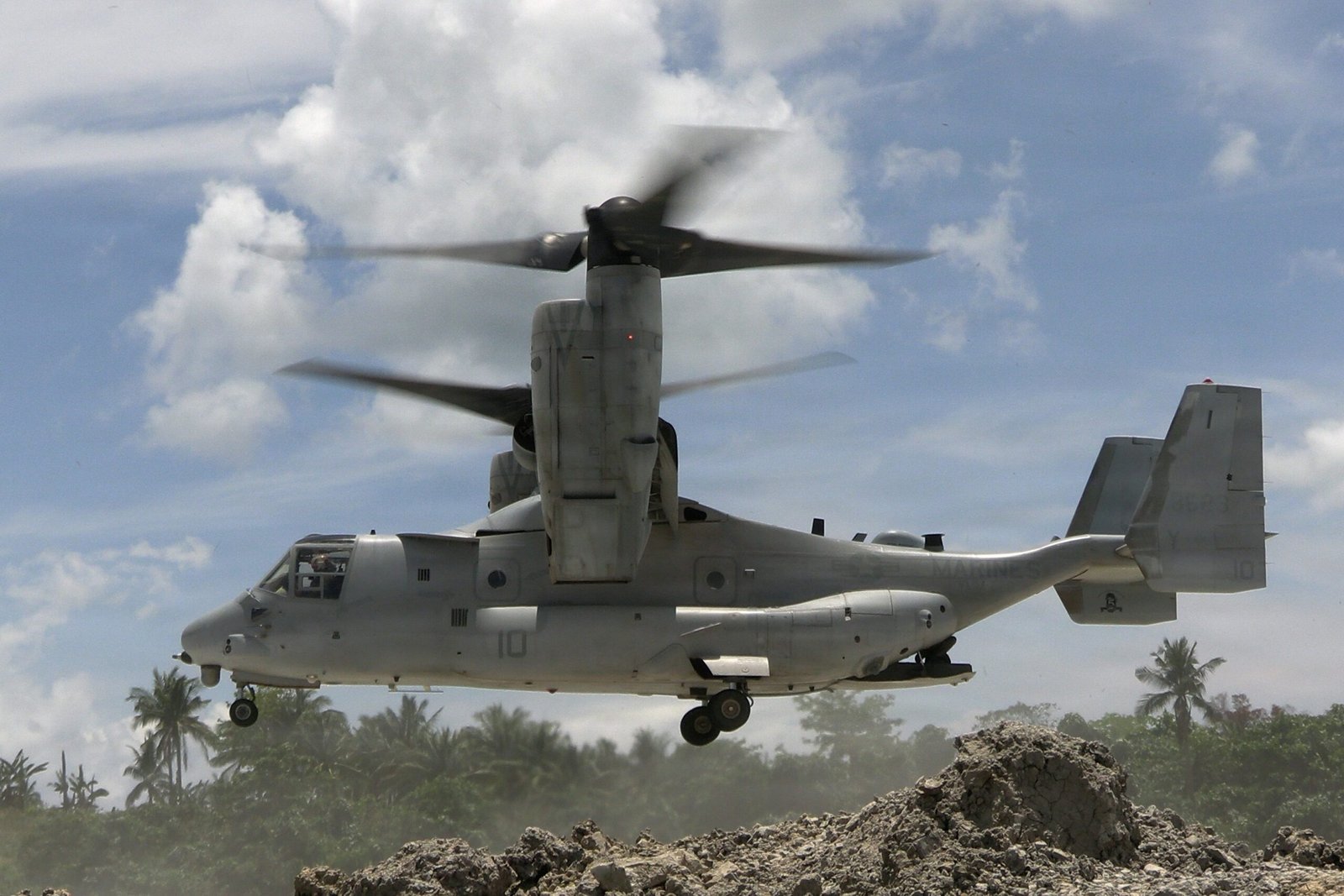
US Marine Corps (USMC) MV-22B Osprey tiltrotor aircraft, deployed to Australia under the Marine Rotation Force – Darwin (MRF-D) initiative, honed their skills in expeditionary operations in a deployment to Philippines during this year’s rotation.
This year’s MRF-D rotation is the 15th deployment since the first rotation in 2012, and which was launched following the signing of the US-Australia bilateral force posture agreement in 2011.
The annual six-month USMC deployments to Darwin, Northern Territory first incorporated an Aviation Combat Element (ACE) in 2014, joining command, ground combat and logistics elements to form a Marine Air-Ground Task Force (MAGTF).
However, this year’s rotation is the first to be certified a Special-Purpose MAGTF (SPMAGTF), indicating that MRF-D is validated as being capable of conducting crisis response and contingency operations in the Pacific theatre.
For Marine Medium Tiltrotor Squadron 268 (VMM-268), also known as the “Red Dragons” and which formed the ACE of MRF-D this year, the SPMAGTF designation meant a sharper focus on training for the aviation missions required by the force. The unit operates about a dozen MV-22Bs from RAAF Base Darwin.
Captain Jessica Kelly-Paul, an Osprey pilot and VMM-268’s quality assurance officer for maintenance, told Asian Military Review: “I was on the 2024 rotation, and the squadron’s biggest change since then has been its certification as an SPMAGTF. This has meant a greater emphasis on preparing the unit as a crisis response force, including the specific aviation missions required of the SPMAGTF.”
Based at Marine Corps Air Station Kaneohe Bay in Hawaii, VMM-268 has contributed detachments to MRF-D since its initial participation with four aircraft in 2017. In recent years, the “Red Dragons” have alternated the assignment with sister squadron VMM-363, the “Lucky Red Lions”.
Kelly-Paul noted that, for the first time in an MRF-D rotation, Marine Air Control Groups (MACG) have been organically attached to the ACE. MACGs provide air traffic control functions and coordinate air operations and airspace management.
“Usually, they fall under the Ground Combat Element [GCE], so having them attached directly to the ACE has really increased our ability to conduct operations in an austere environment, particularly during our exercises in the Philippines,” Kelly-Paul noted.
Training in the Philippines featured heavily in the 2026 MRF-D rotation, including Exercises Balikatan and Kamandag 10 – major annual military training events conducted jointly by the Philippines, USA and other partners across the archipelago from late April till early July.
Marine Exercise (MAREX) 2026 was another bilateral military drill in which MRF-D participated alongside the Philippine Marine Corps in May.
During the Philippines deployment, the VMM-268 detachment was based out of Clark Air Base, located 5km west of Angeles City in Luzon. “With many exercises taking place on islands away from where the ACE was based, we were able to employ the hub-and-spoke Expeditionary Advanced Base Operations (EABO) concept developed specifically for the SPMAGTF,” Kelly-Paul explained.
The USMC’s EABO concept of operations emphasises the employment of distributed and easily sustained forces from austere locations to support a larger campaign. The hub-and-spoke notion envisages dispersion of aircraft from major bases to several smaller distributed locations in support of this concept.

Kelly-Paul continued: “We supported Balikatan, Kamandag and MAREX, operating across different islands in the Philippines. This included providing CASEVAC [casualty evacuation] support to the GCE during live-fire events, and moving troops and equipment between islands to support the SPMAGTF as a whole.”
Balikatan was held on Luzon and Palawan, the northernmost and westernmost main islands of the Philippine archipelago respectively, while MAREX was held on Mindanao, the southernmost major island.
VMM-268’s expeditionary operations in the Philippines represented a more realistic step-up from what the unit conducted during its 2024 MRF-D rotation. “Back in 2024, during Exercise Predator’s Run, we established an expeditionary advanced base at Gove, a remote region in the Northern Territory, with a detachment of aircraft and maintenance personnel operating from tents,” Kelly-Paul shared.
“In the Philippines this year, the ACE had its own detachment on a different island from the rest of the MAGTF, allowing us to operate across the islands while leveraging the available logistics network.”
Kelly-Paul said the EABO concept is an evolving playbook that is constantly reviewed and refined at both the USMC and unit levels.
“Deployments give us an opportunity to exercise and rehearse the concept for future operations. Being able to execute it in the Philippines this time has given us another opportunity to develop the concept,” she concluded.
by Roy Cho
