

Modern military power is not only about fighters and missiles. It also depends on the ability to move people, equipment and supplies quickly across long distances.
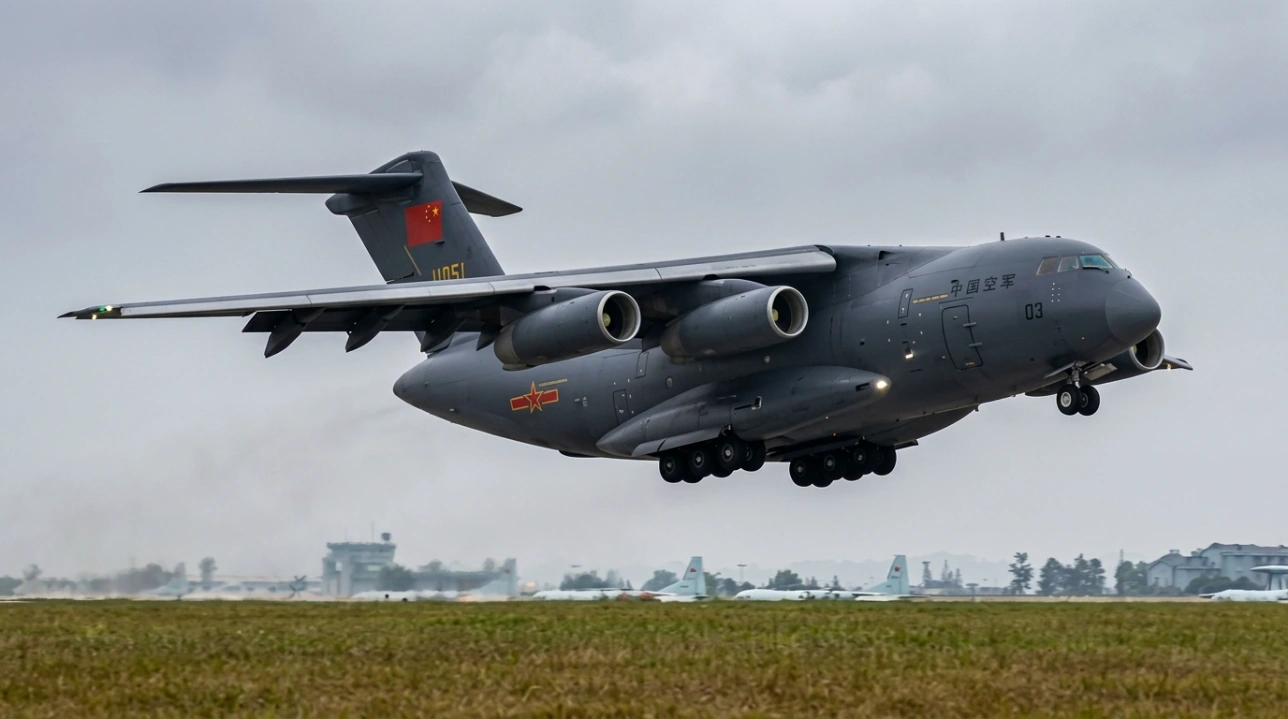
That is where the Xi’an Y-20 Kunpeng comes in.
Developed as China’s large strategic transport aircraft, the Y-20 gives the People’s Liberation Army Air Force (PLAAF) a domestically developed platform for moving heavy cargo and personnel on a scale smaller transports cannot match.
The Xi’an Y-20 Kunpeng first flew in January 2013 and entered PLAAF service in July 2016. Chinese defense authorities describe it as the country’s first domestically developed new-generation large military transport aircraft.
But its importance goes beyond size. The Xi’an Y-20 Kunpeng reflects China’s growing focus on strategic mobility, supporting military logistics, emergency response and overseas transportation. New engines and specialized derivatives have also expanded the aircraft’s potential role.
So why did China decide it needed the Xi’an Y-20 Kunpeng in the first place?
The answer begins with the strategic airlift gap China wanted to close.
Why Did China Build the Xi’an Y-20 Kunpeng?
The decision to develop the Xi’an Y-20 Kunpeng came from a practical problem: China needed a stronger and more independent way to move large military loads over long distances.
For years, China’s heavy military airlift capability depended significantly on foreign-designed aircraft, particularly the Russian Il-76. While those aircraft provided valuable transport capacity, relying on imported platforms created limitations in fleet expansion, modernization and long-term logistics. Developing the Xi’an Y-20 Kunpeng gave China a domestic alternative designed around its own military requirements.
The timing was also important. China’s military modernization was increasingly focused on building capabilities that could operate beyond its immediate geographic surroundings. That created a growing requirement for strategic mobility. A modern transport aircraft could move personnel, vehicles, equipment and supplies between distant locations much faster than traditional ground or maritime transportation.
The Xi’an Y-20 Kunpeng therefore became part of a much larger modernization effort.
Its role is not limited to supporting combat units. Strategic transport aircraft can also contribute to disaster relief, emergency evacuation and other large-scale logistics missions. In 2020, for example, six Xi’an Y-20 Kunpeng aircraft participated in an operation supporting Wuhan, carrying around 1,400 military medical personnel along with medical supplies. The mission demonstrated how a platform originally developed for military airlift could also provide rapid national-level transportation during an emergency.
Read also: Top 5 Largest Military Transport Aircraft in the World
There was another long-term objective: technological independence.
China initially relied on Russian D-30KP-2 engines for the Xi’an Y-20 Kunpeng. Later development of the domestically produced WS-20 opened the possibility of reducing that dependence while improving the aircraft’s growth potential.
That makes the Xi’an Y-20 Kunpeng more than a replacement for older transport aircraft.
It is a strategic logistics platform and an important part of China’s effort to build an increasingly self-reliant air mobility capability.
What Are the Xi’an Y-20 Kunpeng Specifications?
The Xi’an Y-20 Kunpeng is built around one central requirement: moving a lot of useful weight without turning every mission into a logistics puzzle.
The aircraft has a reported maximum takeoff weight of around 220 tonnes and a maximum payload of approximately 66 tonnes, according to Chinese defense sources and Jane’s. It uses four turbofan engines and features a high-wing configuration with a rear cargo ramp, giving it the basic architecture expected from a modern strategic transport aircraft.
| Specification | Xi’an Y-20 Kunpeng |
| Maximum takeoff weight | ~220 tonnes |
| Maximum payload | ~66 tonnes |
| Engine configuration | 4 turbofans |
| Early engine | D-30KP-2 |
| Newer engine | WS-20 |
| Primary role | Strategic airlift |
The 66-tonne payload figure is particularly important, but it needs context. Maximum payload does not mean the aircraft can carry that weight on every long-distance mission. Like other heavy airlifters, the practical combination of payload, fuel and distance changes depending on the mission.
China’s Ministry of National Defense has described the Xi’an Y-20 Kunpeng as capable of conducting long-distance airlift operations for personnel and cargo under complex weather conditions. Its development has therefore focused on more than simply increasing cargo capacity.

The aircraft has also evolved since the original Y-20A entered service. Early aircraft were powered by Russian-origin D-30KP-2 turbofans, while the newer Y-20B uses China’s domestically developed WS-20 high-bypass turbofan. Jane’s reports the WS-20 at around 127.5 kN of thrust, compared with 117.7 kN for the D-30KP-2 Series II.
Those numbers help explain the Xi’an Y-20 Kunpeng’s significance.
But specifications only tell half the story. The more revealing question is what China can actually put inside the aircraft and how that changes the practical value of its strategic airlift fleet.
What Can the Xi’an Y-20 Kunpeng Actually Carry?
A transport aircraft’s real value is not determined by its maximum takeoff weight alone. The more useful question is what can actually fit behind its cargo ramp and how that payload can support different missions.
The Xi’an Y-20 Kunpeng has a reported maximum payload of around 66 tonnes, giving the PLAAF enough capacity to move heavy military equipment, vehicles, personnel and large quantities of supplies in a single sortie. That places it in a very different category from medium-sized tactical transports, which generally require more aircraft to move the same overall load.
One example illustrates the point. Jane’s has reported that the Y-20 is capable of transporting two Type 15 light tanks, demonstrating its ability to accommodate armored vehicles rather than being limited to personnel and conventional cargo. The aircraft can also transport other military equipment, pallets and supplies depending on mission requirements.
But strategic airlift is not exclusively about military hardware.
In January 2020, six Xi’an Y-20 Kunpeng aircraft were used during China’s response to the COVID-19 outbreak in Wuhan. According to China’s Ministry of National Defense, the aircraft transported approximately 1,400 military medical personnel and medical supplies to the city. The operation showed how quickly a large transport fleet could be organized for a national emergency.
This flexibility is one of the Xi’an Y-20 Kunpeng’s most important characteristics.
A single aircraft can potentially move a substantial combination of personnel and equipment, while different loading configurations allow the same basic platform to support very different missions. That could include military logistics, emergency response, disaster relief or strategic movement between distant locations.
The headline figure of 66 tonnes therefore tells only part of the story.
The bigger advantage is the combination of payload capacity, cargo flexibility and rapid mobility. That combination gives China a transport platform capable of supporting missions that would otherwise require a much larger logistical effort.

How Did the Xi’an Y-20 Kunpeng Become China’s Global Airlift Workhorse?
An aircraft becomes a strategic asset not when it enters a hangar, but when it starts moving real people and equipment where they need to go. The Xi’an Y-20 Kunpeng has gradually taken on that role as China expanded the operational use of its strategic transport fleet.
The Xi’an Y-20 Kunpeng entered PLAAF service in 2016, giving China a domestically developed heavy transport platform that could support missions across a much wider geographic area. Since then, its role has extended beyond routine domestic logistics, with the aircraft appearing in military exercises, emergency operations and overseas missions.
One notable example came in 2022, when six Xi’an Y-20 Kunpeng aircraft were reported to have flown to Serbia. Chinese state media said the aircraft delivered equipment associated with the FK-3 air-defense system. The mission attracted international attention because it demonstrated the Y-20’s ability to conduct a long-distance overseas transport operation rather than simply supporting activities within China.
The aircraft has also featured in China’s broader humanitarian and emergency-response activities. Such missions are important because they demonstrate a different aspect of strategic airlift: the ability to rapidly concentrate personnel and supplies when conventional transportation would take considerably longer.
This operational experience matters for another reason.
Strategic airlift is a capability built through repetition. Crews gain experience with long-distance routes, cargo handling and coordination, while planners develop procedures for operating aircraft away from their normal bases. Every successful mission can contribute to a larger pool of operational knowledge.
The Xi’an Y-20 Kunpeng is therefore becoming more than China’s newest heavy transport aircraft.
Its growing use demonstrates how China is turning an indigenous airframe into an increasingly flexible mobility platform. And as newer versions receive more capable engines and specialized equipment, the Y-20’s role could extend well beyond conventional cargo transportation.
Why Is the WS-20 Engine So Important to the Xi’an Y-20 Kunpeng?
For the Xi’an Y-20 Kunpeng, the airframe was only one part of the challenge. The aircraft also needed an engine capable of providing the thrust, efficiency and reliability required for a large strategic transport platform.
That makes the WS-20 engine one of the most important developments in the Xi’an Y-20 Kunpeng program.
Early Xi’an Y-20 Kunpeng aircraft relied on Russian-made D-30KP-2 turbofans. While those engines enabled China to bring the aircraft into service, continuing to depend on an imported powerplant created a technological constraint. Developing the WS-20 gave China an opportunity to gain greater control over one of the most technically demanding components of a large military aircraft.
The WS-20 is a high-bypass turbofan developed in China for the Y-20 family. Chinese aviation industry sources have presented it as a significant step in the country’s development of large high-bypass turbofan technology. Open-source reporting has also associated the engine with higher thrust than the D-30KP-2 used on earlier Xi’an Y-20 Kunpeng variants.

The difference is important because engine performance affects much more than speed.
For a strategic transport aircraft, greater available thrust can influence takeoff performance, payload flexibility and operations from demanding airfields. Engine efficiency can also affect fuel consumption and the distance an aircraft can cover with a given load. These factors directly influence the usefulness of an airlift fleet.
But the WS-20’s significance goes beyond the Xi’an Y-20 Kunpeng itself.
A domestically developed high-bypass turbofan represents accumulated expertise in areas such as materials, manufacturing, testing and engine integration. Those capabilities can support future Chinese large aircraft programs as well.
The transition therefore marks an important stage in the Xi’an Xi’an Y-20 Kunpeng Kunpeng.
How Is the Xi’an Y-20 Kunpeng Becoming More Than a Cargo Aircraft?
The evolution of the Xi’an Y-20 Kunpeng is increasingly about what can be built around the aircraft, not just what can be loaded inside it.
China has begun expanding the Y-20 family into specialized roles, with the YY-20 aerial tanker representing one of the most significant developments. Rather than designing an entirely new tanker aircraft from scratch, the approach uses the Y-20’s large airframe as a foundation for aerial refueling and extended-range support.
That changes the strategic value of the platform.
A tanker does not carry troops or armored vehicles as its primary mission. Instead, it transfers fuel to other aircraft, allowing compatible aircraft to remain airborne longer and operate farther from their bases. For China’s air force, that can support longer-range aviation operations while reducing the dependence of aircraft on nearby airfields.
The YY-20 has therefore turned the Y-20 from a transport project into something closer to an air mobility family. The same basic platform can support different requirements, including strategic transportation and aerial refueling.

This approach also has an industrial advantage.
Once an aircraft manufacturer has developed a large airframe, production system and supporting infrastructure, creating derivatives around that architecture can be more efficient than developing an entirely separate aircraft for every mission. Commonality can potentially simplify training, maintenance and logistics, although the exact degree of commonality between variants is not fully public.
The broader Xi’an Y-20 Kunpeng family also illustrates how China’s strategic airlift ambitions are developing beyond simply increasing cargo capacity.
Transport aircraft provide the foundation, but specialized derivatives can extend what that foundation does. A tanker can support longer-range aviation, while future versions could potentially serve additional logistical or support roles.
That makes the Xi’an Y-20 Kunpeng increasingly important as a platform rather than a single aircraft type.
The question now is not simply how many tonnes China can move with the Xi’an Y-20 Kunpeng. It is how many different strategic missions can be built around the same airframe.
What Challenges Could Limit the Xi’an Y-20 Kunpeng’s Global Reach?
Building a large strategic transport aircraft is one challenge. Turning it into a truly global airlift capability is another.
For the Xi’an Y-20 Kunpeng, one of the biggest limitations is the relationship between payload and range. The aircraft’s maximum payload is reported at around 66 tonnes, but carrying heavier loads generally requires more fuel and can reduce the distance available for a mission. This means the Xi’an Y-20 Kunpeng cannot simply combine its maximum payload with its maximum possible range on every flight.
Overseas operations also depend on infrastructure.
A strategic airlift aircraft can fly long distances, but sustained operations require suitable airfields, maintenance facilities, fuel supplies, spare parts and trained personnel. China’s ability to access overseas airports and establish reliable logistical arrangements can therefore influence how consistently the Xi’an Y-20 Kunpeng can operate far from its home bases.
There is also the question of fleet scale.

A strategic transport capability is not created by a single aircraft design. It requires enough airframes, crews, maintenance capacity and support equipment to conduct multiple missions while retaining capacity for unexpected requirements. China has expanded its Xi’an Y-20 Kunpeng fleet, but the exact operational size and readiness of the force are not fully transparent in publicly available information.
The WS-20 represents another important area to watch. Moving from the Russian D-30KP-2 to a domestically developed engine reduces dependence on foreign propulsion technology, but producing advanced turbofans reliably at scale remains a demanding industrial challenge. Engine durability, production consistency and long-term maintenance all matter to an airlift fleet.
Finally, strategic airlift involves more than aircraft performance.
Global mobility depends on diplomatic access, overseas logistics and the ability to coordinate complex transportation networks. The Y-20 can provide the aircraft itself, but it cannot independently create all the infrastructure required to sustain worldwide operations.
These constraints do not erase the progress represented by the Xi’an Y-20 Kunpeng. Instead, they highlight the difference between owning a strategic transport aircraft and possessing a mature global airlift system.
What Does the Xi’an Y-20 Kunpeng Mean for China’s Future Military Mobility?
The Xi’an Y-20 Kunpeng is becoming more significant because its development is no longer centered on a single transport aircraft. It is evolving into part of a broader Chinese air mobility ecosystem built around strategic transportation, aerial refueling and increasingly domestic aerospace technology.
The Xi’an Y-20 Kunpeng gives China an indigenous platform for moving large quantities of personnel and equipment over long distances. The introduction of the WS-20 also represents an important stage in the program, reducing reliance on the Russian-origin engines used by earlier aircraft. Meanwhile, the YY-20 tanker demonstrates how the same basic airframe can support missions beyond conventional cargo transportation.
Together, these developments provide China with more options for sustaining distant operations and responding to large-scale logistical requirements.

However, the significance of the Xi’an Y-20 Kunpeng should not be measured only by the aircraft’s published payload or range. Strategic mobility depends on an entire network of aircraft, crews, maintenance facilities, airfields, fuel infrastructure and overseas access. Building that network takes considerably more time than developing an airframe.
The Xi’an Y-20 Kunpeng nevertheless gives China an important foundation.
As the fleet gains operational experience and additional variants enter service, the aircraft can potentially become increasingly integrated with China’s wider military transportation system. Its value may therefore lie less in any single mission and more in the flexibility it provides across different requirements.
For China, the Xi’an Y-20 Kunpeng represents a shift from simply possessing heavy transport aircraft to developing a more comprehensive strategic airlift capability.
And that may ultimately be the aircraft’s most important contribution: not just carrying more, but giving China greater control over how, when and where its military and logistical resources can move.
