

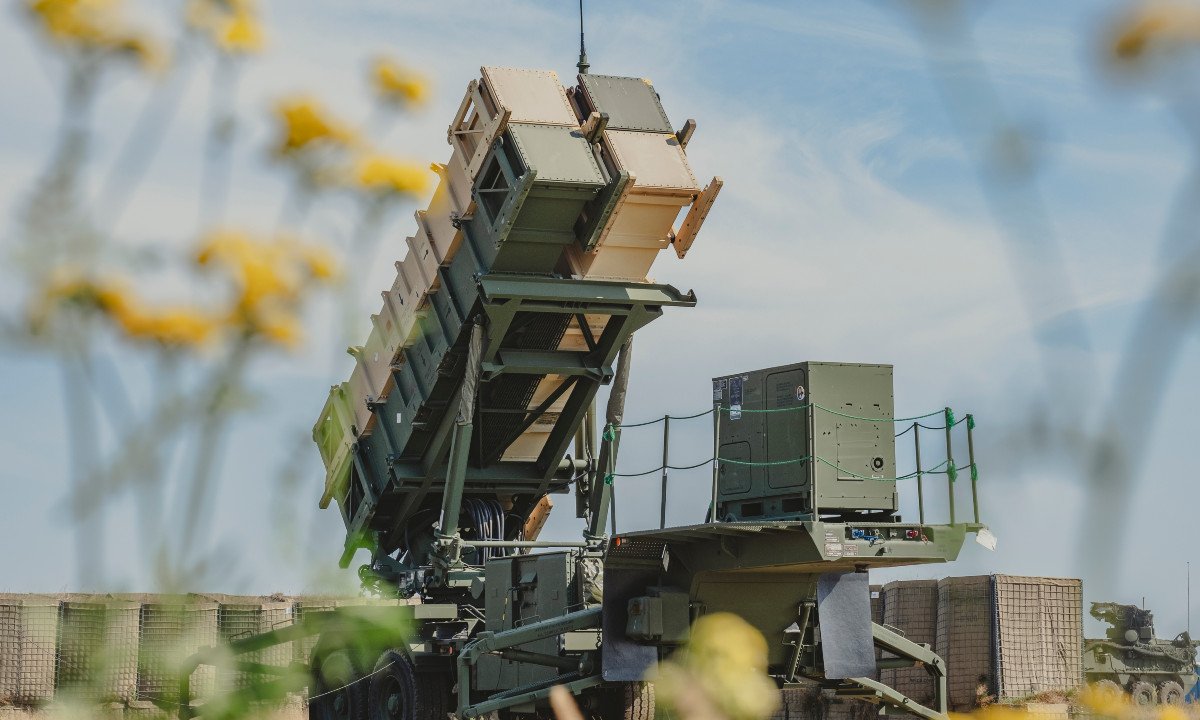
The US Army currently has fifteen Patriot battalions and eight THAAD batteries—finite resources that are badly needed across the service’s global operational footprint. EUCOM needs them to deter an ever-encroaching Russia. CENTCOM needs them shooting down Iranian missiles and drones. PACOM needs them to protect Guam, Japan, South Korea, and a growing list of bases and logistics nodes spread across the most dispersed theater on earth. One Patriot battalion is needed to perform the critical testing and modernization mission. And now the homeland does too, as Golden Dome revives a mission the Army hasn’t resourced since Project Nike and the Strategic Defense Initiative.
None of these demands is going away any time soon and moving a single firing unit from one to another merely transfers unacceptable risk.
The answer, so far, has been to grow the force with three more Patriot battalions. But since the mission set isn’t getting any smaller, this is only addressing gaps that the service has right now. Even fully manned and equipped, it’s not enough to generate the capacity the Army needs for future contingencies.
According to the Congressional Research Service, the Army does not expect the first of these new battalions until fiscal year 2029, followed by two more in 2030 and 2031. Each new four-battery Patriot battalion is estimated to cost roughly $1.8 billion.
The Army must absorb several more years of simultaneous demand before the first additional battalion becomes available. And when it does, there is no guarantee that it will constitute genuine contingency depth rather than immediately filling another requirement that already exists.
The usual framing of the air defense shortfall is as a matériel problem: not enough PAC-3s, not enough SM-6s, not enough prime industrial capacity. Gallons of ink have been spilled over this and much has been addressed already.
The matériel solution is relatively straightforward. A PAC-3—the most advanced Patriot missile—can be built faster than a Patriot battalion and is quite content sitting in a warehouse until needed. The future constraint will be a human one: namely, the lack of trained 14-series soldiers, officers, and warrant officers and the schoolhouse capacity to generate them.
And even if all three new Patriot battalions are activated on schedule, if they are immediately consumed by existing theater requirements then the Army has expanded without actually increasing its strategic depth.
The Army needs a metric measuring how many air defense formations remain available for an unforeseen contingency once the requirements of enduring missions are subtracted. Call it contingency depth. This would be an objective measure of whether a formation can be employed without transferring risk from one theater to another.
Wars and Rumors of Wars
For those who missed the past eighteen months, the CENTCOM air defense mission has recently shifted from a rotational deterrent to a persistent commitment.
And it’s not just consuming missiles. Only last year a battalion was unprecedentedly pulled from PACOM to CENTCOM.
Ongoing CENTCOM demands consume crews, maintainers, radars, dwell time, and—critically—training opportunities at a prodigious rate. The old cycle of deploy, reset, train has gone from three steps to one: deploy.
Golden Dome adds a brand-new need, and is a clear signal that the Department of Defense has made the homeland the priority theater. Every new Army air defense commitment to the homeland further reduces the pool available for overseas demands. And at present, none of them can be covered by the National Guard or Army Reserve because there are no Patriot or THAAD units there.
Air defense is stretched to its upmost when upper-tier systems are forced to engage threats that could be detected and defeated by lower layers. Better sensing and integration of fires is key to prevent these inefficiencies.
The Army should extend the National Capitol Region Integrated Air Defense System to key defended assets nationwide, creating a mesh of interconnected radars that provides comprehensive coverage against the full spectrum of air threats, including unmanned aerial systems.
Laying radars and weapons systems is a critical component of air defense doctrine. Expanding sensor coverage over “limited area defense” sites and other critical defended assets could reserve Patriot for upper-tier threats.
For now, filling up holes in our coverage is not growth. Some portion of the new units being stood up must be reserved for contingency depth rather than immediately going to satisfy a standing requirement.
Fort Sill’s Air Defense Artillery School is currently the only place that can generate more air defense capacity, and it’s running around the clock trying to meet demand. In August 2025, the 30th Air Defense Artillery Brigade reorganized its training structure, splitting advanced individual training responsibility across both of its battalions instead of concentrating it in one. The reorganization was intended to distribute training responsibilities more efficiently as demand on the branch increased, since the sustained expansion of the operational force is only possible by training additional students. The schoolhouse has adapted rapidly, but the branch is still drawing on a limited pool of experienced personnel to support a force now substantially larger than it was a decade ago.
The problem is that new battalions aren’t just made up of privates. The Army cannot sow dragon’s teeth like Cadmus and expect fully grown air defense officers and noncommissioned officers to spring from the earth.
End strength is not the only metric that matters in force design. Every new operational battalion the Army stands up must pull its cadre from the ranks of existing units and the schoolhouse itself. The faster the Army expands air defense, the more carefully it has to manage the risk of hollowing out the formations and the training base it has (and consequently, the risk of falling into the trap the Russians are facing right now).
Future Plans
In order to address this issue, Army senior leaders should consider four things:
First, create a contingency depth metric reported alongside air defense unit readiness. Count what remains after deployments, modernization, reset, and training. Force design should explicitly require some air defense capacity not assigned against standing demands.
Second, tie growth to force generation. Every new battalion authorization must create an accompanying allocation toward training. As Robert Heinlein wisely reminded us, “There ain’t no such thing as a free lunch.”
Third, resist the temptation to eat the seed corn. Every expansion decision needs to account for experienced personnel being pulled from existing formations to stand up the new ones. Expansion that hollows out existing battalions and the schoolhouse promises only a sugar rush with an ensuing crash.
Fourth, stop treating every aerial threat as a Patriot problem. Contingency depth also depends on preserving Patriot and THAAD capacity for the threats those systems are uniquely suited to defeat. The Army should accelerate the integration of medium-range sensors, networked command and control, and lower-cost defenses against drones and cruise missiles at critical sites so that high-end formations are not consumed performing missions that other units can assume.
The first of the new Patriot battalions will not arrive until 2029 at the earliest. The Army therefore has several years in which there is effectively no new Patriot force structure coming to the rescue. More importantly, if those formations arrive only to inherit requirements that already exist, the service will have spent precious time without creating any margin for surprise.
Ultimately, a simple test will tell if the Army has managed its air defense capacity properly: Five years from now, can the secretary of defense ask for another Patriot battalion in an unexpected theater without forcing the Army to choose which theater to strip?
Major Peter Mitchell is a US Army strategist and air defense officer with operational experience in the Pacific and Middle East.
The views expressed are those of the author and do not reflect the official position of the United States Military Academy, Department of the Army, or Department of Defense.
Image credit: Capt. Leara Shumate, US Army
