

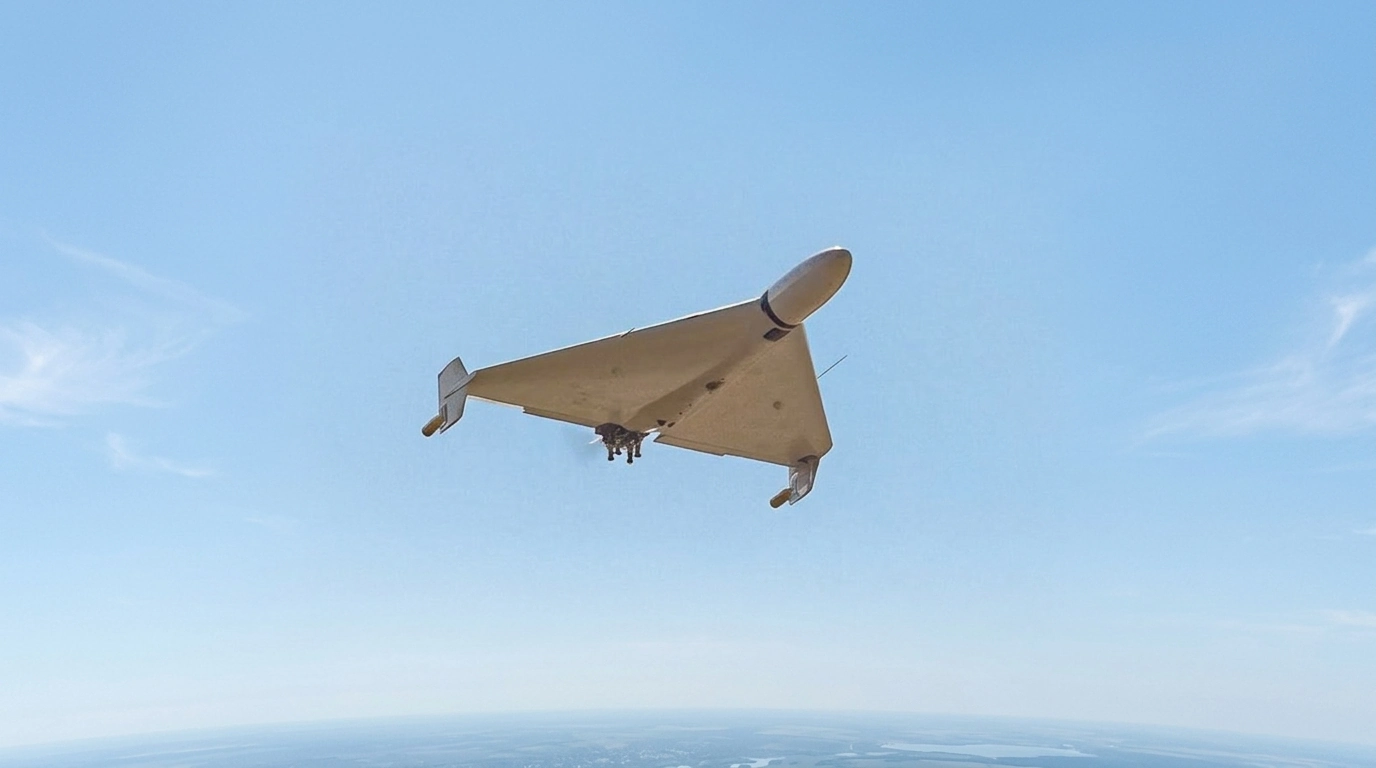
A drone that costs a fraction of the target it threatens can create a surprisingly complicated problem. That simple economic equation helps explain why the best kamikaze drones have become such a closely watched part of modern warfare.
The term “kamikaze drone” is often used broadly, covering everything from relatively simple one-way attack drones to sophisticated loitering munitions that can search for targets before committing to an attack.
They don’t all do the same job, and that distinction matters. A long-range system designed to strike infrastructure is solving a very different problem from a compact loitering munition hunting battlefield equipment.
The biggest lesson from recent conflicts is that effectiveness isn’t just about explosive payload or maximum speed. A drone can be highly capable on paper and still be poorly suited to a particular mission. Range, endurance, sensors, navigation, target-selection methods, production scale and cost all change the equation.
Think of it less like comparing five sports cars and more like comparing five tools in a workshop. A hammer isn’t “better” than a screwdriver simply because it hits harder.
In this post, we’ll examine five of the best kamikaze drones and loitering munitions, focusing on what makes each system effective and where its strengths lie.
We’ll also look beyond headline specifications to understand a bigger question: why have these relatively small aircraft become such an influential feature of modern military operations?
How We Ranked the Best Kamikaze Drones
Calling one drone the “best” sounds straightforward, until you compare systems built for completely different jobs. A long-range one-way attack drone and a battlefield loitering munition may both be labeled kamikaze drones, but their missions, operating distances and measures of success can be worlds apart.
So this ranking uses a broader question: How effectively does each system perform the mission it was designed for?
The first factor is combat record. A system that has been repeatedly used in real operations provides more evidence than one whose reputation rests mostly on demonstrations or manufacturer claims. Recent rankings similarly emphasize combat experience alongside reach and payload.
Next comes range and endurance. Range matters enormously for strategic one-way attack drones, while loiter time can be more important for tactical systems. A drone that can remain over an area gives its operator, or its onboard systems, more opportunity to locate an appropriate target.
Then there’s payload and guidance. A larger warhead isn’t automatically better. The useful question is whether the payload matches the intended target and whether the drone can place it accurately. Sensors, navigation and communications therefore matter almost as much as explosive capacity.
Finally, we consider fieldable scale and cost-effectiveness. This is the slightly uncomfortable part of comparing modern weapons. A technically superior drone may have less practical impact if it is expensive and difficult to produce in quantity.
Recent analysis of the Lancet, Switchblade 600 and other systems highlights exactly this tension between capability per weapon and the number of weapons a military can realistically field.
In other words, this isn’t a contest for the biggest warhead.
It’s a test of range, persistence, precision, battlefield experience, versatility and scalability, and how those pieces fit together.
1. Shahed-136 / Geran-2 — The Mass-Strike Specialist
When discussing the best kamikaze drones, the Shahed-136 deserves attention for a reason that goes beyond its specifications: scale.
Designed and produced in Iran, the Shahed-136 is a one-way attack UAV that Russia has used extensively under the designation Geran-2. The latest CSIS assessment lists a reported range of 1,000–2,500 km, a speed of about 180 km/h, a weight of roughly 200 kg, and a payload estimated at 20–50 kg. Exact figures vary by configuration and source.
| Specification | Shahed-136 / Geran-2 |
| Origin | Iran |
| Russian designation | Geran-2 |
| Type | One-way attack UAV |
| Reported range | 1,000–2,500 km |
| Speed | ~180 km/h |
| Weight | ~200 kg |
| Estimated payload | 20–50 kg |
| Primary strength | Long-range, scalable strike |
The numbers are useful, but they don’t fully explain why this drone matters.
The Shahed-136 isn’t particularly fast, and it lacks the sophisticated sensor suite associated with some high-end loitering munitions. Its advantage comes from combining long reach, relatively simple construction and expendability. CSIS estimates that Shahed variants have cost roughly $20,000–$50,000 per aircraft, although estimates vary.
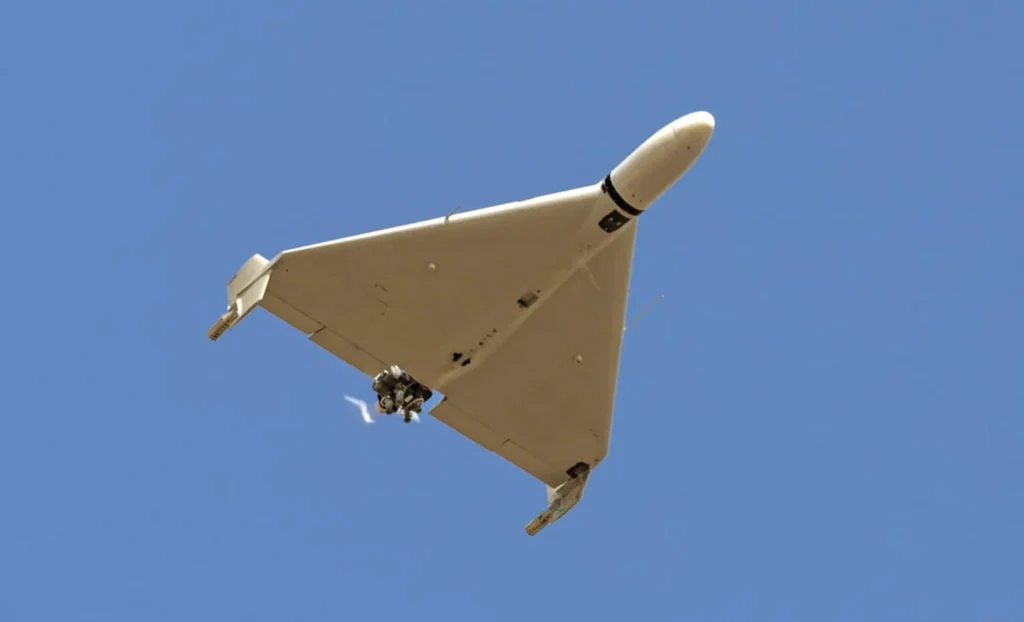
That creates an unusual economic problem for defenders. A relatively inexpensive incoming drone can still force the use of surveillance assets, air-defense systems or interceptors. And when drones arrive repeatedly, the challenge becomes cumulative rather than simply tactical.
Russia’s campaign has demonstrated this particularly clearly. CSIS reported that Russia launched more than 14,700 one-way attack drones between September 2022 and December 2024, with Shahed-type systems making up most of that total.
So, what makes the Shahed-136 effective?
It doesn’t need to be the smartest drone in the sky. It needs to be capable enough, long-ranged enough and available in sufficient numbers to create a persistent problem.
2. IAI Harop — The Long-Range Precision Hunter
If the Shahed-136 shows how scale can shape a drone campaign, the IAI Harop demonstrates the opposite idea: give the aircraft time to think, observe and wait.
Developed by Israel Aerospace Industries (IAI), the Harop is a long-range loitering munition that combines characteristics of a UAV and a missile. IAI describes it as a system designed to detect, identify and attack high-value targets including command posts, tanks, supply depots and air-defense systems.
Its published specifications help explain why the Harop stands out among the best kamikaze drones:
| Specification | IAI Harop |
| Manufacturer | Israel Aerospace Industries |
| Type | Long-range loitering munition |
| Endurance | Up to 9 hours |
| Guidance | Electro-optical seeker |
| Control | Human-in-the-loop |
| Launch | Canister |
| Primary strength | Long endurance and target search |
| Typical targets | Air defenses, command posts, vehicles and other high-value targets |
The most striking figure is its nine-hour endurance. That changes the nature of the mission. Instead of simply flying toward a coordinate, the Harop can remain in a designated area, search for targets and wait for an appropriate opportunity. IAI says its electro-optical seeker allows the system to locate and identify targets without requiring prior intelligence on the exact target location.

There is another important detail: human control remains part of the system. According to IAI, operators can supervise the mission and abort an attack when necessary.
That combination of endurance, sensing and human oversight gives the Harop a quality that a simple one-way attack drone lacks: patience.
And patience can be extremely valuable when the target is moving, appears only briefly, or wasn’t exactly where intelligence predicted. In that sense, the Harop isn’t merely a flying warhead. It’s closer to a persistent hunter, one that can spend hours looking for the right moment before committing to the attack.
3. ZALA Lancet — The Battlefield Precision Striker
If the Shahed-136 represents mass and reach, and the IAI Harop represents endurance and target search, the ZALA Lancet occupies a different niche: the tactical battlefield.
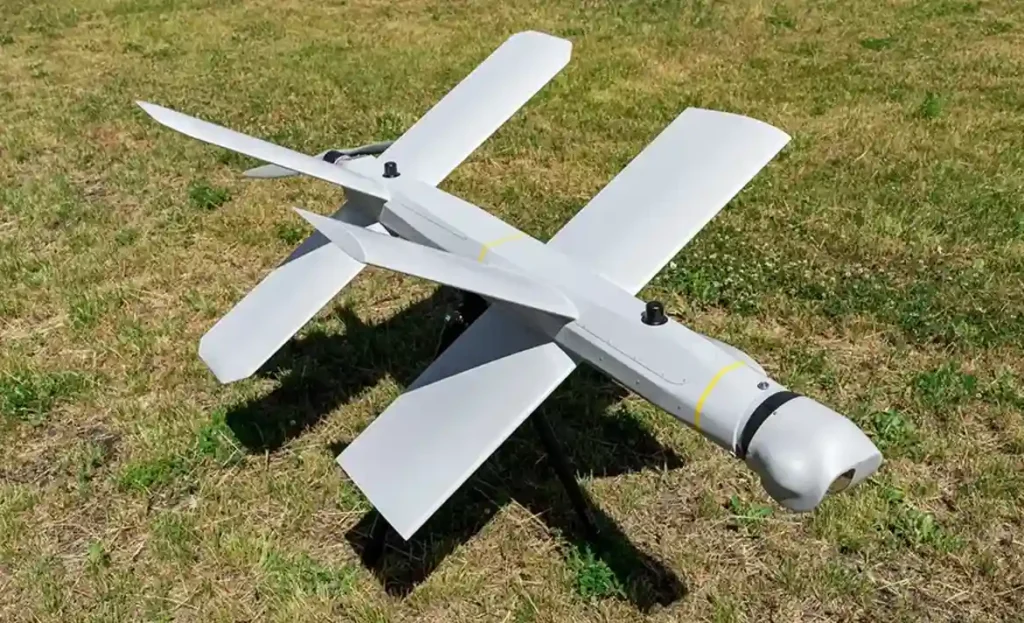
Developed by Russia’s ZALA Aero, the Lancet family is a loitering munition intended for relatively close-range precision attacks. Its battlefield use in Ukraine has made it one of the more recognizable Russian drone systems of the war, particularly in footage involving artillery and other military equipment.
The Lancet family has evolved through several variants, so published specifications should be treated carefully rather than as one fixed set of numbers. Open-source assessments commonly place later variants in the tens of kilometers for operational range, with endurance measured in roughly tens of minutes to around an hour, depending on the model and mission configuration.
| Characteristic | ZALA Lancet |
| Developer | ZALA Aero |
| Country | Russia |
| Type | Loitering munition |
| Typical role | Tactical precision strike |
| Reported range | Variant-dependent; generally tens of km |
| Guidance | Electro-optical / remote control |
| Typical targets | Artillery, vehicles, air-defense equipment |
| Key advantage | Tactical precision and flexibility |
What makes the Lancet particularly interesting is its targeting philosophy. Rather than being optimized primarily for long-distance strategic attacks, it is designed to operate closer to the battlefield, where targets can appear, move or reveal themselves during an engagement.
That makes the system useful against targets whose location may change quickly. Russian forces have repeatedly used Lancets against Ukrainian artillery and other high-value battlefield equipment, although claims about individual strikes should be treated cautiously because wartime video does not always establish the final outcome.
There’s also a broader lesson here.
The Lancet doesn’t need to fly thousands of kilometers to be one of the best kamikaze drones in its category. Its value comes from matching the weapon to the battlefield problem: find a target, maintain enough flexibility to engage it, and deliver an expendable precision strike.
In that sense, the Lancet is less like a long-range spear, and more like a precision tool kept close to the action.
4. Switchblade 600 — The Anti-Armor Specialist
The Switchblade 600 takes the kamikaze-drone concept in a distinctly heavier direction. Rather than focusing on long-range strategic strikes, it is designed to give tactical units a portable way to find and engage larger, hardened targets without relying entirely on conventional missiles or artillery.
Developed by AeroVironment in the United States, the Switchblade 600 combines an anti-armor warhead with a high-resolution electro-optical/infrared sensor system. The manufacturer currently lists more than 40 minutes of endurance and a range of 90+ km when using a forward pass, while its baseline target engagement distance is described as more than 40 km.
| Specification | Switchblade 600 |
| Manufacturer | AeroVironment |
| Country | United States |
| Type | Extended-range loitering munition |
| Endurance | 40+ minutes |
| Range | 40+ km; 90+ km with forward pass |
| Sensors | High-resolution EO/IR |
| Munition weight | 15 kg |
| Primary role | Anti-armor precision strike |
| Key strength | Combination of endurance, sensing and anti-armor capability |
What makes it particularly interesting is the time it spends looking before striking. The system’s sensor package provides real-time imagery to the operator, allowing targets to be identified rather than simply attacked based on a preloaded coordinate. AeroVironment also describes a “wave-off” capability that can allow an attack to be aborted and the system redirected when circumstances change.
That matters on a battlefield where targets rarely behave like stationary dots on a map.

The Switchblade 600 has also moved beyond the experimental stage in U.S. military planning. In August 2026, AeroVironment announced a $51 million U.S. Army order covering additional Switchblade 600 Block 2 systems, alongside Block 1 systems for a foreign military sale.
So why include it among the best kamikaze drones?
Because its strength isn’t sheer range or mass production. It’s the combination of persistent observation, operator control and anti-armor precision in a relatively deployable package.
5. UVision HERO-120 — The Flexible Tactical Loitering Munition
The HERO-120 earns its place among the best kamikaze drones for a different reason: flexibility. Rather than being built around one narrow mission, it is designed as a medium-range loitering munition that can give relatively small units their own surveillance and precision-strike capability.
Developed by Israel’s UVision, the HERO-120 is an electrically powered, canister-launched system. Current UVision material lists a 4.5 kg warhead, up to 60 km of range and about 60 minutes of endurance, although specifications have changed across different versions and configurations.
| Specification | HERO-120 |
| Manufacturer | UVision |
| Country | Israel |
| Type | Medium-range loitering munition |
| Reported range | Up to 60 km |
| Endurance | Up to 60 minutes |
| Warhead | Up to 4.5 kg |
| Guidance | EO/IR seeker |
| Propulsion | Electric |
| Primary role | Precision anti-armor and multi-purpose strike |
| Key strength | Flexibility and operator control |
What really separates the HERO-120 is its sensor-to-shooter concept. UVision describes a gimbaled electro-optical/infrared seeker that allows operators to track moving or stationary targets, while the system can also be aborted or redirected as the situation changes.
That creates an interesting middle ground. The HERO-120 is substantially more persistent than a simple short-range attack drone, yet it remains compact enough for deployment by forward units and integration with vehicles, vessels and helicopters. UVision has also demonstrated helicopter-launched operation, showing how the same basic munition can be adapted to different platforms.

There is another useful distinction here: versatility doesn’t necessarily mean doing everything at once. It means giving commanders more options when circumstances change.
A target may move. Intelligence may improve. The original engagement may no longer make sense.
The HERO-120’s combination of endurance, imaging, operator control and abort capability is designed for precisely that uncertainty. In a battlefield where information can become outdated within minutes, that adaptability may be one of its most important advantages.
What Makes Kamikaze Drones So Effective?
The effectiveness of the best kamikaze drones does not come from one specification alone. A large warhead is useful, but so are range, endurance, sensors, guidance, cost, and the ability to deploy the system at scale. In practice, the strongest designs combine several of these advantages rather than maximizing just one.
1. Cost and Scale
Perhaps the biggest advantage is economics. A relatively inexpensive one-way attack drone can force an opponent to spend far more on detection and interception. CSIS estimates Shahed-type drones at roughly $20,000–$50,000 each, while noting that their effectiveness comes partly from the ability to launch them in large numbers.
That creates an important battlefield calculation: defenders must protect valuable targets without exhausting their own limited supply of expensive interceptors.
2. Persistence
Unlike a conventional projectile, some loitering munitions can remain in an area while searching for a suitable target. That persistence can be particularly valuable when targets are mobile or intelligence is incomplete.
Systems such as the Harop and HERO-120 demonstrate how endurance and operator control can turn a drone into something closer to a search-and-strike system rather than simply a flying warhead.
3. Precision and Sensors
Modern loitering munitions increasingly combine electro-optical or infrared sensors with human control and, in some cases, increasingly sophisticated onboard processing. This gives operators more information before an engagement and can allow a mission to be changed when circumstances shift.
4. Range and Survivability
Longer range allows a launch platform to remain farther from danger, while navigation systems and electronic-countermeasure resistance can influence whether a drone reaches its intended area. At the same time, electronic warfare has become a major factor because jamming can interfere with navigation and control links.
Ultimately, the most effective military kamikaze drones are those that balance cost, range, persistence, sensing, accuracy and deployability. That’s why the five systems on this list look so different: each represents a different answer to the same battlefield problem.
