

In the complex security landscape of South-Eastern Europe, Türkiye has re-emerged in recent years as one of the most active and influential external actors. Ankara’s approach provides a mix of hard security interests with investment, cultural diplomacy, and selective political engagement. For European defence and security audiences, understanding Türkiye’s role requires moving beyond simplistic “neo-Ottoman” narratives and recognising a pragmatic strategy shaped by NATO commitments, regional ambitions, and shifting relations with the EU and Russia. Increasingly, Türkiye is not merely present in the region, it is embedded across multiple layers of governance,from infrastructure and finance to defence institutions and security sector reform.
Türkiye’s engagement with the Western Balkans is rooted in a combination of geography and history. The region has also functioned as a bridge between Europe and Asia Minor, and developments have direct implications for Turkish security, migration management, and trade corridors extending into Central Europe. Control over connectivity — physical, economic, and political — remains a key underlying objective.
The Western Balkans have long occupied a place in Turkish strategic thinking, reinforced by historical ties dating back to the Ottoman era and by lasting diaspora and religious linkages. However, contemporary policy is less about historical revivalism than about forward-looking positioning in a region where EU enlargement fatigue has created a certain degree of political and economic space for external actors.
Since the early 2000s, Ankara has adopted a more proactive regional posture, driven in part by the foreign policy doctrine associated with former foreign minister Ahmet Davutoğlu. Foreign policy concepts such as “zero problems with neighbours” and “win-win cooperation” underpinned a shift towards economic integration, mediation, and political engagement. While these doctrines have since evolved, their legacy persists in Türkiye’s preference for flexible, bilateral engagement rather than rigid bloc politics.
Economic Footprint
Economic engagement and investment form the backbone of Türkiye’s presence in the region. Over the past two decades, Turkish companies have expanded across sectors including infrastructure, banking, energy, and telecommunications. This expansion has been facilitated by Türkiye’s own economic growth and its outward-looking business sector, often supported by state-backed financing and political facilitation.
In countries such as Albania, Bosnia and Herzegovina (BiH), Kosovo, and EU member Croatia, Turkish firms have played a prominent role in airport management, highway construction, and energy distribution networks. These projects are not only commercially viable but strategically significant, linking regional economies more closely to Turkish supply chains and logistics corridors.
Türkiye is also among the key economic partners for several Balkan states and a significant employer through foreign direct investment. Trade volumes have steadily increased, with Ankara positioning itself as a complementary, rather than competing, partner to the EU. In practice, this allows governments in the region to diversify economic dependencies while maintaining their EU accession trajectories.
However, this economic engagement is not purely commercial. It also serves geopolitical objectives, firmly embedding Türkiye within local economies and strengthening bilateral relationships. At the same time, Ankara has demonstrated pragmatism by maintaining robust economic ties even with countries where political alignment is less clear, such as Serbia — highlighting more of a transactional approach rather than an ideological one.
Bosnia and Herzegovina: History and Political Sensitivity
No country better illustrates the depth — and complexity — of Türkiye’s engagement than Bosnia and Herzegovina. The relationship is grounded in a dense layering of historical, cultural, and religious ties, but it is also shaped by the legacy of the conflict in the 1990s and the fragile post-Dayton order.
For Ankara, BiH represents both a strategic partner and a symbolic anchor of its Balkan policy. Successive Turkish governments have framed support for BiH’s territorial integrity and political stability as a core foreign policy priority. This has translated into sustained diplomatic engagement, including high-level mediation efforts between Bosniak, Serb, and Croat political actors.
Economically, Türkiye has invested in infrastructure, banking, and manufacturing sectors in BiH, though not at the scale of the EU. More visible has been its role in reconstruction and cultural heritage restoration, particularly through the rehabilitation of Ottoman-era sites. These efforts have reinforced Türkiye’s image as a long-term stakeholder, particularly among Bosniak (Bosnian Muslim) communities.
At the same time, Türkiye’s position in the country is politically sensitive. Its close ties with the Bosniak leadership have raised concerns among Republika Srpska (Serb entity of BiH) authorities and, to a lesser extent, Bosnian Croat actors, who view Ankara’s involvement solely through a geopolitical lens. As a result, Türkiye must navigate BiH’s complex internal divisions carefully — balancing symbolic support with pragmatic engagement across all entities.
In security and defence terms, Türkiye contributes to EUFOR Althea in BiH (the EU’s military stabilisation mission, tasked with maintaining a secure environment, supporting the implementation of the Dayton Peace Agreement). Ankara also maintains defence cooperation links with the BiH armed forces, focusing on training, interoperability, and institutional development. While less visible than its role in Kosovo, this engagement underscores Ankara’s broader objective: to remain embedded in BiH’s long-term stability architecture.
Soft Power and Cultural Diplomacy
Türkiye’s influence in the Western Balkans extends beyond economics into the realm of soft power. Cultural diplomacy — often implemented through institutions such as TİKA, the Yunus Emre Institute, and religious networks — has focused on restoring Ottoman-era heritage sites, funding religious and cultural institutions, and expanding educational exchanges.
This approach leverages shared historical and religious identities, particularly among Muslim communities in Albania, BiH, and Kosovo. Turkish media, including television series and digital content, has also played a subtle but effective role in shaping perceptions of Türkiye as both modern and culturally familiar.
However, this dimension remains contested. Critics in parts of the region and within the EU view Turkish cultural engagement as politically instrumentalised, particularly where it intersects with domestic political actors or religious institutions. As a result, soft power — while effective — also introduces friction, especially in states with more pluralistic or EU-oriented identity frameworks.
Security Cooperation
While economic and cultural tools dominated Turkish engagement in the early 2000s, security cooperation has gained prominence over the past decade. Türkiye is now positioning itself as a credible security provider in the Western Balkans, particularly in areas where NATO frameworks leave room for bilateral capacity-building.
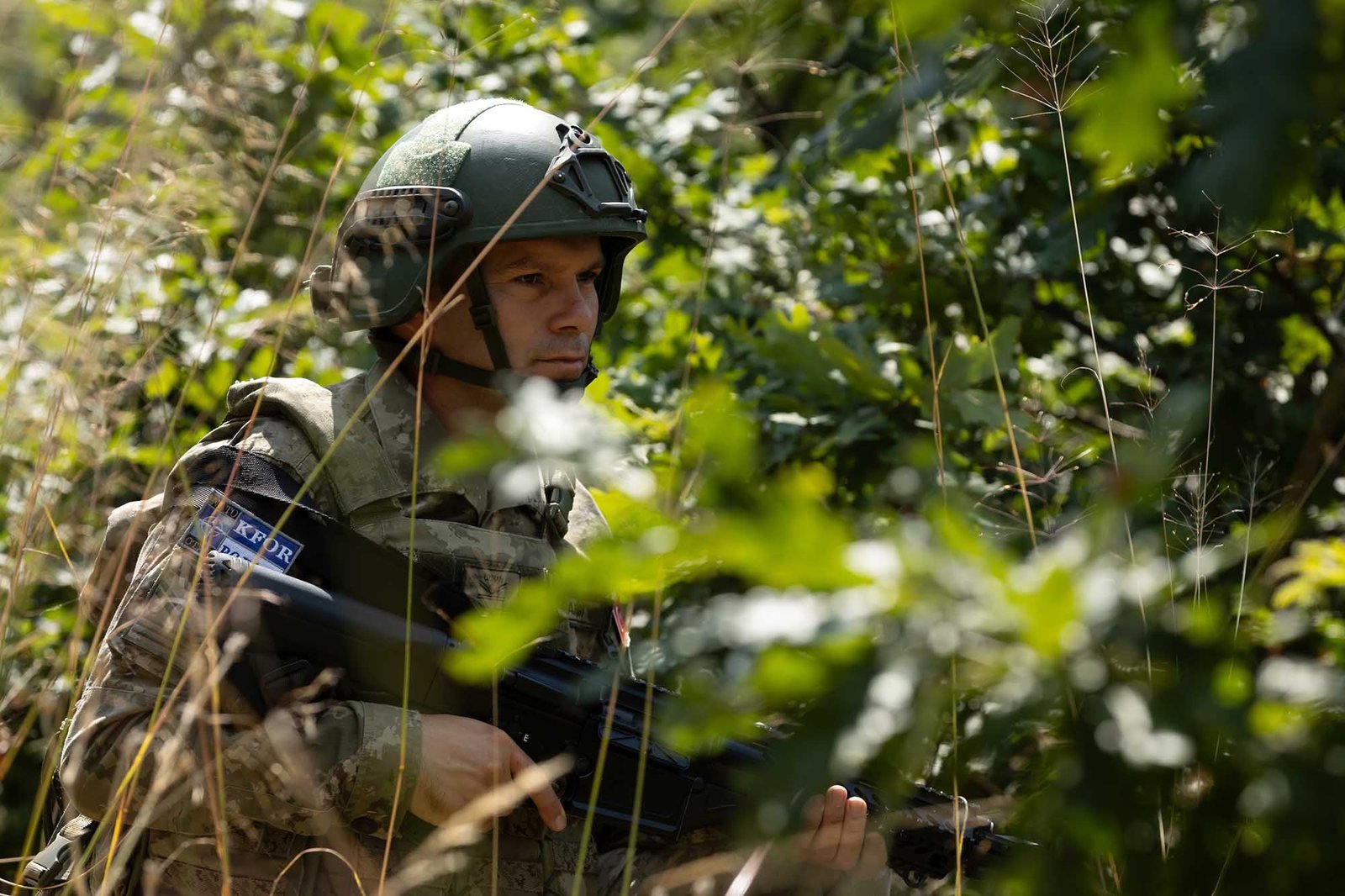
Ankara participates actively in NATO-led missions, most notably the Kosovo Force (KFOR), where Türkiye has not only been a long-standing troop contributor but has also assumed command of the mission. This is a significant marker of trust within NATO and underscores Türkiye’s operational credibility in the region. Commanding KFOR places Turkish officers at the centre of one of the Western Balkans’ most sensitive security environments, overseeing stability operations, crisis response, and coordination with local security institutions.
Beyond KFOR, Türkiye is supporting regional security initiatives and maintains a network of bilateral defence agreements. Its cooperation — with Albania, Kosovo, North Macedonia, and Montenegro — includes officer training, military education exchanges, joint exercises, and institutional reform support, often focusing on interoperability with NATO standards.
A key trend has been the expansion of Turkish defence exports. Turkish-made systems, including armoured vehicles, small arms, communications equipment, and unmanned aerial vehicles (UAVs), have been supplied to several Western Balkan countries. This equipment is typically cost-effective and combat-proven, making them attractive alternatives to more expensive Western platforms.
The growing presence of systems such as the Bayraktar TB2 UAV reflects both the competitiveness of Türkiye’s defence industry and the increasing demand for intelligence, surveil lance, and reconnaissance (ISR) and strike capabilities among Western Balkan militaries. Beyond procurement, Ankara is also exploring maintenance, training, and potential co-production arrangements, indicating a longer-term ambition to embed itself within regional defence ecosystems rather than simply export hardware.

Kosovo: Anchor of Turkish Influence
Among Western Balkan states, Kosovo occupies a central place in Türkiye’s regional strategy. Ankara was among the first countries to recognise Kosovo’s independence and has consistently supported its state-building efforts across diplomatic, economic, and military domains.
Türkiye has contributed to the development of Kosovo’s security forces through training, advisory support, and equipment transfers, playing a role in the gradual transition of the Kosovo Security Force (KSF) into a more capable, lightly armed military structure. Defence cooperation agreements continue to deepen, with a growing focus on capability development and operational readiness.
Beyond defence, Turkish investment and cultural engagement have reinforced Ankara’s influence in Kosovo’s domestic landscape. This presence — combining hard and soft power — makes Kosovo one of Türkiye’s most reliable regional partners.
At the same time, Türkiye has sought to balance this close partnership with continued engagement with Serbia. High-level political dialogue, economic cooperation, and defence-industrial contacts with Belgrade reflect a deliberate strategy of preserving ties across the region’s main geopolitical divide.
Balancing Act: Between NATO, the EU…and Russia
Türkiye’s role in the Western Balkans cannot be understood in isolation from its broader foreign policy. As a NATO member, Ankara supports the Euro-Atlantic integration of the region, viewing enlargement as a stabilising framework aligned with its interests.
However, Türkiye’s increasingly complex relationship with the EU, alongside its pragmatic ties with Russia, adds a degree of strategic ambiguity to its regional role. For Western Balkan states, this brings both benefits and concerns: Türkiye offers flexibility, investment, and security cooperation outside traditional European structures, but without the predictability and a long-term framework associated with the EU. This balancing act is particularly evident in Türkiye’s ability to engage simultaneously with Kosovo, Serbia, and BiH’s competing political actors.
Constraints and Criticism
Despite its growing influence, Türkiye faces several constraints in the region. Its economic footprint, while significant, remains secondary to that of the EU, which continues to dominate trade, investment, and regulatory influence across the region.
Political concerns also limit Ankara’s reach. Tensions with the EU, perceptions of democratic backsliding, and controversies surrounding political influence operations have generated scepticism in parts of the region, particularly among pro-EU elites.
Moreover, Türkiye’s influence is uneven. It is strongest in countries with historical, cultural, or religious affinities, and more limited in states where strategic alignment is defined primarily through EU accession frameworks. This asymmetry constrains Ankara’s ability to operate as a truly region-wide actor.
Conclusion
Türkiye’s engagement in the Western Balkans reflects a pragmatic and adaptive strategy. By combining economic investment, cultural diplomacy, and expanding defence cooperation, Ankara has positioned itself as a significant external actor. For European defence and security policymakers, Türkiye represents both a partner and a competitor. Its support for NATO integration and regional stability aligns with Western objectives, yet its independent foreign policy and growing defence-industrial footprint introduce new dynamics into an already complex strategic environment.
As the Western Balkans continue to navigate between EU accession, great-power competition, and domestic challenges, Türkiye’s role is likely to remain a defining feature of this region’s security architecture, and increasingly difficult to ignore.
Author: Lincoln Gardner, Freelance Editor
Click here to read the latest issue of ESD.
