

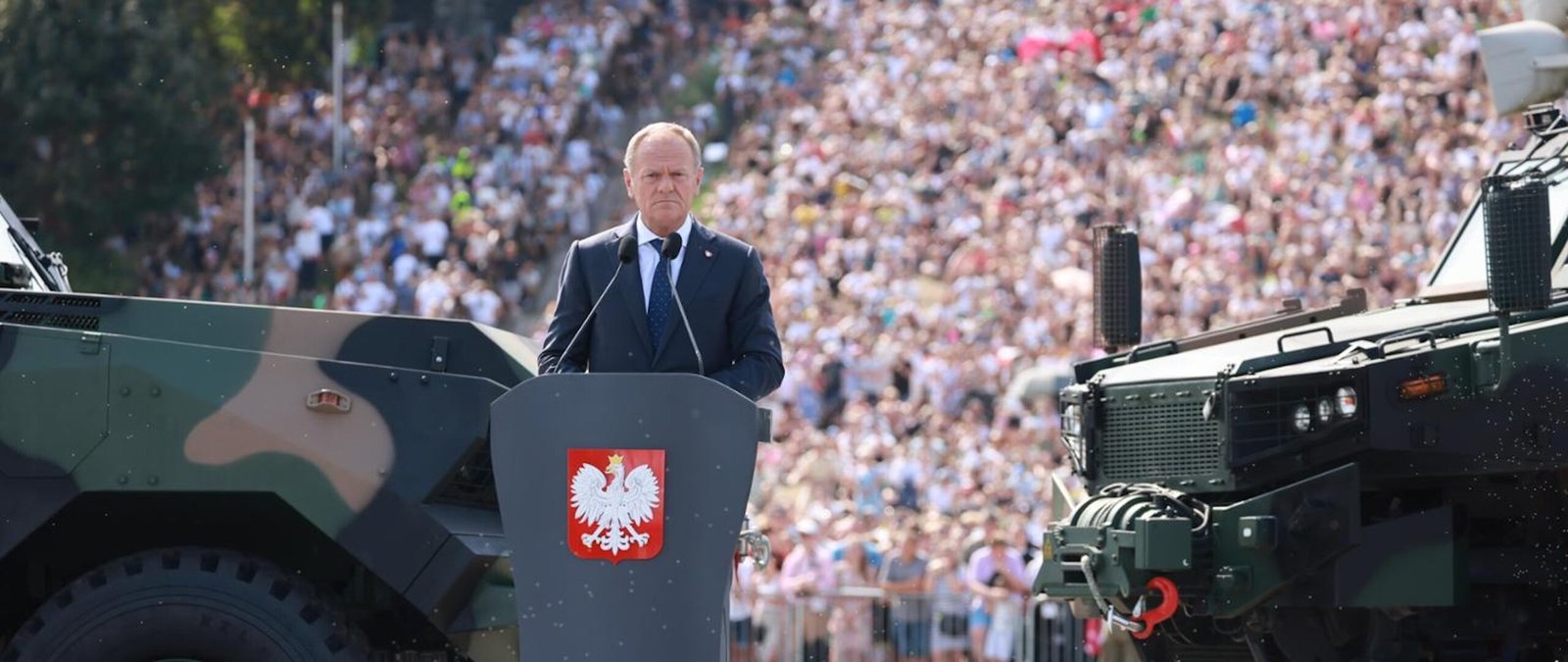
On 3 July, Polish Prime Minister Donald Tusk warned that “the coming months could truly be critical” for European security. This warning reflects a broader assessment taking shape across Europe as Russia intensifies pressure on Ukraine and NATO accelerates its rearmament efforts. In this regard, European governments increasingly believe they are entering one of the most sensitive periods for the continent since 2022.
The coming months could indeed be critical. Poland’s Prime Minister has captured a growing sense of unease spreading across the European security establishment. His warning was not so much a prediction of an imminent Russian attack on NATO territory, but a reflection of an increasingly shared assessment that the remainder of 2026 could represent one of the most sensitive periods for European security since Russia’s full-scale invasion of Ukraine.
The significance of Tusk’s remarks in early July lies less in the statement itself than in what it reveals about strategic thinking across NATO’s Eastern Flank. European governments increasingly believe that Moscow may seek to exploit the coming period before the Alliance’s latest capability commitments are fully realised, and before Europe’s expanding defence industrial base begins delivering at scale. While a conventional attack on a NATO member country is still unlikely, the risk of hybrid operations, military provocations, and attempts to test Allied cohesion is now firmly shaping defence planning across the continent.
For Poland, these concerns are not exactly theoretical. Bordering Belarus and Russia’s Kaliningrad exclave, Poland has spent the past three years transforming itself into NATO’s primary hub for supporting Ukraine, while undertaking one of Europe’s most ambitious rearmament programmes. Warsaw has consistently argued that the Kremlin views military pressure, information operations, and acts of sabotage as integral elements of modern warfare, rather than activities separate from conventional conflict.
And as witnessed in recent months, events have certainly reinforced the Polish assessment. Across Europe, intelligence agencies have reported an increase in cyberattacks, disinformation campaigns, espionage, suspected sabotage against critical infrastructure, and interference with satellite navigation systems. Incidents in the Baltic Sea involving seabed cables, persistent GPS jamming affecting civilian aviation, and suspected Russian intelligence activities have all contributed to an atmosphere of heightened vigilance. Individually, these incidents may appear manageable. But collectively, they indicate a sustained campaign designed to impose costs on Europe while remaining below NATO’s threshold for collective military response.
This explains why Tusk referred to the “changing nature of the war”. The challenge facing Europe today goes beyond traditional questions of territorial defence. The modern battlefield now encompasses energy infrastructure, digital networks, logistics, public opinion, and supply chains. Russia has consistently shown its willingness to exploit ambiguity, operating in the ‘grey zone’ between peace and open conflict in ways intended to complicate political decision-making within democratic societies.
And of course, Ukraine remains central to this strategic calculation. Moscow continues to press its offensive while dramatically expanding missile and drone strikes against Ukrainian cities and critical infrastructure. The Kremlin understands that time remains a significant factor. Although European governments have committed to substantial increases in defence expenditure, industrial production, and military capability, these investments will require years to reach full effect. Russia may therefore perceive the present period as a window of opportunity to maximise pressure before Europe’s enhanced military capacity begins altering the strategic balance.
This broader context also helps explain why European defence planning has become more focused on resilience alongside conventional deterrence. Protecting ports, rail networks, communications infrastructure, and energy systems has now become as important as deploying additional combat formations. Governments are investing in civil preparedness, stockpiling critical supplies, strengthening cyber defences, and improving coordination between military and civilian authorities. The objective is not only to deter armed attack but also to make sure that European societies remain functional under sustained hybrid pressure.
The political dimension is equally significant. Moscow has always sought to exploit differences among NATO members, particularly regarding military assistance to Ukraine, sanctions, and defence spending. Any element of political uncertainty within Europe or across the Atlantic becomes part of Russia’s strategic calculus.
At the same time, uncertainty surrounding future American security priorities has encouraged European governments to accelerate efforts to strengthen their own defence capabilities. While the transatlantic relationship remains the cornerstone of European security, leaders increasingly acknowledge that Europe must assume greater responsibility for its own deterrence. Recent EU defence initiatives, combined with NATO’s updated capability targets agreed at the Alliance’s summit in The Hague, reflect this changing reality.
But none of this suggests that Europe faces an inevitable escalation into direct war. Most analysts continue to assess that Moscow remains heavily committed in Ukraine and is unlikely to enter into a conventional conflict with NATO. However, this does not reduce the risks of limited provocations, miscalculation, or deliberate actions designed to test Alliance resolve. A drone crossing a border, a cyberattack on critical infrastructure, sabotage against transport networks, or a maritime incident in the Baltic Sea could rapidly generate political pressure requiring coordinated Allied responses.
In this regard, Tusk’s stark warning on 3 July should be understood less as a prediction than as a call for sustained vigilance. Europe has entered a period in which security now depends on preparedness, resilience, and political cohesion rather than conventional military strength.
As the Irish Presidency of the Council of the European Union has just begun its 6-month term on 1 July, these issues will undoubtedly feature at the forefront of the European security agenda. Defence industrial expansion, military mobility, infrastructure protection, and continued support for Ukraine will all require sustained political attention despite the summer pause in legislative activity.
The “critical months ahead” that Donald Tusk highlighted therefore reflect more than heightened rhetoric. They capture Europe’s growing recognition that the continent has entered a prolonged era of strategic competition in which resilience, readiness, and unity will prove just as decisive as tanks, aircraft, or missiles. Whether Europe successfully navigates this period may shape not only the outcome of the war in Ukraine but also the future credibility of European deterrence itself.
William Glynn
