

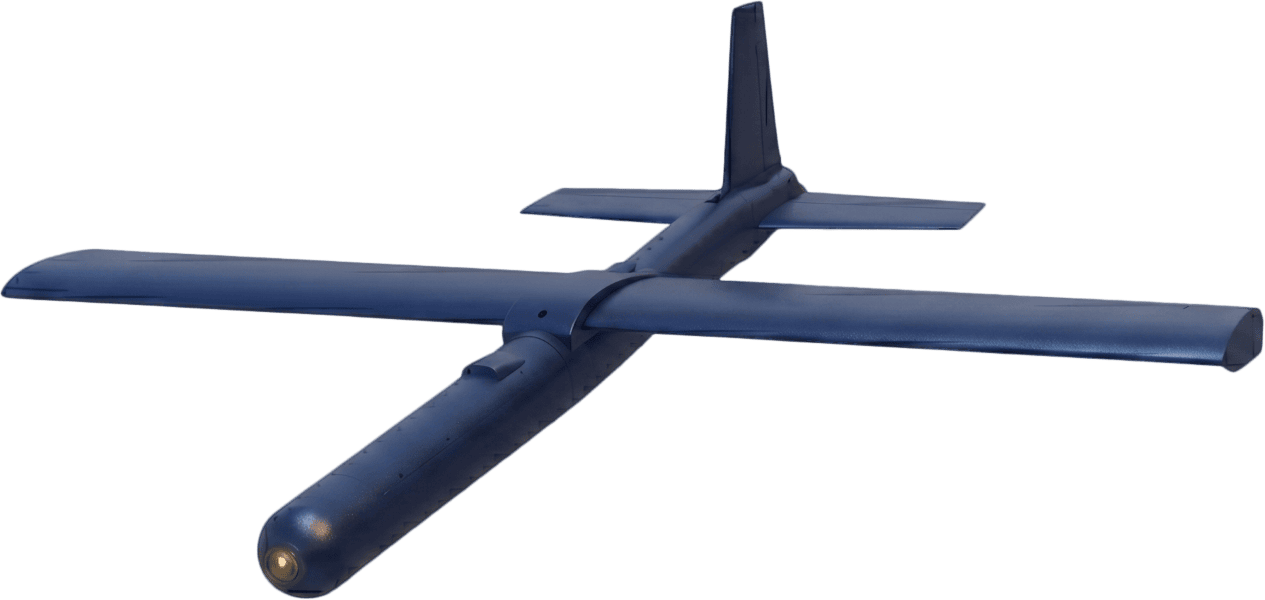
Japan has announced its intention to secure the supply of up to 80,000 unmanned aerial vehicles (UAV) per year in the civilian sector by 2030, representing an 80-fold increase from the current domestic production of approximately 1,000 units per year. Military-grade UAVs could then be drawn from that production base.
Faced with severe military personnel shortages and a deteriorating security environment shaped by Chinese military growth and North Korean missile development, Tokyo is making unmanned systems a pillar of its defence modernisation.
The Japanese government has allocated JPY100 billion (US$618 million) to build a multi-layered, coastal-defence fleet of UAVs designed to protect remote islands. Known as Synchronized, Hybrid, Integrated and Enhanced Littoral Defense (SHIELD), this fleet will be used for both reconnaissance and attack purposes. Japan’s FY2026 draft budget includes an additional JPY277.3 billion to strengthen defence capabilities related to unmanned systems more broadly.
Six reasons Japan cannot get there alone
Reaching that target will require Japan to confront six structural obstacles that its domestic defence industry, in its current form, cannot overcome alone.
Manufacturing infrastructure remains a fundamental constraint. According to AM Insight Asia, Japan lacks large-scale manufacturing facilities equivalent to the one Anduril built in Sydney, Australia. Despite generous government subsidies – amounting to up to 50% of research, development (R&D) and capital investment costs – a clear vision for the manufacturing infrastructure required to achieve 80,000 units annually remains elusive.
Furthermore, there appears to be an absence of combat-tested doctrine. Japan has no testing environment in which UAV designs can be validated under live electronic-warfare conditions. A domestic production programme built around designs that have never been proven under real electronic-warfare conditions risks producing obsolete units at scale.
Chinese component dependency compounds both problems. Japan’s home-grown drone industry relies heavily on Chinese imports, particularly control and guidance components.
Analysis from the Center for Strategic and International Studies identifies five strategic vulnerabilities in drone supply chains: structural materials, propulsion, batteries, semiconductors and logistics. Japan is exposed across multiple categories. Prior to the government’s initiative to promote domestic production, 90+% of Japan’s civilian-sector UAV supply was dominated by Chinese manufacturers.
Furthermore, domestic political constraints have slowed the legislative foundation for expansion. April 2026 revisions to export controls were a milestone, but it was contested and took years to negotiate. Offensive capabilities such as one-way attack drones remain politically sensitive too. Japan’s scientific community is sceptical of defence-related research, adding an institutional friction that slows the pace of UAV R&D beyond what budget allocations alone can resolve.
Regulatory fragmentation with potential partners adds a further layer of difficulty. For example, Kakuya Iwata, Executive Director of the Japan UAS Industrial Development Association, identified a certification wall preventing Japan and Taiwan from integrating their manufacturing capabilities, despite complementary strengths. Differences in drone certification, electrical safety and communications standards make cross-border cooperation harder, and complicate one government buying the other’s systems.
Speed asymmetry is perhaps the deepest problem of all. Japan’s defence procurement system is built around careful, multi-year acquisition cycles. Modern drone warfare demands overnight software updates and hardware iterations measured in days. These two production cultures are not easily reconciled, and the gap between them is not primarily a funding problem.

Japanese and Ukrainian cooperation
Japan-Ukraine cooperation, which emerged in early 2026, represents the most concrete response to these structural obstacles. In March, Terra Drone Corporation announced full-scale entry into the defence equipment market and a strategic investment in Kharkiv-based Amazing Drones, which develops and manufactures interceptor drones in Ukraine.
The partnership’s product, the Terra A1, is a rocket-type interceptor drone designed to neutralise Shahed-class attack drones at a unit cost of $2,000-$3,000. This is significantly lower than multi-million-dollar missile interceptors.
The Terra A1 is a compact platform with a maximum speed of 302km/h. It carries a warhead in the 500-650g range and is equipped with both day cameras (available in analogue and digital configurations) and a thermal-imaging capability. Its maximum operational range is 32km, with an operating altitude ceiling of 5,000m.
The system is vertically launched, enabling rapid deployment without dedicated runway infrastructure, and it completes it has a maximum flight time of 15 minutes. According to the Japan Times, the Terra A1 entered active combat use in April 2026, having been deployed to a military unit tasked with countering Russian UAVs.
In April, Terra Drone announced a second investment in WinnyLab, a manufacturer of fixed-wing interceptor drones, to produce the Terra A2. Whereas the Terra A1 is optimised for rapid, close-range terminal interception, the Terra A2 is designed for wide-area, forward-line defence. It has a top speed of 312km/h, provides coverage of up to 75km and has a 40+-minute flight endurance.
This enables persistent airspace surveillance, early target detection and threat neutralisation before an attack drone reaches close-range interception range. Together, the two platforms form a layered defence architecture suited to the mass Shahed-type threat environment.
An institutional framework was established in July 2026 with the launch of the Japan-Ukraine Drone Cluster, which brought together Japanese manufacturers, Ukrainian defence firms, universities and research centres to focus on manufacturing UAVs for both military and civilian applications.
The cluster is explicitly open to Taiwan and Southeast Asian partners. The commercial results have been immediate: Terra Drone secured its first Japanese Ministry of Defense contract in May 2026, valued at JPY115.4 million, to supply 300 modular UAVs to the Acquisition, Technology and Logistics Agency.
What Ukraine transfers to this partnership is not hardware alone. It brings four years of combat data, iteration methodology and a production culture built around speed.

Prospects and obstacles
James Brown, Professor of International Relations at Temple University in Tokyo, assessed the partnership as structurally sound. “Japan is a maritime country that faces mostly maritime and air threats, but it can obviously learn a lot from Ukraine,” he said. “And Ukraine is ready to help, which is great, considering that one would think they’d need all the equipment they can get to fight the Russians. Now they clearly have sufficient capacity to start exporting it.”
This trajectory is reinforced by parallel agreements. On 26 June, Airbus announced a memorandum of understanding with Kawasaki Heavy Industries to develop UAVs for anti-submarine warfare based on the Eurodrone platform.
The CEO of Ukrainian company UForce also visited Japan in April to present government officials and defence contractors with a proposal to produce thousands of UAVs for Japan’s defence and that of its allies. Ukrainian companies are simultaneously working to secure drone components from Japanese and Taiwanese suppliers to reduce their own dependence on Chinese parts.
The obstacles, however, are real.
Eisaku Ito, head of Mitsubishi Heavy Industries, warned that retooling factories to produce military drones risks generating large quantities of rapidly obsolete equipment. This is a concern that reflects the gap between Japan’s quality-control manufacturing culture and Ukraine’s faster, cheaper, accept-higher-failure-rates production philosophy.
The certification and standards fragmentation that Iwata identified with Taiwan applies to Ukrainian designs to some degree as well. So far, Russia’s response to Terra Drone’s investments has been unambiguous: Moscow summoned the Japanese ambassador in April 2026 to formally protest the Amazing Drones partnership, signalling that cooperation carries diplomatic costs.
Japan’s scientific community remains sceptical of defence-related R&D more broadly, a structural disposition that will slow integration of combat-derived Ukrainian innovations into Japan’s institutional research framework, regardless of how much the government allocates.
The 80,000-unit target requires not only investment and partnership, but also a cultural shift in how Japan’s defence establishment approaches speed, failure tolerance and iteration. That shift is already in progress, but it remains to be seen whether it will be sufficient to meet the 2030 deadline.
by Gordon Arthur
