

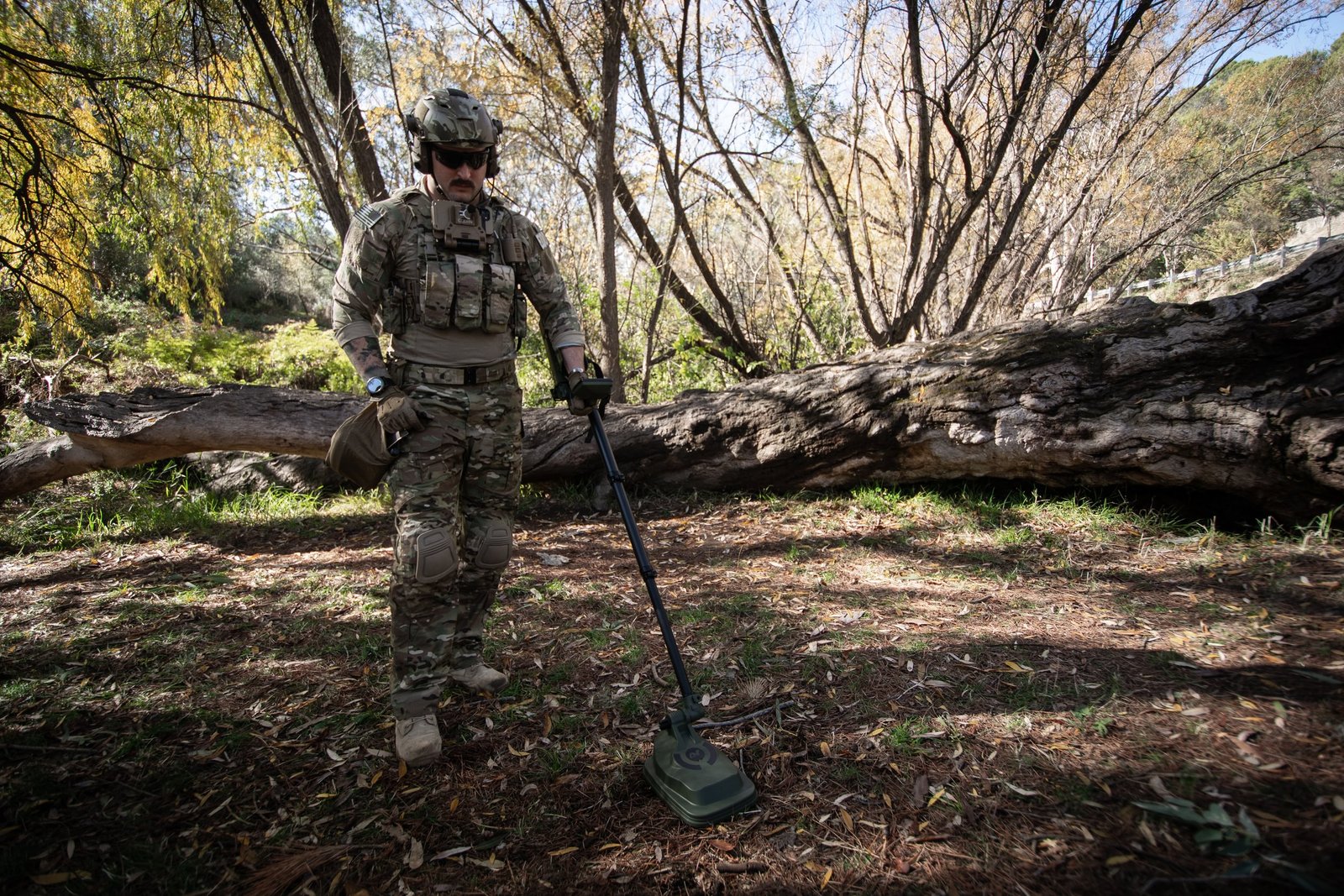
The Australian Department of Defence awarded a contract to Brisbane-based company EPE to supply specialist tools under the military’s DEF08101 Joint Counter-Explosive Hazards Programme.
EPE announced the deal on 18 June, with the equipment helping explosive ordnance disposal (EOD) personnel to find, analyse, neutralise and exploit explosives hazards. The company said older Australian Defence Force (ADF) equipment facing obsolescence will be replaced.
EPE also commented, “This single-source award offers greater assurance of the acquisition process, and greater opportunity for collaboration and controlled evolution of the search capability, with EPE managing the supply chain network and specialist training.” The company will also ensure ongoing technical support.
Two main types of device are to be inducted: Institut Dr. Foerster Ferex 4.035 digital fluxgate magnetometers supplied through KK&S Instruments, and Minelab MDS-20 handheld dual-sensor counter-improvised explosive device (IED) detectors.
These two tools will help locate deeply embedded ordnance, mines and IEDs.
Measuring 1.2m long and weighing 3.3kg, the Ferex 4.035 detects ferro-magnetic materials buried in the ground.
The MDS-20 detector, meanwhile, is manufactured in Mawson Lakes, South Australia by Minelab, a subsidiary of Codan. With production commencing in November 2025, the MDS-20 can detect low-metal landmines and IEDs.
Ben Harvey, Executive General Manager at Minelab, said: “The delivery of 205 MDS-20 counter-IEDs detectors to the ADF reflects Minelab’s sustained investment in advanced detection technologies. The MDS-20 is the result of decades of investment in Australian engineering and detection expertise, designed to deliver reliable performance in complex and high-risk environments to help keep people safe.”
The company further explained: “The MDS-20 integrates advanced metal detection and ground penetrating radar technologies to deliver exceptional detection of low- and no-metal explosive hazards, and the most challenging improvised explosive devices in a compact, lightweight platform.”
The MDS-20 works against various materials, including explosives in plastic containers, and in different soil conditions. Minelab has offices in in Brazil, India, Ireland, Mexico, the UAE and USA.
The same DEF08101 programme also saw L3Harris deliver T4 and T7 EOD robots to the ADF under a 2023 contract.

Another success for EPE was subcontracting to Babcock Australasia to supply Qinetiq Squad Packable Utility Robots (SPUR) to the ADF. Delivery of 35 robots under Project Land 154 commenced in 2022. EPE also helped integrate chemical, biological, radiological, nuclear and explosives sensors onto the SPURs.
EPE supplies MedEng bomb suits to Australia, New Zealand and other Indo-Pacific nations too.
In fact, EPE has exported to 17 nations to date, part of a deliberate de-risking, diversification strategy. For example, it previously delivered the Counter-Explosives Hazards programme to the New Zealand Defence Force (NZDF).
In 2024, EPE also provided Skydio X2D quadcopters and Bertin Exensor Flexnet unattended ground sensors under Tranche 2 of New Zealand’s Network Enabled Army programme. Furthermore, EPE teamed up with Spanish firm UROVESA and was awarded an NZDF contract for VAMTAC 4×4 vehicles. An initial acquisition of 60 vehicles will expand to 230 as follow-on phases are implemented.
by Gordon Arthur
