

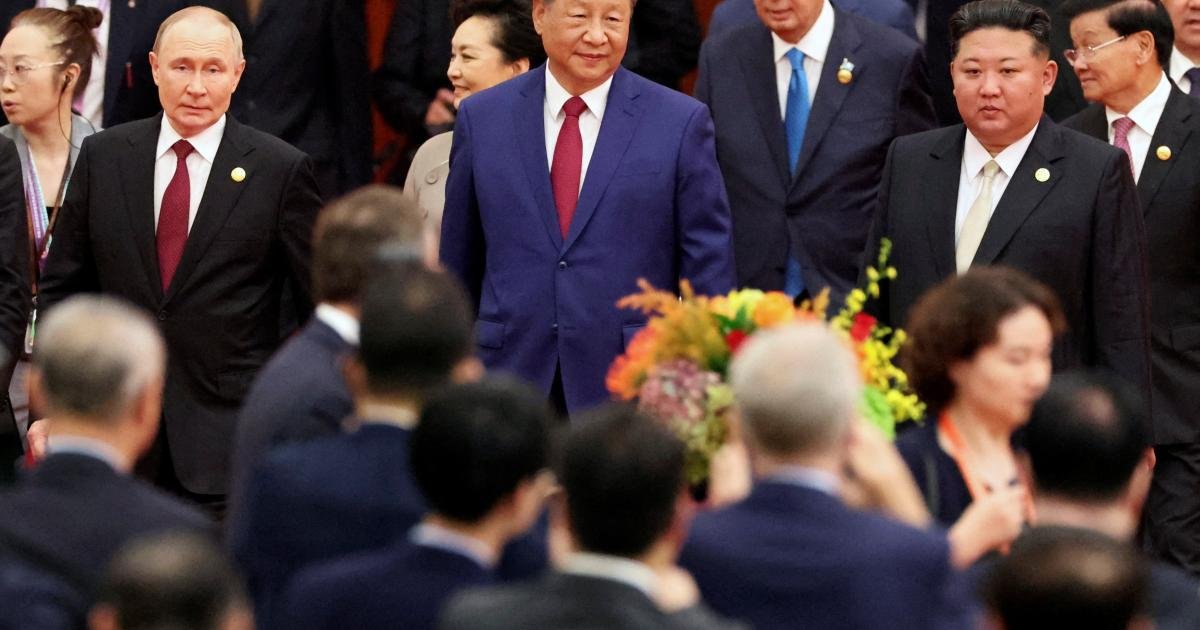
If actions speak louder than words, the four major adversaries of the United States have sent a very clear message over the past few months. In June, Chinese leader Xi Jinping took his first international trip of 2026 to North Korea, where he and North Korean leader Kim Jong Un agreed to expand their cooperation with no mention of denuclearization. Xi’s trip took place just weeks after Russian President Vladimir Putin made his 25th official visit to China, where he and Xi signed 20 different agreements spanning trade, technology, and economic cooperation. Meanwhile, news reports emerged detailing how Beijing and Moscow have provided indirect support to Iran in its war with Israel and the United States, including satellite imagery of U.S. forces in the region, missile propellant, and advanced drones. These four countries—China, Iran, North Korea, and Russia—don’t have a formal alliance but are increasingly aligning and supporting one another in ways that are materially changing the balance of power and challenging the United States and its allies.
Skeptics argue that this alignment remains shallow, divided by competing interests and mutual suspicion. In this perspective, it is nothing like the feared Axis powers during World War II because it lacks any formal commitments or aggressive public rhetoric. The U.S. intelligence community even makes a version of this argument in its 2026 Annual Threat Assessment, concluding that these relationships are “limited and primarily bilateral” and that the concept of “adversary alignment” risks overstating the depth of current cooperation.
But the absence of a formal bloc does not mean the cooperation is weak. In fact, bilateralism may be precisely what makes it effective. These four states have cooperated on military integration, technological transfers, and mutual learning in a way that exceeds that of most previous authoritarian partnerships. The bilateral arrangements among Washington’s adversaries today can be negotiated faster, are easier to conceal or deny, and are more readily tailored to each pair’s immediate strategic needs than traditional, formal authoritarian alliances. Indeed, history suggests that authoritarian alliances have often proved brittle and unreliable when formalized, particularly when they involve more than two countries. What is emerging among these four powers may be more flexible, and in some respects more dangerous.
Washington’s challenge, then, is not to determine whether a new authoritarian axis has emerged. It has not. The more important question is whether a looser but ever more capable network of military, technological, and political cooperation can generate strategic effects comparable to or even exceeding that of a formal alliance. Increasingly, the answer appears to be yes. The United States will not be able to break apart this alignment. But by understanding its structure and taking it seriously, Washington may still be able to limit its effectiveness.
TRANSACTIONAL TODAY, STRATEGIC TOMORROW
China, Iran, North Korea, and Russia have long shared an adversarial relationship with the United States, but only since 2022 have they developed something approaching meaningful cooperation. The principal catalyst was Russia’s full-scale invasion of Ukraine that year, after which Moscow faced severe sanctions and the rapid depletion of key weapons stocks. As Russia needed more external military support, it became far more willing to exchange its advanced military technology and operational expertise in order to get it.
North Korea, for example, initially withheld meaningful support after Russia’s invasion, but by 2023 it had become one of Moscow’s most important wartime suppliers, providing millions of rounds of artillery ammunition, ballistic missiles, and other military materiel. In return, Russia gave North Korea assistance with military modernization, including of satellites and air defense, as well as deepening economic ties. This relationship began as purely transactional but has gone on to become both deeper and more strategic. In 2024, for instance, the two countries signed a mutual defense treaty, and Kim subsequently dispatched more than 12,000 troops to support Russian military operations in the first large-scale deployment of North Korean combat personnel abroad.
Iran similarly emerged as a critical wartime partner for Russia. At first, Tehran supplied Moscow with large numbers of one-way attack drones, including the Shahed systems that have been used extensively against Ukrainian infrastructure. It then expanded its support to include ballistic missiles, technical expertise, and trainers. The relationship has since evolved into joint defense production, with Russia and Iran cooperating to finance and manufacture Iranian-designed drones in the Alabuga special economic zone in Russia.
China has stopped short of directly providing arms to Russia, but its support has been indispensable to Moscow’s war effort. U.S. officials have said that China is supplying dual-use technologies, including microelectronics, machine tools, the nitrocellulose used to manufacture ammunition, optical components for use in Russian tanks and armored vehicles, and other critical inputs for weapons production. China’s help has enabled Russia to rebuild its defense industrial base far more rapidly than would otherwise have been possible. China, in other words, has become the economic and industrial foundation of Russia’s military reconstitution. And as with China’s collaboration with North Korea and Iran, this economic engagement has led to deeper military cooperation, including increasing interoperability and expanding joint bomber patrols and naval exercises. According to Reuters, Russian and Chinese officials signed a covert military training agreement in July 2025 under which 200 Russian troops have already been trained in China in drone warfare and hundreds of Chinese soldiers are to train in Russia.
Russia, in turn, has provided its partners with technological and military assistance that could materially alter regional balances of power. In November 2024, the commander of the U.S. Indo-Pacific Command, Admiral Samuel Paparo, warned that he expected Russia “to provide submarine technology to [China] that has the potential of closing American undersea dominance.” Similarly, the U.S. Defense Intelligence Agency assessed in 2025 that “Russia is expanding its sharing of space, nuclear, and missile applicable technology, expertise, and materials to China, Iran, and North Korea,” potentially helping all three countries accelerate their development of weapons of mass destruction and other advanced military tools.
A ROSE BY ANY OTHER NAME
These states are also helping one another other mitigate Western sanctions and reduce strategic isolation. For instance, as the U.S.-China Economic and Security Review Commission reported to Congress, China was helping Russia, Iran, and North Korea circumvent Western sanctions “through money laundering, barter trade, and a shadow fleet of tankers as well as skirting of export controls through direct sales, transshipment, technology transfer, and local production.” Joint weapons production, technology transfers, and supply-chain integration reinforce such resilience. Institutions such as the BRICS and the Shanghai Cooperation Organization, meanwhile, provide diplomatic venues through which these countries can gradually legitimize alternative political and economic arrangements that form outside of U.S.-led institutions. The cumulative result is a parallel security and industrial ecosystem that is less vulnerable to coercive pressure from the United States.
The fact that this alignment is bilateral and falls short of a formal, multicountry alliance is no reason to underestimate it. Indeed, it’s hard to see how the cooperation between China, Iran, North Korea, and Russia would be more consequential if it became a formal axis along the lines of historical cases of authoritarian alliances. Alliances in the nineteenth century, after all, tended to be defensive frameworks designed to manage great-power rivalries and domestic threats; allies promised that if one of them went to war, the others would not join the enemy. There was virtually no joint military planning, no unified command structures, and no shared doctrine. By contrast, today, China, Iran, North Korea, and Russia are actively helping strengthen one another and are sharing more and more resources and know-how.
Even the most feared authoritarian alliance in modern history, the Axis alignment of Nazi Germany, imperial Japan, and fascist Italy before and during World War II, was comparatively weak. In 1939, the three countries signed the Tripartite Alliance, which committed each one to assisting the others if any of them were attacked by a power not yet in the war. But there was no operational planning or coordination. Germany did not inform Japan of its plan to invade the Soviet Union. Japan did not inform Germany of its plans for Pearl Harbor. The Axis never executed a single joint military operation. Japan even signed a neutrality pact with Moscow in 1941 and maintained it until the final weeks of the war, completely ignoring Germany’s war on the eastern front.
Even the most feared authoritarian alliance in modern history was comparatively weak.
The Sino-Soviet alliance formed after World War II was more substantive but still fragile. Signed in February 1950, it was founded on a binding mutual defense treaty to prevent the resurgence of Japanese imperialism. The two countries cooperated closely in the Korean War, and afterward, there was a degree of military industrial cooperation and co-production. But Soviet leader Joseph Stalin saw China as very much the junior partner—a slight that Chinese leader Mao Zedong felt acutely—and after Stalin died, the alliance began to come apart as Mao’s frustrations with an unequal alliance rose to the surface.
By contrast, the personal ties in the Chinese-Russian relationship today run deep. Xi and Putin have met over 40 times and demonstrated a profound commitment to working together, including in what they call a “no limits partnership.” This alignment is driven by the two leaders, which ensures that all the other pieces in their governments fall into place.
There are, of course, tensions among the four countries. For example, The New York Times reported that the Russian domestic intelligence agency feared Chinese penetration. And Western scholars point to Russians who criticize China and Chinese who criticize Russia as proof that the alignment is not as strong as it seems. But ultimately, the leaders appear to be fully invested and to set the agenda, and their representatives are meeting and talking regularly to handle the irritants in their relationships, minimizing them as much as possible and ensuring that they do not get in the way of a broader alignment.
SAND IN THE GEARS
Adversary alignment affects U.S. national security interests in a number of ways. First, wars in one region involving one of these four powers are highly likely to lead the others to intervene indirectly, as China, Iran, and North Korea have in the war in Ukraine and as China and Russia have in Iran. The technological transfers in which these countries engage have the potential to shift the regional balances of power against the United States. It will make it harder for the United States and its allies to isolate their rivals through sanctions. Adversary alignment also increases the risk of simultaneous conflict for the United States: if war broke out between China and the United States, for instance, North Korea and Russia would likely see a strategic opportunity to act in their own interests while the United States was distracted.
As long as the current leadership remains in power in each of these countries, Washington has very little chance of breaking up this alignment. But there are steps that the United States can take to limit its effectiveness. Updating and imposing sanctions and export controls, for instance, may resemble a game of whack-a-mole, but it is a necessary step in impeding illicit trade between these countries. Washington could also publicly disclose elements of their illicit cooperation, which would likely give Beijing pause, given its fear of becoming a target of additional U.S. sanctions. And Washington can activate third countries to bring pressure to bear, as seen in 2024 when Saudi Arabia pressed Russia not to provide advanced missiles to the Houthi militia in Yemen. The United States can also contain the network by using diplomacy to prevent it from expanding. For instance, the United States worked with Brazil, India, and South Africa in 2024 to stymie the efforts of China and Russia to turn the BRICS into a more overtly anti-American organization.
The United States must also prepare to deal with the consequences of the alignment. This includes ensuring that the intelligence community collects, analyzes, and appropriately shares information pertaining to adversary cooperation; engaging and educating allies about the nature and effects of the alignment; and developing countermeasures for the military advantages that one adversary may gain from another’s assistance.
Washington’s authoritarian rivals are highly unlikely to launch a coordinated attack on the United States or directly intervene on each other’s behalf if the United States uses military action against one of them. But their alignment does represent one of the most significant and serious integrations of authoritarian militaries in modern history. And it comes at a time when the old rules-based international order has broken down and the risk of major war is rising. It would be irresponsible not to take it seriously and on its own terms.
Loading…
