

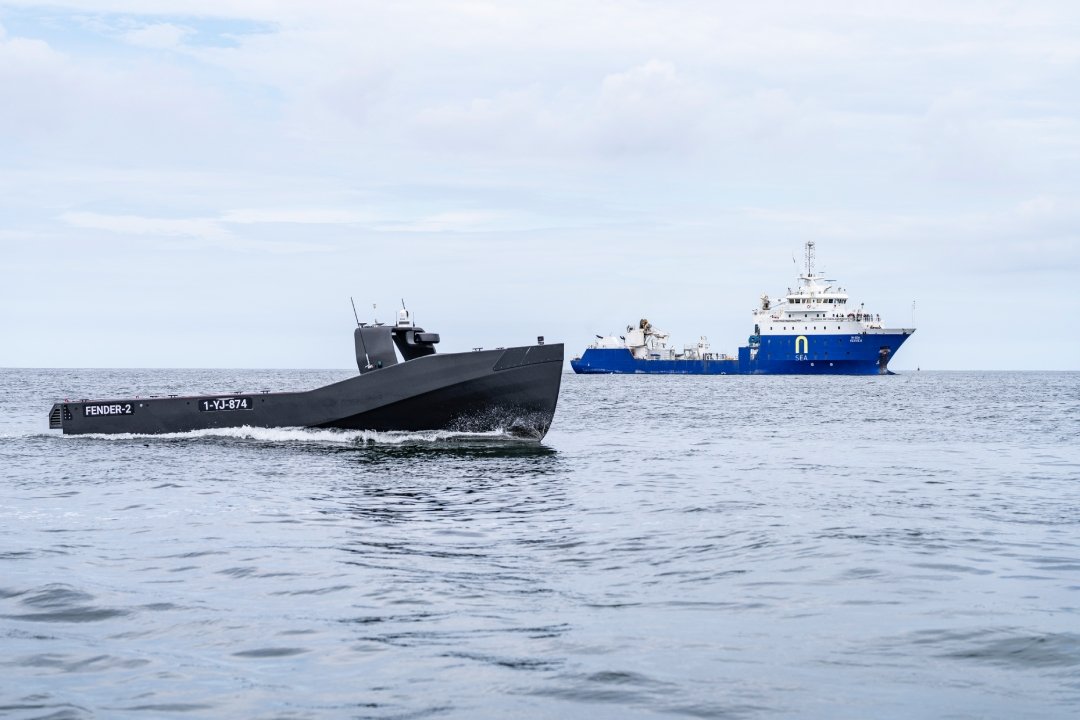

The Netherlands Ministry of Defence (MoD) has launched the design stage for an uncrewed surface vessel (USV) that will support the Royal Netherlands Navy’s (RNLN’s) new anti-submarine warfare (ASW) frigates.
The RNLN plans to procure up to four new crewed ASW frigates, under what is known as the ASWF programme (with this programme being produced in partnership with the Belgian navy). The first new Dutch ship is scheduled to enter service in 2033.
Across the maritime domains (air, surface, and sub-surface) and across naval warfare tasks therein, the RNLN sees uncrewed systems as supporting crewed platforms in a ‘hybrid navy’ construct. This integrated, emerging force structure was set out in the Navy’s ‘Future Vision: Maritime Uncrewed’ strategy, published in April 2026.
The development of a USV capability to support the ASWF platforms is an early illustration of this crewed/uncrewed ‘hybrid’ approach, an approach designed to deliver a maritime uncrewed task force (MUTF) operational construct for the Navy.
In late July, the MoD announced that its Materiel and IT Command (COMMIT) had authorised the Dutch Naval Design (DND) organisation to commence design work on a 12-metre USV.
DND is a bespoke naval design partnership that integrates the respective inputs of the RNLN and COMMIT, the national defence industrial base, and the national research and development (R&D) ‘ecosystem’.
Under a construct called ‘USV Alliance’, a dozen design, industry, and R&D organisations – the latter including MARIN and TNO – have come together to develop the concept for meeting the navy’s new USV requirement.
The programme will develop a prototype vessel for testing; lessons will then be iterated into a final design.
The USV is slated to carry a dipping sonar to support its uncrewed underwater ASW sensing capability. This requirement is to be met by Thales’ Compact Flash active-dipping sonar system.
In a social media post announcing the USV development, COMMIT said the uncrewed vessel will expand the frigate’s range and area of operation, thus improving underwater threat detection capacity. This will allow the frigate to react faster without itself entering harm’s way, COMMIT added.
It noted too that ASW is a core task for the RNLN.
In the ‘Future Vision’ document, ASW was one of seven warfare areas for which the Navy has developed what it terms ‘perspectives’ on how the crewed/uncrewed ‘hybrid’ model may reinforce warfighting and wider operational outputs. The other six areas are: naval mine warfare; integrated air and missile defence; amphibious littoral operations; maritime special operations; maritime strike; and securing North Sea and Dutch Caribbean territorial waters.
In the ASW area, the ‘Future Vision’ document perceives that the USV’s contribution, alongside deploying sonar capabilities (including towed-array as well dipping systems) to support underwater target prosecution, will involve operating as a forward-deployed communications node; here, it will pick up and pass on (to the frigate, and elsewhere) messages sent from submarines and uncrewed underwater vehicles via surface gateway communications buoys.
According to the vision, the USV could perform these roles while in open-water transit within a task group or while securing coastal waters or maritime chokepoints.
By 2035, the vision added, the RNLN’s crewed ASW assets, like the frigates, will be supported by several USVs operating in a dispersed manner.
A primary part of the ‘Future Vision’ process for building the Navy’s developing ‘hybrid’ force structure and MUTF operational construct was the establishment of the annual Maritime Uncrewed Sea Trials (MUST) operational experimentation (OPEX) activity. At the inaugural MUST event, which took place across five weeks in June – in the North Sea, off the RNLN’s Den Helder base – MUTF components from all maritime domains were integrated, and with crewed platforms, to test the capability to search, detect, locate, and identify a vessel of interest, and then to determine its threat level. In this context, USVs present were employed in a dispersed but collaborative manner to position themselves to identify the target.
by David Oliver
