

What does “big” really mean when you’re talking about a military base?
Is it the amount of land? The number of troops? The aircraft, tanks, and equipment packed inside its borders? Or is it the influence that base has on military operations around the world?
The answer is a little bit of everything.
Across the United States, military installations serve as the backbone of national defense. Some cover hundreds of square miles of rugged desert terrain.
Others function almost like self-contained cities, with schools, hospitals, shopping centers, fire departments, and populations larger than many American towns. Drive through one of these installations and you might forget you’re on a military base at all, until a convoy of armored vehicles rolls past.
The biggest US military base isn’t necessarily the one with the most personnel. Likewise, the largest military installation by acreage may not be the most strategically important. That’s what makes this topic so fascinating. Every giant base has its own story, purpose, and role in America’s defense network.
In this post, we’ll examine the top 5 biggest US military bases and look beyond simple rankings. You’ll discover which installations occupy the most land, support the largest military communities, and play critical roles in training, deployment, research, and global security operations.
From sprawling desert testing grounds in the Southwest to bustling military hubs on the East Coast, these bases represent billions of dollars in infrastructure and decades of military history. Some train elite combat units. Others test cutting-edge missile technology. One even operates on a scale so enormous that it can be seen clearly from space-based imagery.
Let’s begin by understanding how military bases are measured, and why “biggest” isn’t always as straightforward as it sounds.
How Are Military Bases Ranked by Size?
Before we jump into the rankings, there’s something worth clearing up. Ask ten military enthusiasts to name the biggest US military base, and you might get five different answers. That’s because military installations can be measured in several ways, and each method tells a different story.
The most obvious measurement is land area. This is where massive training and testing facilities often dominate the conversation.
Some installations stretch across hundreds of thousands, or even millions, of acres. To put that into perspective, certain military ranges are larger than entire U.S. counties. These vast spaces allow troops to conduct live-fire exercises, test missile systems, and train under realistic battlefield conditions without disturbing nearby civilian communities.
Then there’s population. A base with 30,000 acres might seem small compared to a sprawling desert range, but if it houses tens of thousands of active-duty personnel, civilian employees, contractors, and military families, its daily footprint can be far greater.
In many cases, the largest military communities operate like fully functioning cities with their own schools, hospitals, transportation networks, and retail centers.
Strategic value also matters. Some bases serve as deployment hubs capable of moving troops and equipment anywhere in the world within hours. Others are centers for intelligence, special operations, or advanced weapons development. Their influence extends far beyond their physical boundaries.
Read also: Why Guam Military Base Is a Vital U.S. Stronghold in the Pacific
For this ranking, we’ll consider a combination of factors: total land area, military population, operational capacity, and overall significance to U.S. defense. This broader approach provides a more complete picture of what truly makes a military installation one of the largest military bases in the US.
With that framework in mind, let’s start with a base that has become synonymous with America’s rapid-response military power.
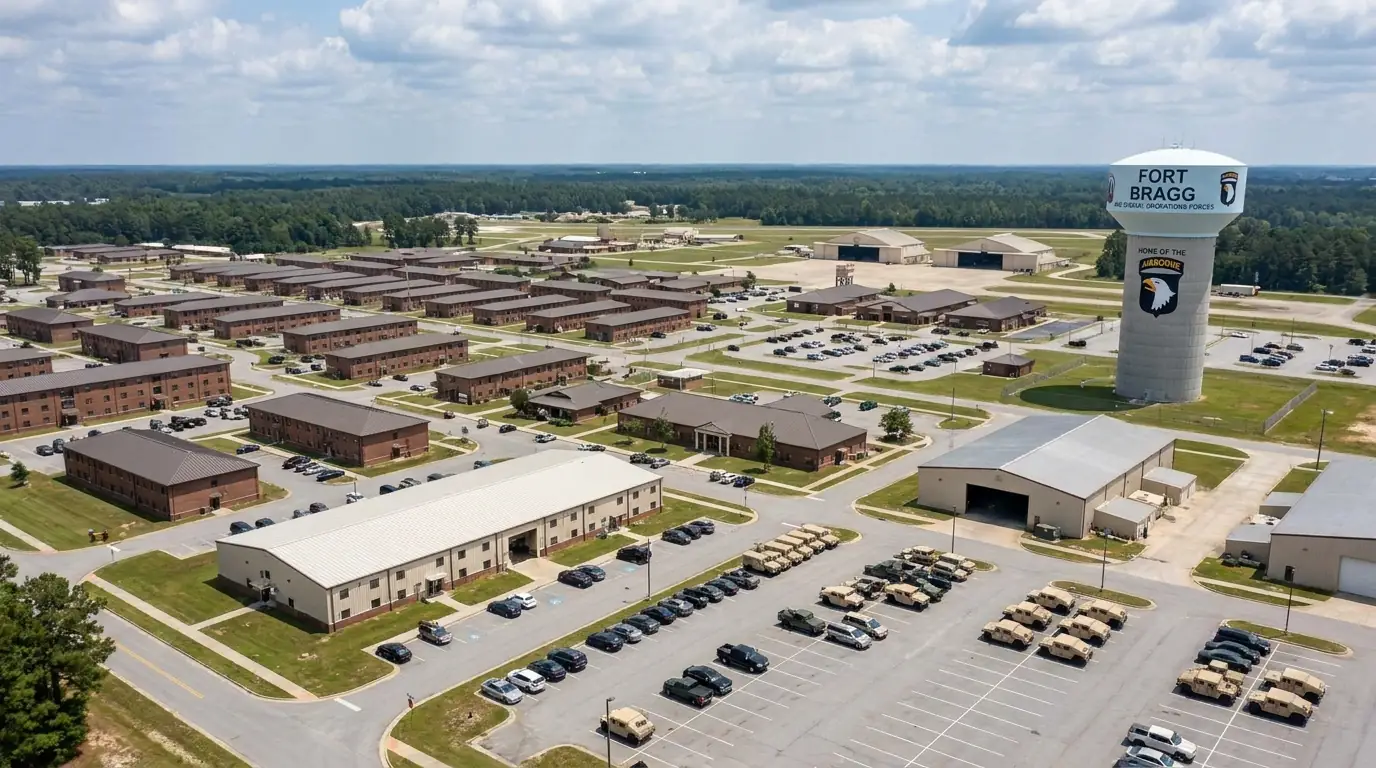
1. Fort Bragg, North Carolina
If military bases were ranked purely by activity, movement, and sheer human energy, Fort Bragg would be difficult to beat.
Often recognized as one of the largest military bases in the US by population, Fort Bragg serves as a nerve center for some of the Army’s most deployable and combat-ready forces. Located in North Carolina, the installation supports a military community that routinely exceeds 50,000 active-duty personnel, with thousands of civilian employees and family members living nearby. At any given moment, soldiers may be training for airborne operations, preparing for overseas deployments, or returning from missions around the globe.
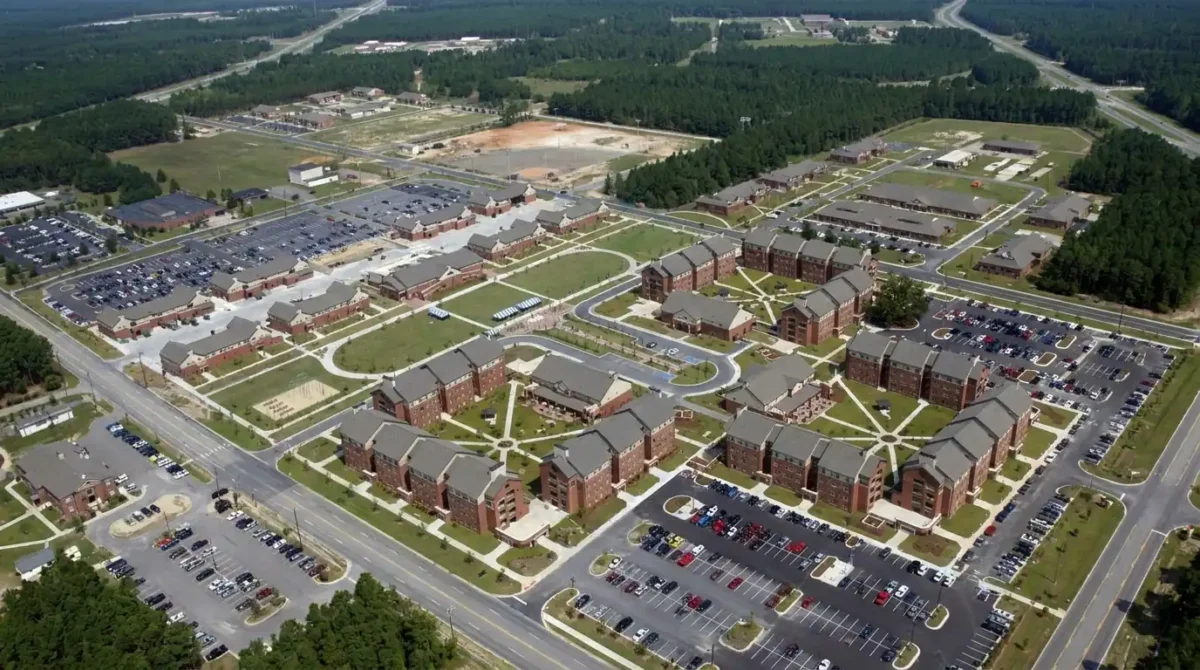
What makes Fort Bragg stand out isn’t just its size, it’s its concentration of elite military capability. The installation is home to the XVIII Airborne Corps, the 82nd Airborne Division, and the U.S. Army Special Operations Command. Few military locations anywhere in the world house such a powerful collection of rapid-response units in one place.
Covering more than 160,000 acres, the base includes extensive training grounds, airfields, firing ranges, and support facilities. Yet despite its enormous footprint, Fort Bragg often feels less like a remote military post and more like a bustling city built around a mission. Schools, medical centers, fitness facilities, and shopping districts support the thousands of families who call the installation home.
One way to appreciate its scale is to consider deployment capability. During major operations, units stationed here can mobilize and move across continents with remarkable speed. That’s one reason military planners often view Fort Bragg as one of the most strategically important installations in the United States.
Big in acreage. Bigger in influence. Fort Bragg has earned its place near the top of any list discussing the biggest US military base.
2. Fort Cavazos, Texas
Everything feels larger in Texas, and Fort Cavazos is a perfect example.
Formerly known as Fort Hood, this enormous installation ranks among the biggest military bases in America and has long been considered one of the Army’s most important centers for armored warfare. Spanning roughly 214,000 acres in central Texas, the base possesses enough open terrain to support large-scale combat training that would be impossible in more densely populated regions of the country.
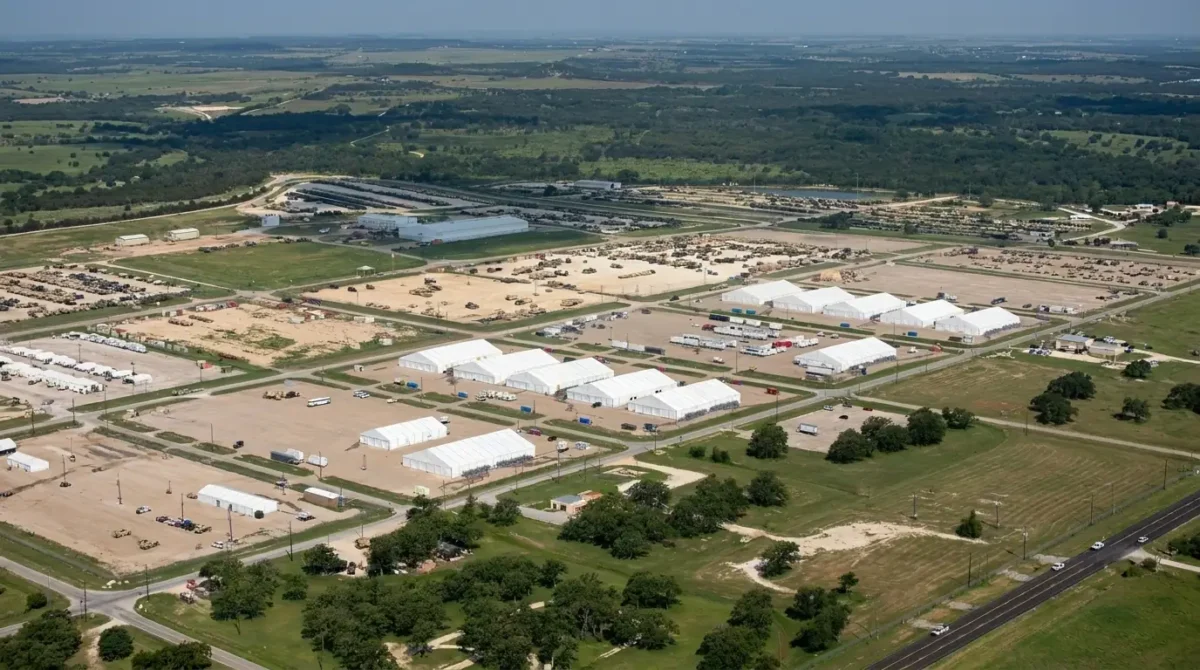
Fort Cavazos is often described as a city disguised as a military installation. Tens of thousands of active-duty soldiers, civilian workers, contractors, and family members pass through its gates every day.
The total population connected to the base can rival that of a mid-sized American city, creating a constant flow of activity across housing areas, medical facilities, schools, training grounds, and administrative centers.
What truly sets the installation apart is its role in preparing heavy combat forces. Tanks, armored fighting vehicles, artillery systems, and support units regularly conduct exercises across the base’s expansive training areas. From the air, sections of Fort Cavazos resemble a patchwork of maneuver corridors, firing ranges, and tactical training zones stretching toward the horizon.
The economic impact is equally impressive. Military spending associated with the installation contributes billions of dollars to the Texas economy and supports thousands of jobs throughout surrounding communities. Restaurants, retailers, construction companies, and service providers all benefit from the base’s presence.
Perhaps the most remarkable aspect of Fort Cavazos is how it balances scale with readiness. Despite its vast size, the installation remains focused on a singular purpose: preparing soldiers for real-world operations. Every road, training area, and facility contributes to that mission.
When discussing the biggest US military base by both acreage and military population, Fort Cavazos consistently earns a place near the very top of the conversation.
3. Fort Bliss, Texas
If Fort Cavazos feels big, Fort Bliss feels almost endless.
Located in western Texas and extending into parts of New Mexico, Fort Bliss covers more than 1.1 million acres of training land, making it one of the largest military installations in the United States. To visualize that scale, imagine an area larger than some entire national parks. A soldier could spend hours navigating portions of the training range without ever approaching the installation’s outer boundaries.
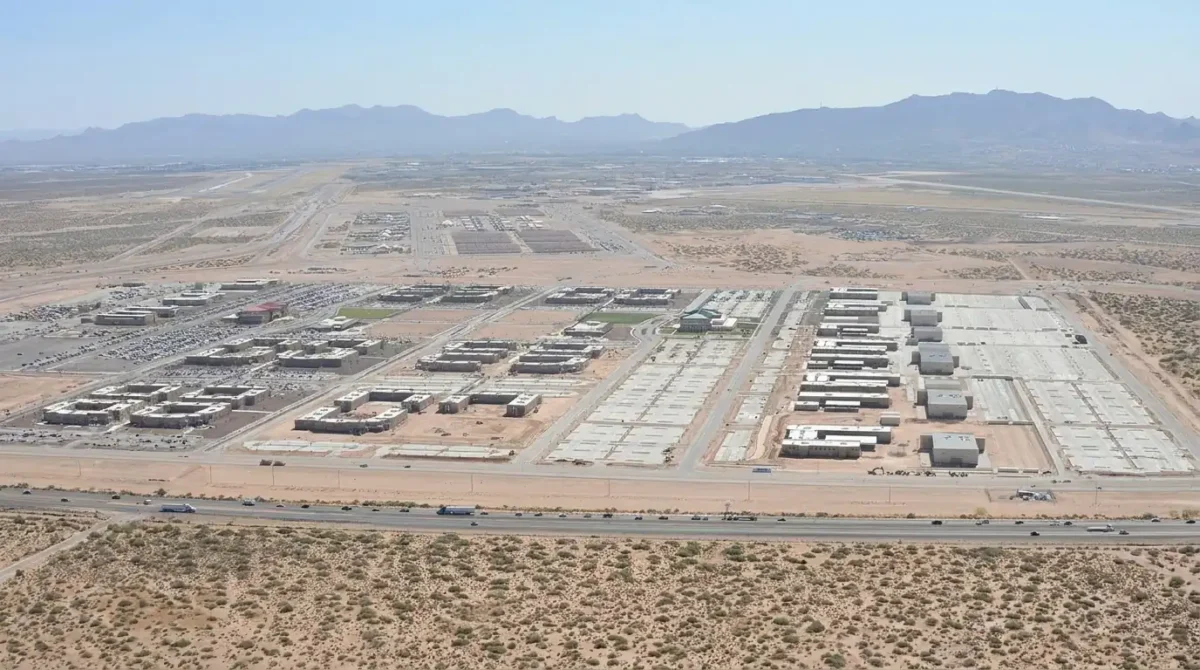
The geography of Fort Bliss plays a major role in its importance. Unlike bases constrained by urban development, Fort Bliss benefits from vast stretches of desert terrain that closely resemble environments where U.S. forces have operated throughout the Middle East and other arid regions. This realistic landscape allows troops to conduct large-scale exercises under conditions that mirror actual deployment environments.
Fort Bliss is best known as the home of the Army’s Air Defense Artillery branch. Here, soldiers learn to operate sophisticated missile defense systems designed to detect, track, and intercept airborne threats.
The installation also supports joint training exercises involving multiple military branches, making it a critical hub for modern warfare preparation.
Yet Fort Bliss isn’t simply a giant training ground. It supports a thriving military community with housing, schools, healthcare facilities, recreational centers, and commercial services. Thousands of military families live and work on or near the installation, creating a vibrant ecosystem that extends far beyond military operations.
One of the lesser-known advantages of Fort Bliss is space itself. Modern military exercises increasingly require room for drones, missile systems, electronic warfare testing, and large troop movements. Few installations can offer the scale needed for such activities.
That’s why Fort Bliss continues to grow in strategic importance. While some bases are known for population and others for prestige, Fort Bliss stands out because of something increasingly valuable in the modern world: room to operate, train, and innovate on a truly massive scale.
4. White Sands Missile Range, New Mexico
When people think about the biggest US military base, they usually picture soldiers, barracks, and training exercises. White Sands Missile Range is different. Very different.
Covering approximately 2.2 million acres across southern New Mexico, White Sands is the largest military installation by land area in the United States. Its footprint is so immense that it dwarfs many cities, counties, and even some small states’ protected park systems. If acreage alone determined the rankings, White Sands would sit comfortably at the top.
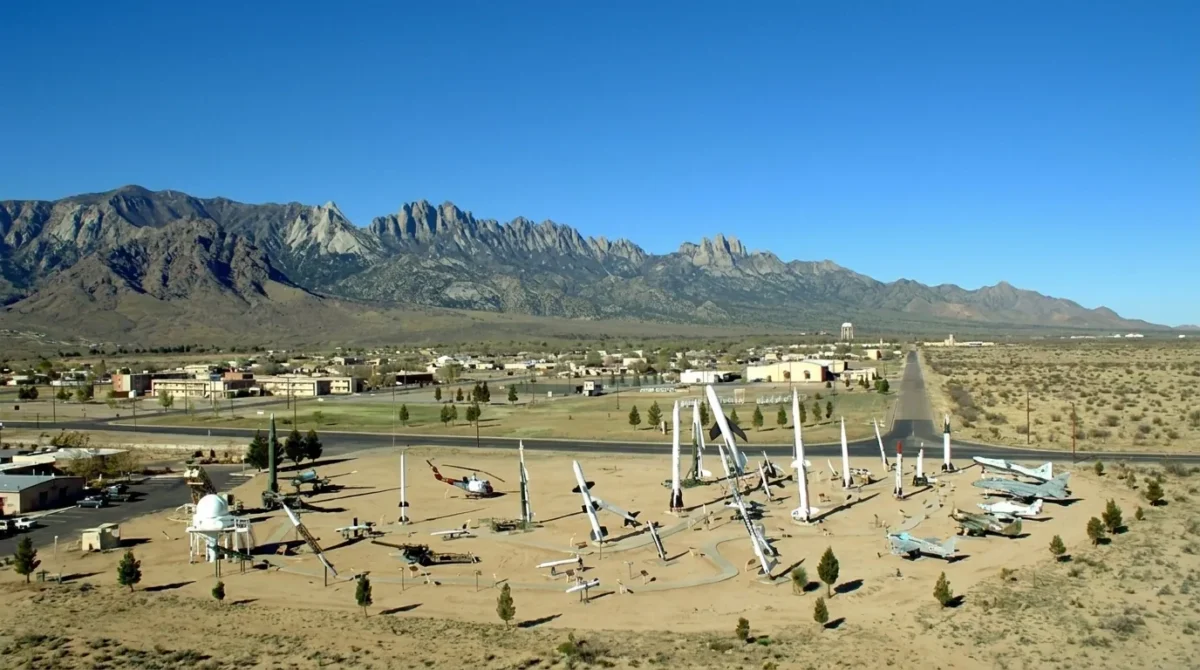
But size is only part of its story.
Unlike traditional military bases focused on housing large troop populations, White Sands functions primarily as a testing and research complex.
For decades, it has been one of America’s most important locations for missile development, weapons testing, aerospace research, and defense innovation. The vast, isolated desert landscape provides an ideal environment for experiments that require huge safety zones and unobstructed flight paths.
The range has witnessed some of the most significant moments in military technology history. Missile systems, rocket programs, radar technologies, and advanced defense platforms have all been tested here. In many cases, technologies that later became central to national defense were first evaluated across these remote desert expanses.
One reason White Sands remains so valuable is simple geography. In an era of increasing urban development, finding millions of acres where long-range tests can occur safely is extraordinarily rare. White Sands offers that space at a scale few places on Earth can match.
Today, the installation continues supporting cutting-edge research involving missile defense, space operations, unmanned systems, and emerging military technologies. While it may not have the largest military population, its influence reaches far beyond New Mexico.
White Sands proves that the biggest military installation isn’t always measured by the number of people inside it, sometimes it’s measured by the innovations that emerge from it.
5. Naval Station Norfolk, Virginia
Not all military giants are built in deserts or spread across endless training grounds. Some are built around the sea.
Naval Station Norfolk, located in Virginia, is widely recognized as the largest naval base in the world. While it occupies far less land than White Sands Missile Range or Fort Bliss, its operational scale is staggering. This is the beating heart of America’s naval power, a place where aircraft carriers, destroyers, cruisers, submarines, and support vessels come together in one of the busiest military ports on the planet.
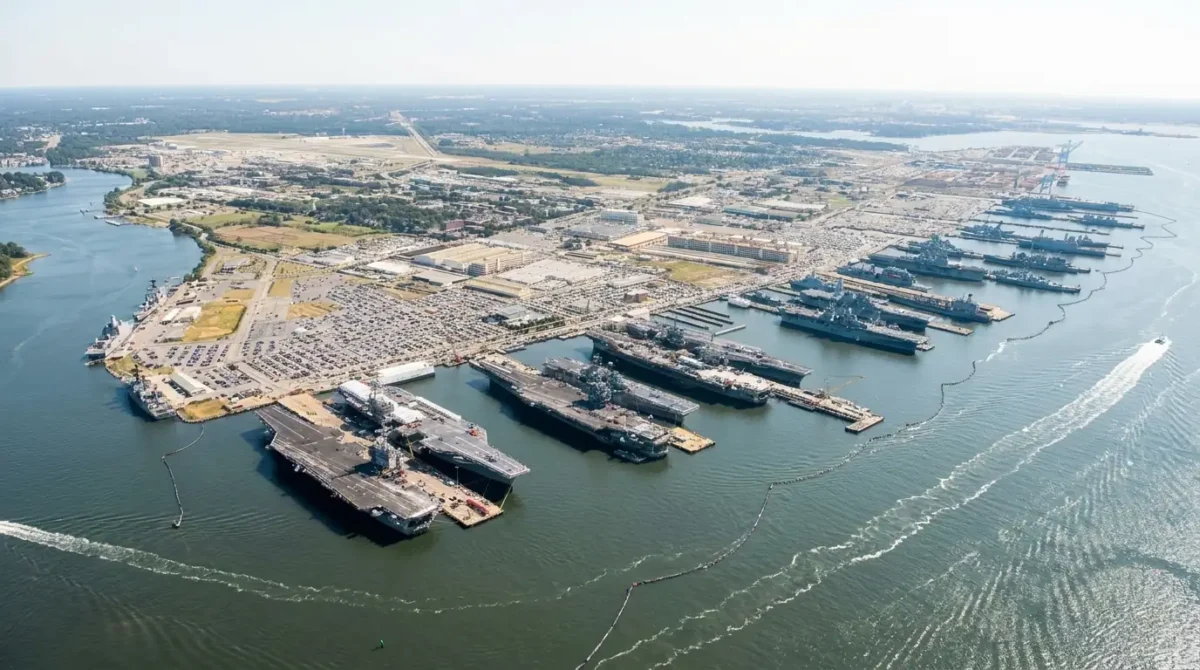
A walk along the waterfront offers a remarkable sight. Massive warships line the piers, stretching across miles of shoreline. The installation contains dozens of piers, extensive maintenance facilities, logistics centers, air operations infrastructure, and command headquarters that support naval missions around the globe.
What makes Naval Station Norfolk unique is the concentration of assets. Instead of measuring size by acreage alone, consider the value and capability packed into its boundaries.
Aircraft carriers, essentially floating cities, are stationed here alongside some of the most advanced vessels ever built. Thousands of sailors, civilian employees, contractors, and military families contribute to the base’s daily operations.
The station also serves as a critical deployment hub. Naval forces can move rapidly from Norfolk into the Atlantic Ocean and beyond, supporting missions in Europe, the Middle East, Africa, and other strategic regions. That geographic advantage has helped make the base indispensable to U.S. military planning.
Economically, its influence is enormous. The installation generates billions of dollars in regional activity and supports countless jobs throughout southeastern Virginia.
When discussing the biggest military bases in America, Naval Station Norfolk earns its place because of what it represents: unmatched naval capability concentrated in one location. Few military installations anywhere on Earth wield such a powerful combination of scale, readiness, and global reach.
Comparison Table: The Top 5 Biggest US Military Bases
Numbers don’t tell the whole story, but they do help put these military giants into perspective.
One base dominates in land area. Another leads in military population. One specializes in missile testing, while another serves as the command center for some of America’s most elite combat forces. Looking at them side by side reveals just how differently the United States uses its largest military installations.
| Military Base | State | Approximate Size | Primary Function | Notable Feature |
| Fort Bragg | North Carolina | 160,000+ acres | Airborne and Special Operations | One of the largest military populations in the U.S. |
| Fort Cavazos | Texas | 214,000+ acres | Armored Warfare Training | Major Army combat readiness center |
| Fort Bliss | Texas & New Mexico | 1.1+ million acres | Air Defense and Large-Scale Training | Vast desert training environment |
| White Sands Missile Range | New Mexico | 2.2+ million acres | Missile Testing and Research | Largest military installation by acreage |
| Naval Station Norfolk | Virginia | Major naval complex | Fleet Operations and Deployment | Largest naval base in the world |
What’s interesting is that no single installation dominates every category.
White Sands Missile Range is the clear winner in terms of acreage. Fort Bragg, meanwhile, stands out for its concentration of personnel and rapid-deployment capability. Fort Cavazos remains a cornerstone of Army readiness, while Fort Bliss offers training space on a scale few installations can match. Naval Station Norfolk brings together a level of maritime power that few countries could replicate.
In many ways, these bases reflect the evolution of modern warfare. Success isn’t just about having more land or more troops. It’s about having the right facilities, in the right location, supporting the right mission.
And that’s exactly what these five installations do better than almost anywhere else in America.
Why These Military Bases Matter to National Security
It’s easy to look at a list of the biggest US military bases and focus on the numbers, millions of acres, thousands of personnel, billions of dollars in infrastructure. But the true value of these installations lies in what they make possible.
Every day, these bases function as launchpads for military readiness. Soldiers train at Fort Cavazos before deploying overseas. Airborne units at Fort Bragg maintain rapid-response capabilities that allow them to mobilize within hours during international crises. At Fort Bliss, troops learn to operate advanced missile defense systems designed to counter evolving threats.
Meanwhile, White Sands Missile Range helps shape the future of military technology through testing and research. Naval Station Norfolk projects American naval power across multiple continents.
Together, these installations form a network that supports nearly every aspect of modern defense operations.
Their importance extends beyond military activities. During natural disasters, military bases frequently become coordination centers for emergency response. Aircraft, helicopters, medical personnel, and logistical resources stationed at these facilities often assist communities affected by hurricanes, floods, wildfires, and other emergencies. In many cases, military infrastructure provides capabilities that civilian agencies simply cannot match.
The economic impact is equally significant. Large military installations generate thousands of jobs and support local businesses ranging from construction firms to healthcare providers. Entire regional economies have developed around the presence of these bases.
Perhaps most importantly, these installations provide strategic flexibility. The world changes quickly. New technologies emerge. Threats evolve. Military planners need locations where personnel can train, equipment can be tested, and forces can be deployed at scale.
That’s why America’s largest military bases remain so valuable. They aren’t just pieces of land on a map. They’re critical assets that help ensure the United States can respond effectively to challenges both at home and abroad.
