

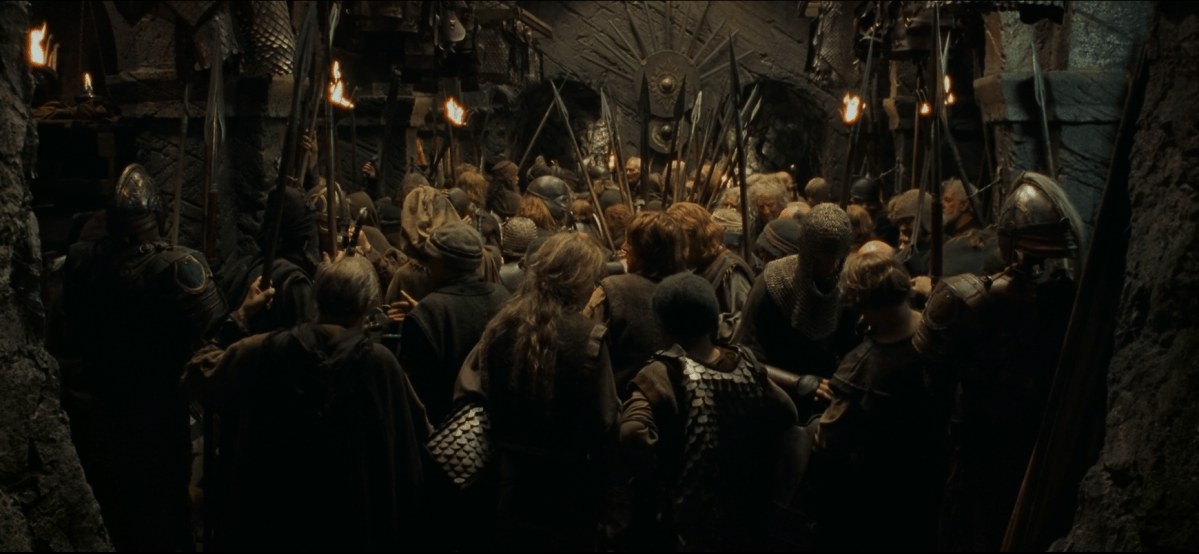
This is the first half of the final part (I, IIa, IIb, III, IVa, IVb, Va) of our apparently five-part series laying out some general guidelines for how pre-modern armies are organized, in particular exploring the principle that armies cannot help but recreate their civilian social structures on the battlefield. Last time we looked at the importance of generating cohesion in these armies and the ways cohesion could come either organically from the underlying society or be manufactured as part of training (or not be produced at all, resulting in less effective armies).
To close out this week, I wanted to provide some examples – each relatively brief – pulling the factors we’ve discussed (recruitment principles, mobilization methods, dealing with costs, leadership and cohesion sources) into coherent military systems that emerge organically from their underlying civilian society. And since this series was always intended as ‘one for the world-builders,’ I figured the best way to do this would be to take some fictional militaries, examine them along the lines above and see what (if anything) is necessary to fix them so that the underlying civilian society and the military it generates ‘matches.’
In a lot of cases, these are going to be fictional militaries we’ve looked at before, so a lot of this will be overlapping with more detailed treatments (which I’ll link) but also we’ll get some new stuff.
In the end, I had enough examples I wanted to work through that I opted to split this last part in two. So in this part we’re going to be taking apart some examples of matching up (or struggling to do so) army and society in literature (namely my perennials, A Song of Ice and Fire and The Lord of the Rings). Then in the second half, we’ll break some new ground and look at some examples out of video games that deviate from some of the classic ‘medieval fantasy’ patterns: the standing legions of the Empire of Cyrodiil, the oddly (but interestingly) bifurcated urban defense force of Baldur’s Gate and finally some private enterprise war in the Deadfire Archipelago.
I want to be clear, the goal here is not to praise or tear down any of these examples, but to explore them, to practice thinking about how the fiction armies and societies do and don’t match. I’ve tried to avoid here picking any example that is actively really bad (thus a preference for A Song of Ice and Fire (the books), for instance, over Game of Thrones (the show)).
But first, as always, recruiting and maintaining large pre-modern armies is expensive! Much like many of those pre-modern armies, this project is supported by devolving the costs of my ruinous book-buying habit on to recruits readers. You can help by spreading the word to new readers and by supporting this project over at Patreon. If you want updates whenever a new post appears or want to hear my more bite-sized musings on history, security affairs and current events, you can follow me on Bluesky (@bretdevereaux.bsky.social). I am also active on Threads (bretdevereaux) and maintain a de minimis presence on Twitter (@bretdevereaux).
Westeros and Fragmented Vassalage-Based Polities
So my critiques of some of the ‘realistic’ worldbuilding of A Song of Ice and Fire and Game of Thrones (and spinoffs) are not new. To be clear, I don’t think there is anything wrong with enjoying these stories; rather my critiques emerged in a period – now largely passed, thankfully – where it was common to claim that George R.R. Martin’s work represented a truer or more faithful vision of medieval vassalage-based polities. But that era is largely passed and my sense is that the ASoIaF/GoT community largely now understands that Westeros is not necessarily the gold-standard for ‘realistic’ medieval fantasy societies. So I don’t bring this up first to bash GRRM, but rather because (unlike Middle Earth, as we’ll see) it represents close to a ‘pure’ example (notionally) of a fragmented, vassalage-based polity.
So first we should begin with the underlying society. Westeros as we see it is a complex agrarian society – that is there is quite a lot of specialization, but this is a distinctly pre-modern society in which the vast majority of the population is still engaged in agriculture or pastoralism. Now I find that Martin’s depiction of the ‘smallfolk’ – ably summed up by the Wiki – is a bit frustrating as it is mostly a collection of aristocratic stereotypes about peasants, but nevertheless this is clearly a society where the bulk of the population is a largely demilitarized peasantry. In short, it is supposed to resemble high or late medieval Europe. Above the smallfolk is a hereditary landed aristocracy which fashions itself a ‘knightly’ (mounted military) warrior aristocracy, structured through vassalage. The social distance between these two groups is yawning: Westerosi aristocrats have more in common with other aristocrats half a continent away than they do with the peasants out of their front door. That social distance is not a worldbuilding problem, mind you; we see that kind of ‘trans-national’ elite (keeping in mind these aren’t nation-states so we’re using the word ‘national’ rather loosely) in a number of pre-modern societies. A French nobleman often did have more culturally in common with an English nobleman than he did with his own peasants and indeed in some cases a mounted Christian European military aristocrat might find he had more in common with a mounted Muslim military aristocrat from the Middle East than either had with their own peasants too.
So far, so good. But – as I’ve noted a few times before – when we see the armies of these polities, both in the books and in the show, they do not derive organically from this society at all. Westeros produces very large, surprisingly uniform armies which are not obviously organized into the retinues of smaller lords but rather function as large field armies tied explicitly to the largest vassals of the crown. Moreover, very large proportions of these armies are infantry (especially in the show, where the Lannister, Tyrell and Stark armies are almost entirely infantry!), composed of massed peasant soldiers. They’re also broadly uniformly equipped, often with recognizable liveries.

In short, these resemble the armies we would expect of large, extensively administered state-based societies.
But, and I have to stress this extremely strongly, Westeros does not have a state. It was not a state under the Targaryens (they make no effort to consolidate control of the various House armies) and it sure as heck isn’t a state under the Baratheons who are even weaker in terms of central power.
So what ought we see? Well, let’s return to that underlying society.
The core of these armies are going to be that mounted military aristocracy. It’s possible in some regions (the north, perhaps?) the aristocrats might also fight on foot, but we’re still looking at the aristocracy. Now the core landed aristocracy is going to be really small, but what is going to expand out this class are two kinds of soldier that GRRM has largely neglected: unlanded knights bachelor and non-aristocratic ‘men at arms’ (men who fight like knights but do not have the social status of knights). GRRM has some unlanded knights, but not many – but in this sort of society, such men are going to be ubiquitous in the households of those landed elites.
After all, most of the wealth in this society is held by a landed military aristocracy (the lords) who want to develop private military force and lack a state, so they’re going to do so in their household, by retaining (as retainers) full time warriors. And in this society, we see very clearly that full time warriors are almost invariably mounted heavy cavalrymen. So while the number of lords and their families is small, they can retain a bunch of non-noble heavy cavalrymen as part of the retinues, though we’re still dealing with armies that are likely much smaller than the massive armies Martin reports: whereas Martin has armies reaching the upper tens of thousands, we might instead expect the armies of the most powerful houses to at best be fielding a few thousand to perhaps 10,000 or so mounted men at arms.

In short, to use our typology, our first component here is a retainer-based army composed of a warrior class, recruited on a vocational principle, with military costs largely devolved (these guys or their lords purchase their horses and armor as a private expense). Cohesion is provided through a mix of warrior-class cohesion, probably combined with collective training in small cavalry units within those noble households. We probably ought to expect these men to perform quite well on the battlefield, given how strong that cohesive bond is likely to be.
Now, below this, every army needs infantry, especially because – as noted above – the cavalry components of these armies are still small. But those major Houses didn’t just become states when it was time to equip their infantry, so the infantry – drawn from the commons – is going to be recruited also using non-state structures. That means that equipment and wage costs also have to be substantially devolved, because none of these polities has the administrative infrastructure to handle the complexity of these costs (note that this is as much or more a question of complexity as about raw revenues!).
That leaves the warlords of Westeros essentially two options and we might expect them to use both: they can raise their own peasants or they can hire mercenaries.
If they raise their own peasants, this is going to be clientage principle recruitment, because the administration isn’t there for an employment-based system and the smallfolk don’t have any political entitlements to tie to military service anyway (notably Westeros lacks enfranchised little urban republics to provide urban militias). We should thus expect costs to be devolved, probably using a brigaded household model simply because the smallfolk seem too poor to expect individual households to furnish a man with his equipment. Nevertheless, the equipment that results from this is going to be both poor and non-standard (it would be hard to tell a Tyrell peasant-soldier from a Lannister peasant-soldier if you saw one on the road). And the cohesion principle is pretty obviously weak: these guys don’t have a strong corporate identity and their masters cannot afford to keep them under arms long enough to drill them. They’ll get to the battlefield, but often perform poorly. And because we have to brigade a bunch of households to get a soldier, we should still expect the numbers here to be smaller: low tens of thousands, not mid- or high- tens of thousands.

The real problem is how drab they are. These are men of importance and station! They’re wearing expensive equipment! They would want to look nice!
The alternative would be mercenary infantrymen, recruited en bloc (likely via contractors) using an employment principle and paid in cash. Since these houses don’t have a lot of revenue because they have very limited state capacity, their ability to engage these fellows is also going to be quite limited, but it isn’t hard to imagine how valuable they’d be, especially for providing specific military skills that aren’t ‘mounted military aristocrat,’ which obviously the peasant levies will also generally lack. If there were polities in Westeros that produced good infantry – because they had tight civic militias or other strong communal structures – we should expect them to be in heavy demand as mercenaries, just as Greek hoplites or Swiss pikemen were in their day. Good infantry, after all, is nice to have, but the Great Houses of Westeros are structurally largely incapable of producing good infantry at scale.
In short the military that flows from Westeros social organization is meaningfully different than the one Martin imagines. It is much smaller (no 100,000 man strong Tyrell armies!), more fragmented and much less ‘regular.’ Not only does the king have to care what Tywin Lannister thinks, but Twyin Lannister has to care what Lord Broom thinks and Lord Broom has to care what his retainers think and so on. Tywin’s Lannister army would likely be broken up into dozens of irregularly sized and structured retinues (of which his own would be the largest). Notably, ‘landless knights’ would be a key commodity in this system, an essential military resource that everyone with land and money is trying to attract (which in turn means those retainers have some bargaining power too), in part because none of these fellows will have a lot of faith in their poorly and irregularly equipped, weakly motivated infantry.
Crucially, this is a society defined by low state capacity (because it is, in fact a non-state society), which limits what the king and his lords can do at almost every turn.
Now to be clear, I don’t want to make it sound like Westeros – particularly the Westeros of the books – is a complete failure here. I think we could actually bring the armies of Westeros into line with their underlying society with fairly modest changes: shrink both the world size and the armies to a scale that fits a personalistic, vassalage based mobilization system and acknowledge that these polities are going to really struggle to employ good infantry at scale (lacking the revenues to recruit mercenaries or the social systems to effectively mobilize their peasantry), so they’re going to rely on their cavalry, which is in turn going to put sharp limits on the kind of warfare they wage. Finally, we’d want to flesh out the class of mounted man-at-arms and landless knight – present in Martin’s writing, but less common perhaps than they ought to be. The resulting world would feel smaller (it would be smaller) but that makes sense: these sorts of polities and their military systems do not durably scale.
Infantry and Cavalry in Rohan
I’d argue we can see a ‘heavy cavalry culture’ done a bit better with the Lord of the Rings‘ Rohirrim, although with the caveat that Tolkien is developing something closer to an early medieval society which still retains a relatively strong (perhaps fading) infantry tradition, as opposed to Westeros’ distinctively late medieval (or really early modern) sense; these are as we’ll see fundamentally quite different societies and as a result they produce different armies (albeit I think the armies of Rohan are more tightly fitted to their society).
Once again, we should sketch out Rohan’s society first. This is also a complex agrarian society, albeit less complex than Westeros and seemingly with a fair bit more pastoralism (in the form of ranching or fairly short-range transhumance, given that this society still lives in villages, rather than nomadic pastoralism). Military power is still somewhat fragmented in this society – men like Éomer and Erkenbrand appear to have some independent access to military force (they have their own retinues) but this is both a smaller and ironically more centralized kingdom than Westeros, but what make sit similar in a lot of ways is that state capacity remains low.
What I mean by that is that while on the one hand Théoden’s authority over his subordinates remains notionally higher (Tywin Lannister is a more independent figure than Erkenbrand, by custom and general understanding), Théoden still lacks anything like an administrative apparatus or bureaucracy and instead has to rule through his aristocracy. What’s different and thus what makes Rohan a bit more centralized in its structure is that Théoden has more latitude to hand-pick the top level of that organization chart, the three Marshals of the Mark (he initially picks himself, his son and his nephew, with his son being replaced by Erkenbrand after Théodred was killed), rather than being stuck with a specific local mega-aristocrat (like Tywin Lannister, Mace Tyrell, etc. etc.). Those commands (which historically are what will evolve into the highest reaches of the ‘feudal’ European nobility) are not yet wholly hereditary, though the fact that command in the Westmark immediately devolves to Erkenbrand Lord of the Westfold (the largest chunk of the Westmark) may suggest that, in the absence of a suitable member of the royal house, there’s a strong expectation that overall leadership ought to fall to a major local aristocrat.
As an aside, the fact that Rohan, resembling an early medieval kingdom is more effectively centralized than Westeros, which resembles a late medieval kingdom, should serve as a useful reminder that historical processes like centralization do not proceed only in one direction. It is not always the case that later societies have more centralization or administrative capacity.
We also need to talk about the situation of common folk of the Rohirrim. We don’t see much of them, but there are some assumptions I think we can make (which largely conform to Tolkien’s own pretty obvious Anglo-Saxon inspiration for these fellows). First, the Rohirrim aristocracy strikingly present themselves as having more culturally in common with their commonfolk than with neighboring aristocrats: they have their own language (that is, the aristocracy has not abandoned Rohanese for Westron) and their own internal term for themselves (an endonym) as Eorlingas, ‘people of Eorl’ which appears to include the commonfolk. Notably, the aristocracy, while clearly large landowners, do not appear to be titled: apart from Théoden King himself no one gets hereditary titles appended to their names (the Marshals being appointed positions). They also have a muster of all able-bodied men, implying a tradition of universal military service and thus a peasantry (I’m including their shepherds here) that hasn’t been entirely demilitarized. That last point matters a lot and signals, I think, quite a different underlying social structure than the one we see in Westeros.

We might then, in a desperate moment like this, not only see the lord’s armory emptied out, but individual middling-peasant households passing around old or surplus equipment to friends and relatives (pulling old arms and armor out of temple storerooms where they had been dedicated for last-ditch defenses was a standard trope of ancient Greek and Roman warfare, for instance).
Taken together, what I think we’re looking at is a landholder aristocracy governing a society mostly of free peasants rather than serfs. In something akin to the Carolingian system, there is probably a property line which makes a landowner liable for cavalry service (which thus defined the lower bound of the aristocracy), while landowners below that level are liable for infantry service (a ‘select levy’) and landowners much above that level are expected to furnish not only themselves but a larger retinue (thus we hear of the ‘knights of the king’s house’ and Marshals of the Mark having an Éored (120 mounted men) as part of their household). We should probably also assume a substantial number of farmers or herders who are simply considered too poor to serve (possibly expected to supply men for garrison service on a brigaded household model or as part of a ‘general levy’ in a local crisis).

The military organization then flows that social structure. The aristocracy fight at mounted heavy cavalry and are organized into retinues around the major magnates who on the one hand derive their wealth from large landholding but on the other hand owe their official positions to the king. We meet a fair number of these magnates (Erkenbrand, Grimbold, Elfhelm, along with of course Éomer and Théodred). There is a clear preference in these appointments, when not granted to a man of the king’s family, to use someone local: Erkenbrand commands in the West-mark because he is from the West-mark. Éomer will end up making Elfhelm command in the East-mark and by all indications Elfhelm is from the East-mark as well, given that he was in Éomer’s retinue as Third Marshal of the Riddermark with that geographic area of command.

Meanwhile, as I noted back in the Helm’s Deep series, we get a better sense of what we might term the ‘select levy’ of Rohan (the infantry force kept in the field by Erkenbrand) as well as the ‘general levy’ of all able-bodied men who have fled to Helm’s Deep. We’re pretty clearly told that the levies of Rohan are raised geographically (Erkenbrand has the Westfold’s men, who have a distinct sub-regional identity as ‘Westfolders’ and the ‘musters’ are by region); we don’t see the lower levels of command but there’s no reason to assume they’re not like the higher levels: local magnates lead the levies from their home area. That in turn explains the cohesive principle we see: when the Rohirrim get into trouble – common infantry and aristocratic cavalry alike – they invariably ‘clump up’ around the magnates, which suggest pretty close civilian ties. It makes sense: where do the regular infantrymen go when things are bad? The men of their village clump up together around their village leader (the local Big Man) who is also their unit commander and who they know fairly well. The comparative lack of social distance – implied by the common culture, language and lack of titles above – matters here for making this kind of cohesion work.
So my read on Rohan is that it is a complex, non-state agrarian/pastoralist polity, with a freeholding farmer class (a yeomanry) recruited regionally under a cultural norm of universal military service (at least for landholders), with an elite class that understands itself as a mounted military aristocracy (recruited as a warrior class, defined by wealth), where the cohesive principle is probably tight clientage ties between the infantry and their magnates and then horizontal ties between the magnates and each other. But that works because these fellows seem to actually know each other (in contrast, for instance, to the far more insulated noble class in Westeros). In terms of cost, this is clearly a system where costs are devolved, but the sense we get, given the performance of Rohan’s infantry against Saruman, has to be that the infantry class has preserved a bit more of their wealth against the aristocracy, again leading to somewhat better infantry, although it is worth noting that outside of the king’s immediate retinue, Rohan’s army is not uniform in its equipment.
Men of Gondor
Unsurprisingly, I think that Gondor – particularly book!Gondor in The Lord of the Rings is also an effective example of matching a military to its underlying society, but it is particularly interesting here because it is a composite force: different components are recruited under different principles, equipped differently, probably paid differently and so on. For large states, composite forces were very common.
And Gondor (at least under the last steward, Denethor II), is a composite polity and has a composite army to match. Gondor is also a complex, agrarian society, but a fair bit more complex than Rohan, with quite a few proper cities (Minas Tirith, of course, but also Pelargir, Dol Amroth and others) and evidently a fair bit of specialization. If the model for Rohan seems to have been Anglo-Saxon England, the model for Gondor seems to me fairly clearly to be the Eastern Roman (Byzantine) Empire, complete with a beacon system, and something like the tagmata and theme systems. Given the level of organization we see – Denethor is capable of large-scale building projects (like the repair of the Rammas Echor), substantial mobilizations (including the orderly evacuation of the Pelennor Fields) and maintaining a standing military force – I tend to conclude that Gondor is a state society, albeit that state power has frayed quite a bit around the edges (and of course part of the story is that it will be reasserted by Aragorn as king). Though we never see them, I think we ought to safely assume Denethor has some bureaucracy in addition to his military command structure, which lets him direct Gondor’s efforts from his high hall.
In particular, Gondor is split between the core territory around its capital and its subordinate regions, described as ‘fiefs’ and evidently entrusted to the control of a particular lord. Frustratingly, of these lords, the only one for which we can be sure we know how lordship is assigned is that of Belfalas, governed by the hereditary Prince of Dol Amroth (Prince Imrahil at the time of the War of the Ring), who has a different title from all of the other regional leaders but we do get references to these fellows equipping men out of their households, so I think we should understand them as local rulers who are vassals to Minas Tirith rather than appointed officials. So we have a core state with autonomous vassals making up its periphery; in this case the core state is geographically fairly small but clearly makes up the bulk of the military power: despite Minas Tirith’s long decline, it is a major population and economic center.
And lo! the military system basically follows from that political structure.
Because Gondor has a state at the core of its polity with the resources to manage massive construction projects and the like, he has a substantially wider range of options for the kind of military it will have. And it ends up having a bit of everything: a standing military centered on Minas Tirith but also a mix of other military systems drawn from its constituent regions.
First, the core of Gondor’s armies seem pretty clearly to be a standing, professional force, albeit perhaps not a very large one. The two components we see very clearly are the Guards of the Citadel and the Rangers of Ithilien. The Guards of the Citadel are pretty explicitly a professional force: Beregond is explicit that he is not any kind of aristocrat, but is still a full-time soldier in the Third Company of the Citadel (RotK 42). Given the fact that they are left effectively permanently deployed, it seems like the Rangers of Ithilien are similarly a professional force. To reach a little father, in Unfinished Tales (260 fn. 17) we get a title, “ohtar” for a “fully trained and experienced” footsoldier who was not, however, a knight, which also suggests to me (alongside Beregond’s use of the phrase ‘man at arms’ to seemingly mean the same: a man for whom war was a profession) that Minas Tirith has a substantial body of professional infantry at the core of its armies. We’re quite explicitly told that at least the Guards of the Citadel are equipped at state expensive, for they have a unique livery, but honestly it seems likely to me that the whole of this professional force was state-equipped, which is why we’re told that the livery is unique (in design and materials), rather than being told that these men were unique by having an issued livery at all.
Doubtless in an emergency this would be supplemented by drawing up the rest of the able-bodied male populace, but we’re not given a clear sense for the city of what that would look like. I find myself wondering if under normal circumstances, since Gondor is almost always in some kind of low-intensity conflict with Mordor, if the professional core wasn’t always supplemented by rotating conscription or some kind of reserve among the men of the city.

That said, I can believe that Gondor does have some professional, state-equipped heavy infantry – indeed, we’re told they have at least three companies of it in the Guards of the Citadels and presumably more ‘regular’ soldiers beyond those.
Then we have the forces of Gondor’s fiefs and here it is useful to just reproduce the passage in which they show up:
The men of Ringló Vale behind the son of their lord, Dervorin striding on foot: three hundreds. From the uplands of Morthond, the great Blackroot Vale, tall Duinhir with his sons, Duilin and Derufin, and five hundred bowmen. From the Anfalas, the Langstrand far away, a long line of men of many sorts, hunters and herdsmen and men of little villages, scantily equipped save for the household of Golasgil their lord. From Lamedon, a few grim hillmen without a captain. Fisher-folk of the Ethir, some hundred or more spared from the ships. Hirluin the Fair of the Green Hills from Pinnath Gelin with three hundreds of gallant green-clad men. And last a proudest, Imrahil, Prince of Dol Amroth, kinsman of the Lord, with […] a company of knights in full harness riding grey horses; and behind them seven hundreds of men at arms, tall as lords, grey-eyed, dark-haired, singing as they came. (RotK, 46)
I should note that, in a slightly earlier passage, we also get Forlong the Fat, Lord of Lossarnach, with “a dusty line of men, well-armed and bearing great battle-axes.”
What I love about this passage is that it not only applies our principle of militaries reflecting their civilian societies to Gondor itself – a composite kingdom has a composite army – but it also applies it to the component parts! One gets the sense that Belfalas (with its big city at Dol Amroth) are the most state-like of the fiefs and so they have an army that looks at lot like Minas Tirith’s army: a company (about a hundred) mounted knights, matched by seven hundred men-at-arms which – given their contrast between the other groups, I think we ought to understand as also being professionals, or at least well-trained in addition to well-equipped. By contrast, from the hill country of Morthond, we get five hundred bowmen led by what is evidently a ‘family affair’ of rule there, given that it is Duinhir with his two sons commanding them: a smaller, poorer community that fights in a way that fits with coming from a hard-scrabble kind of place.

We get some class-divisions too, particularly from Anfalas, where the great mass of men – presumably a poor peasant levy – are poorly armed saved for the household guard of their lord. Of course that strongly suggests that outside of Minas Tirith, Belfalas and perhaps Lossarnach (which seem to have fairly uniform equipment and perhaps represent the remains of the decaying Gondorian ‘state’ with professional troops and state-issued arms), these fellows are equipping themselves and that most of the costs of their service have likely been devolved either onto the men themselves or their lords (and quite evidently Golasgil has opted to spend those resources on his household guard and not on the rest of his troops; one wonders how that decision will play with the newly crowned King Elessar).
Notably, this is very clearly an infantry-focused force. That makes quite a bit of sense too, because Gondor is substantially more urban than Rohan or, for that matter, Westeros. The more urban societies get, the more infantry-focused they tend to be, for the obvious reason that raising horses requires a lot of space. Even though it is clear that Gondor’s population has declined, its military tradition still remains infantry focused (with cavalry support) and that too is a product of its economic and cultural structures (urban and state-based).
And again, because the infantry matter, this society can develop cohesion in them: for the professional core, that is probably a professional cohesion. One imagines the Guards of the Citadel are quite stubborn on the battlefield given that we see how intense their professional ethos of obedience to orders goes. On the other-hand, for many of the men of the fiefs, they arrive at Minas Tirith in fairly small, relatively tight groups, organized around leaders that are quite evidently familiar to them. One imagines that the bowmen of Morthond, for instance, probably all know each other and are tightly connected by bonds of clientage to their lord and his sons (notice that he doesn’t have a household guard – this militia is his army).
So we have a range of components, each with its own likely methods of recruitment and supply. We have a core of professionals, equipped by the state, housed and presumably trained together, with an appropriately professional cohesive principle, supported by levies recruited locally, with their costs devolved onto local lords and relying on organic cohesion arising out of their common communal bonds.
The result is something of a messy composite army rather than a ‘cookie-cutter’ army that is unrealistically uniform. And that’s probably more or less right: even the Romans, close to the gold-standard for pre-modern military organization west of the Ganges were never perfectly uniform and always made use of the forces of allies, client kings and subject peoples, creating composite forces.
Next time, we’ll keep this going by turning to look at some societies and armies from video games that, as noted, deviate a bit more from the ‘standard’ medieval fantasy pattern and think a bit about standing professional armies, urban militias and military contractors in substantially more complex state societies.
