

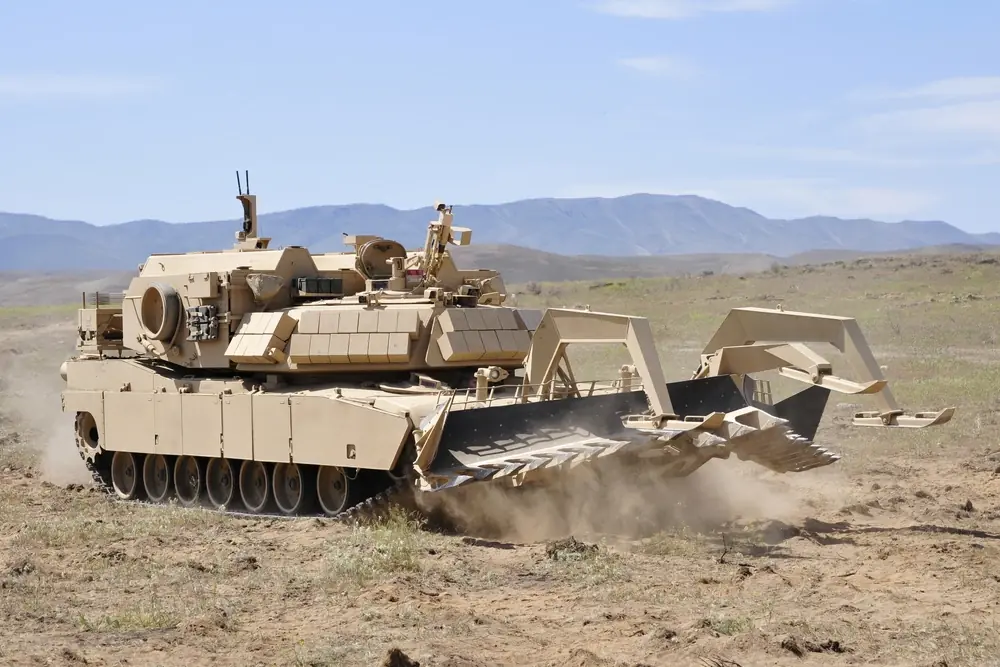
Defense Feeds, Washington — The US Army is accelerating its push toward unmanned combat systems as the US Army M1150 breacher upgrade boosts remote combat capability through a significant 350 percent funding increase.
The investment focuses on transforming the M1150 Assault Breacher Vehicle into a platform capable of remote-controlled operations. As modern battlefields become more complex and dangerous, reducing risk to personnel is becoming a central priority.
The M1150 Assault Breacher Vehicle has long been a critical asset for clearing minefields, obstacles and fortified defenses. Built on the Abrams tank chassis, it combines heavy protection with specialized equipment designed for breaching operations. The planned upgrades aim to extend its effectiveness by integrating advanced remote and autonomous technologies.
This development reflects a broader trend within the US military to adopt unmanned and semi-autonomous systems. By enhancing existing platforms rather than replacing them entirely, the Army seeks to improve capability while maintaining proven operational strengths. The question now is how these upgrades will reshape combat engineering roles.
Transforming the M1150 for Remote Operations
The core objective of the upgrade program is to enable the M1150 to operate remotely, reducing the need for onboard crews in high-risk environments. Breaching operations are among the most dangerous tasks on the battlefield, often conducted under direct threat from enemy fire and explosives. Remote capability offers a way to mitigate these risks.
By integrating remote-control systems, operators can manage the vehicle from a safer distance. This allows missions to continue even in heavily contested areas without exposing personnel to immediate danger. It also enhances operational flexibility by enabling rapid deployment in hazardous conditions.
The upgrade may also include elements of autonomy, allowing the vehicle to perform certain functions with limited human input. This could improve efficiency and response times during complex operations. However, achieving reliable autonomy in such environments presents technical challenges that will require careful development.
At the same time, maintaining the vehicle’s core breaching capabilities remains essential. The M1150’s plows, rollers and explosive line charges are critical for clearing paths through obstacles. Ensuring these systems function effectively alongside new technologies will be a key aspect of the upgrade.

Funding Increase Signals Strategic Priority
The 350 percent increase in funding highlights the importance the Army places on this initiative. Such a substantial boost indicates that remote and unmanned capabilities are no longer experimental but are becoming central to future force planning. It also reflects lessons learned from recent conflicts where exposure to threats has resulted in significant risks to personnel.
Investing in upgrades to existing platforms offers several advantages. It allows the Army to build on proven systems while incorporating new technologies. This approach reduces development time and leverages existing infrastructure and expertise.
The funding increase also supports research, testing and integration of advanced systems. Developing reliable remote-control and autonomous capabilities requires extensive evaluation under realistic conditions. Ensuring these systems perform effectively in combat scenarios is essential.
In addition, the investment aligns with broader defense strategies focused on modernization. As adversaries adopt new technologies, maintaining a competitive edge requires continuous innovation. The M1150 upgrade program is part of this ongoing effort.
Implications for Future Combat Engineering
The evolution of the M1150 Assault Breacher Vehicle has significant implications for combat engineering units. Traditionally, these units operate in some of the most dangerous conditions, clearing obstacles to enable maneuver forces. Introducing remote capabilities changes how these missions can be conducted.
Remote-controlled breaching vehicles could allow engineers to operate from safer positions while still achieving mission objectives. This reduces casualties and enhances overall effectiveness. It also enables operations in environments that might otherwise be too hazardous for direct human involvement.
The integration of such systems may also influence training and doctrine. Personnel will need to adapt to new technologies and develop skills in operating remote platforms. This shift represents a broader transformation in how military operations are conducted.
Looking ahead, the success of the M1150 upgrade program could pave the way for similar developments across other platforms. Expanding remote and autonomous capabilities is likely to become a key focus in future military planning. This reflects a wider trend toward leveraging technology to enhance both capability and safety.
The US Army’s investment in upgrading the M1150 underscores its commitment to modernization and innovation. As warfare continues to evolve, integrating advanced technologies into existing systems will be essential. The move toward remote-controlled breaching operations represents a significant step in that direction.
