

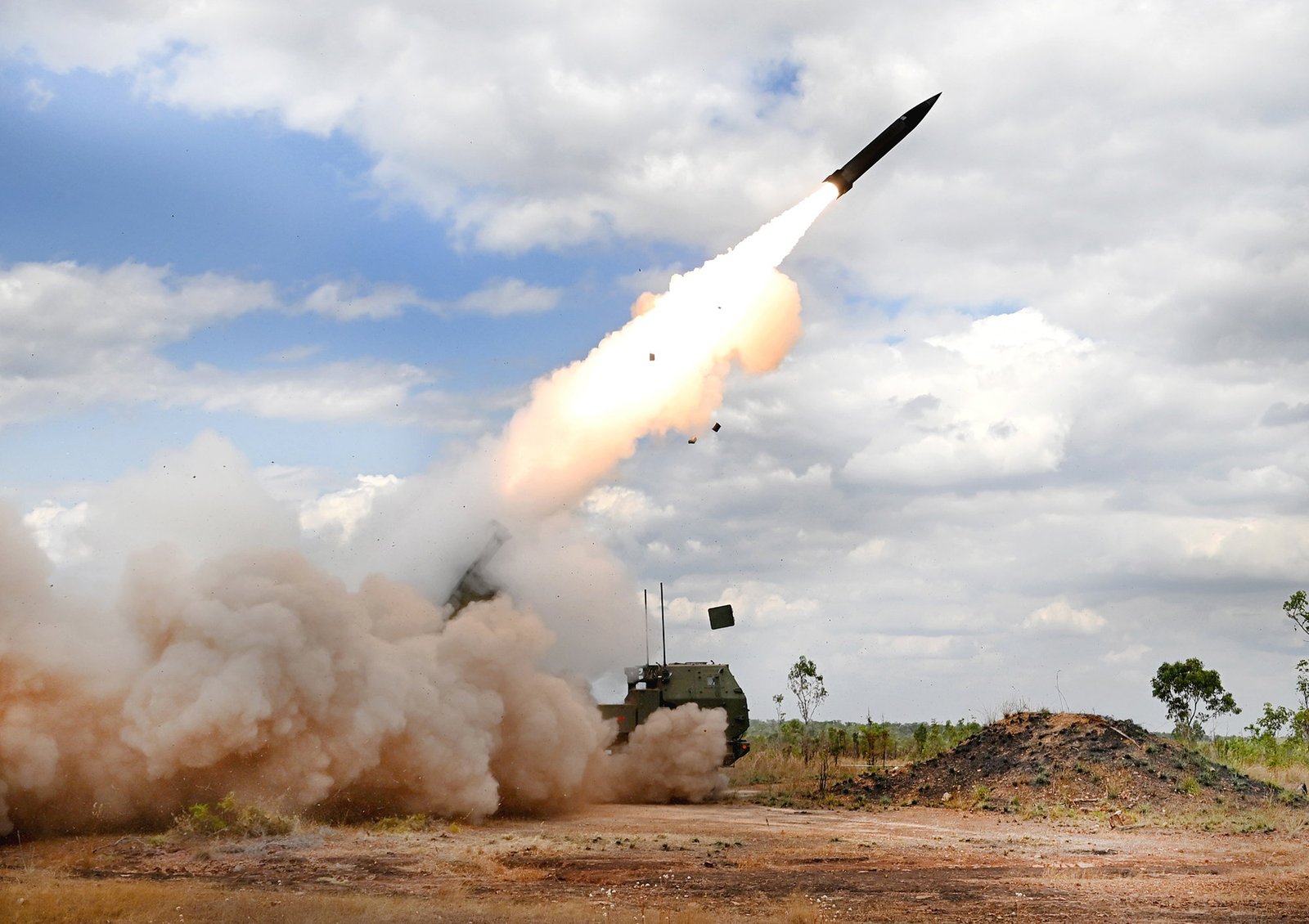
The decision has been made: Australia has selected the Precision Strike Missile (PrSM) and associated M142 HIMARS launcher to serve as the army’s solution for land-based maritime strike.
Canberra announced the decision on 28 April, stating that the combo is a “proven, highly mobile and lethal strike system aligned with Australia’s strategic and operational requirements”.
It added that the procurement “will significantly enhance the Australian Defence Force’s ability to engage targets at ranges of up to 500km, transforming to more than 1,000km with future increments of PrSM”.
Under Project Land 8113 Phase 2, the PrSM had been competing with Kongsberg’s Naval Strike Missile (NSM) mounted on a Thales Bushmaster 4×4 chassis. That particular combination is called the StrikeMaster.
The Department of Defence justified its decision, saying, “This decision follows a comprehensive competitive evaluation process by Defence.” It added that the acquisition “will increase our capacity to respond effectively to contingencies in our region and work with our allies and partners”.
The government promised to spend A$2.3 billion (US$1.65 billion) over the next decade on the HIMARS and PrSM to equip the Australian Army’s second long-range fires regiment. The first regiment adopted the HIMARS as a rocket artillery system, with 42 launchers on order and the first units delivered in early 2025.
Both these regiments are based at Edinburgh near Adelaide in South Australia. The commonality of the HIMARS launcher will also bring attendant advantages.
Defence’s announcement did not reveal how many HIMARS launchers would be ordered for the maritime strike regiment, but a Foreign Military Sales announcement from the USA in September 2025 preapproved the sale of 48 HIMARS.
Simultaneously, Australia under its Guided Weapons and Explosive Ordnance programme, is setting up local assembly of GMLRS rockets with increasing levels of local production. The first Australian-assembled GMLRS was test-fired earlier this month, plus Australia and the USA have a cooperative programme to pave the way for future production of PrSM locally.
Minister for Defence Industry Pat Conroy remarked: “We’re already making missiles that can be fired from the HIMARS – and this decision will create even more demand for PrSM missiles within the Australian Army, and deliver more opportunities for PrSM manufacture in Australia.”
While this decision is disappointing for Kongsberg, the company is building its own production facility in Australia and is supplying NSMs to the Royal Australian Navy, as well as Joint Strike Missiles for the Royal Australian Air Force.
Thales Australia will also be mollified by the announcement on 27 April of a contract for 268 new Bushmaster 4×4 protected mobility vehicles. This is the largest single Bushmaster production contract since the initial one awarded in 1999.
This deal is worth A$750 million, and it keeps the company’s factory in Bendigo operating at capacity.
Thales said the investment will help “develop the next-generation Bushmaster”, with improvements such as increased capacity for carrying personnel, greater towing power, stronger additional armour and a modular crew cabin for better versatility. It will also be available in left-hand drive for export purposes.
Also mentioned are advanced digital systems, the ability to mount more powerful weapons such as roof-mounted effectors, and the opportunity to integrate a wide range of sensors and effectors to defeat threats. Conroy elaborated, highlighting that some will be used for counter-drone roles: “The goal is to mount lasers on these vehicles to destroy drones, and obviously you’ll need plenty of juice to do that.”
Production of these Bushmasters will commence next year, according to Thales.
The company said the new Bushmasters will also support “sensing and striking at range”. Under a previous contract, Thales has already been building 59 Bushmasters that will support the army’s long-range fires regiments.

The Australian Army will also sell some of its older Bushmasters to the Netherlands. Defence Minister Richard Marles said, “The number that we’re building well exceeds, by multiples, the number that we are providing to the Netherlands. Out of respect to the Netherlands, we’re not releasing the number that we are sending to them.”
To date, Thales Australia has manufactured more than 1,300 Bushmasters, and they have been sold to eight user nations. In the Asia-Pacific region this includes Australia, Fiji, Indonesia, Japan and New Zealand. In recent years, Australia has also donated 120 Bushmasters to Ukraine too.
Additionally, Australia is also investing A$450 million for Rheinmetall to upgrade the ADF’s MAN truck fleet, and for Thales Australia to upgrade Hawkei light protected mobility vehicles.
by Gordon Arthur
