

- Malaysia currently has requirements for air defence systems. Do you have suitable air defence systems available in your portfolio, especially as recent wars have highlighted the importance of layered air defence?
Thank you, and I am glad you framed it that way, because this is really the defining lesson of recent conflicts. No single system wins the air defence battle. You need layers. You need integration. And you need a command structure smart enough to manage it all in real time. A nation must be able to counter low-cost swarm drones at one end and ballistic missiles at the other, simultaneously, within a single unified architecture. That is exactly what we have been building.
At ASELSAN, air defence is not one product line among many. It is our number one priority. Steel Dome, Türkiye’s national integrated air and missile defence programme, is the single largest undertaking in our over-fifty-year history. And I want to be very clear about something: this is not a concept. It is not a future vision. It is operational, it is expanding, and it is producing results. In 2025, we delivered close to one hundred Steel Dome components to end users. Forty-seven major system elements were handed over to the Turkish Armed Forces in a single a single ceremony with our President in attendance. That tells you where this programme stands.
Now, what you see on our stand at DSA tells this story layer by layer, and this is deliberate. At the first layer, we have KORKUT 100/25 for kinetic drone engagement and EJDERHA, our high-power electromagnetic counter-drone system that is now in serial production. This is important because when you face swarm threats, the economics have to make sense. You cannot spend a missile on every cheap drone that comes at you. You need cost-effective, scalable solutions, and that is what EJDERHA provides. One layer up, KORKUT 130/35 with its fire control system and modernized towed guns addresses low to medium altitude threats. At the third layer, HİSAR-O provides medium-range air and missile defence, working alongside VURAL 100 for radar electronic attack and PUHU 3-LT for electronic support. You need electromagnetic superiority as much as you need kinetic kill capability, and these systems deliver that. At the fourth layer, AKREP 1000-G fire control radar and KORAL 200 mobile electronic warfare give you the reach to detect, track, and engage at extended ranges while degrading adversary sensor networks.
But the piece I always emphasize, the piece that makes this a dome rather than a collection of individual systems, is HAKİM. Our AI-assisted command and control system. HAKİM is the brain of the entire architecture. It fuses sensor data from every layer, evaluates threats automatically, and allocates the right effector to the right target at the right moment. And again, this is not something we are still developing. HAKİM is deployed today. It is managing real missions within the Turkish Armed Forces as we speak.
For a nation like Malaysia, with its unique maritime geography and its evolving security environment, building a layered air defence posture is not a luxury. It is a strategic necessity. And what ASELSAN offers is not just the hardware. It is the architecture, the integration, the command intelligence, and a partnership model where this capability can be adapted, localized, and sustained within the country over the long term. We are not here to deliver a system and leave. We are here to build it together.

- Aselsan has an extensive naval catalogue too. What kind of naval packages can you offer, especially including unmanned surface vessels?
Absolutely, and I appreciate you raising the naval domain because for a maritime nation like Malaysia, this is where the conversation becomes very concrete.
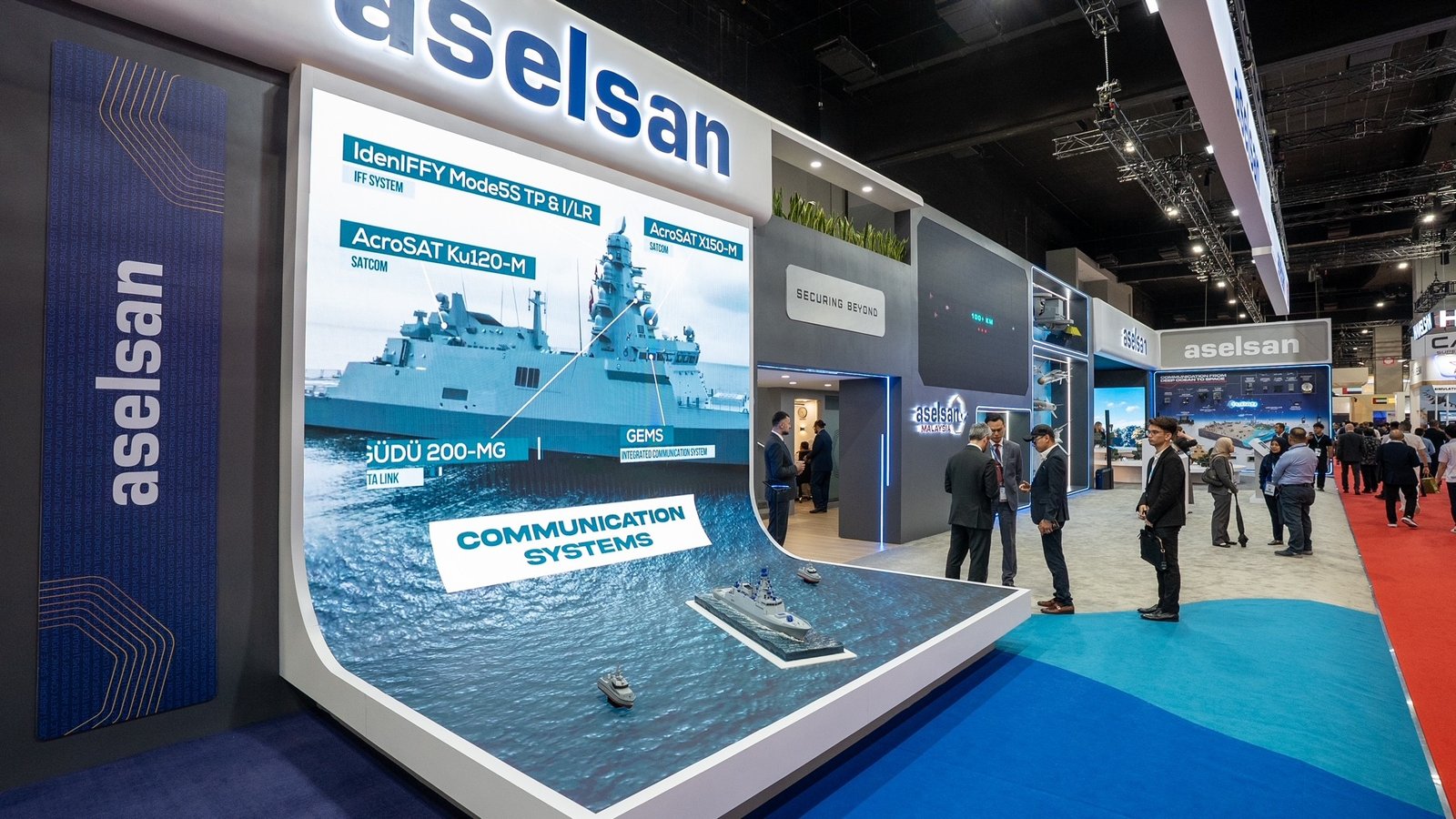
Let me start with where we stand as a company in naval systems. Today, there are 39 military naval platforms simultaneously under construction globally that carry ASELSAN systems. That is not a projection. That is happening right now. Our naval portfolio covers the full spectrum: combat management systems, radars, fire control, electro-optical directors, electronic warfare suites, communication systems, sonar, and close-in weapon systems. When a navy needs to equip a vessel from bridge to hull, ASELSAN can deliver an integrated package.
Beyond unmanned platforms, let me highlight a few things that are particularly relevant for this region. GÖKDENİZ, our close-in weapon system, has already been delivered to naval forces in the Asia-Pacific. It was proven in live-fire trials on TCG İstanbul, engaging high-speed, sea-skimming targets autonomously in a matter of seconds. For any navy concerned about anti-ship missile defence, this is a field-proven last-layer solution.
In underwater warfare, we have the DERİNGÖZ family of autonomous underwater vehicles for seabed surveillance, mine countermeasures, and critical underwater infrastructure protection. And our aselBUOY sonobuoy system is approaching a significant milestone with UAV-launch integration testing, which will bring a completely new dimension to anti-submarine warfare.
What I want to emphasize is that we do not think of naval systems as individual products. We think in terms of a complete maritime package. Sensors, effectors, communications, command and control, manned and unmanned platforms, surface and subsurface, all connected and all working together. And critically, we offer this with a partnership model that includes technology transfer, local production, and long-term sustainment. The NavaMas programme is proof that this model works. We want to expand it further.
- Militaries are becoming increasingly reliant on space-based assets such as satellites. What kind of presence does Aselsan have in the space sector?
This is a domain where we have made a very deliberate strategic decision. Space is not a side project at ASELSAN. It is an integral part of our vision, which I often describe as covering everything from the deep sea to orbit.
Let me give you a concrete milestone. On the 1st of December 2025, ASELSAN successfully launched LUNA-1, our IoT satellite, into low Earth orbit aboard a SpaceX Falcon-9 rocket. That was a significant moment for us. It demonstrated that ASELSAN is not just talking about space. We are in orbit. LUNA-1 is a working satellite, and it marks the beginning of what we intend to be a much broader space programme.
Now, why does this matter for a defence company? Because the modern battlefield is fundamentally dependent on space-based assets. Secure communications, intelligence, surveillance, reconnaissance, navigation, timing. All of these rely on space infrastructure. And if you depend on someone else’s satellites for these critical functions, you have a vulnerability at the strategic level. That is why sovereign space capability matters.
At ASELSAN, we are building this capability step by step. On the ground segment side, we already produce satellite communication terminals. Our AcroSAT family, which you can see here at DSA, provides Ku-band and Ka-band SATCOM for both fixed and mobile platforms. These are deployed operationally and they connect forces in the field to space-based assets in real time.
But the ambition goes further. Under our aselsaneXt strategy, space systems sit alongside artificial intelligence, quantum technologies, and semiconductors as the four pillars of our next-generation investment. We are investing in military-grade chip development and semiconductor production analysis because we understand that the components that go into space systems must also be sovereign. You cannot build an independent space capability if you are importing every critical chip.
For nations in Asia Pacific region, many of which have vast maritime territories and archipelagic geographies, space-based assets are not a luxury. They are essential for maritime domain awareness, secure communications across dispersed forces, and strategic intelligence. ASELSAN’s value proposition is that we can offer not just the satellite, but the ground terminals, the secure communications architecture, and the integration into a broader C4ISR framework. That is the complete picture.
- Drones, or UAVs, have become ubiquitous in modern warfare. Does Aselsan have sensor packages suitable for installation aboard UAVs?
When people think about UAV capability, the conversation naturally gravitates toward the platforms themselves. But in our experience, the real differentiator in operational effectiveness lies in what the platform carries. An UAV without capable sensors, without electronic warfare, without precision munitions, is essentially a flying camera. What turns it into a decisive combat asset is what it carries. And that is where ASELSAN comes in.
We have taken a very deliberate strategic position in this domain. Rather than competing to build airframes, we focused on becoming the premier provider of the systems that make UAVs operationally effective. The eyes, the ears, and the teeth. And today, ASELSAN payloads are operational on UAV platforms across multiple continents.
Here at DSA, we are showcasing a comprehensive suite. In electro-optics, we have the ASELFLIR 500 and ASELFLIR 600 reconnaissance, surveillance, and targeting systems, alongside TOYGUN for lighter platforms and KARAT, our infrared search and track system. In electronic warfare, our ANTIDOT 2-U pods provide both electronic support and electronic attack capability directly from the UAV, which fundamentally changes how unmanned platforms can operate in contested airspace. And in precision strike, we are presenting a full family of guided munitions: TOLUN with GPS/INS guidance, TOLUN IIR with imaging infrared for terminal precision, LGK and GÖZDE laser guidance kits, KGK wing-assisted guidance kits, and SADAK 2T smart pneumatic twin racks for flexible weapon carriage.
But I want to highlight something that truly sets us apart. On 2025, a world first was achieved. Baykar’s Kızılelma unmanned combat aircraft executed a beyond-visual-range air-to-air engagement using a fully national sensor chain. Our MURAD AESA radar detected and tracked the target. A nationally developed RF seeker guided the GÖKDOĞAN missile to a direct hit. And our indigenous IFF system and data link provided secure identification and fire control throughout the entire engagement. Every element of that kill chain, from detection to intercept, was handled by ASELSAN systems. No country had ever demonstrated this with an unmanned platform before. That tells you where our technology stands.
For nations in Southeast Asia that are investing heavily in unmanned capabilities, this is directly relevant. You do not need to source your payloads from five different countries and hope they integrate. ASELSAN offers a complete, interoperable payload ecosystem from a single trusted source, sensors, electronic warfare, munitions, data links, and IFF, all designed to work together. And because we control the entire technology chain, we can structure meaningful technology transfer programmes around these systems.
- Conversely, there’s an urgent need for nations to protect themselves against hostile drones. How does your company fulfil global needs for counter-drone systems?
Counter-drone defence is one of the most pressing tactical challenges of our time. And what makes it so difficult is not the technology. It is the economics. The fundamental problem is asymmetry. An adversary can build or buy a drone for a few hundred dollars and send hundreds of them simultaneously. If your only response is a missile that costs hundreds of thousands of dollars, you lose the equation before the engagement even begins. The solution requires a fundamentally different way of thinking.
At ASELSAN, we approach counter-drone not as a single product but as a layered problem that demands a layered response. And I should say, this is not theoretical for us. Türkiye has been dealing with drone threats operationally for years, and our systems have been shaped by that real-world experience. Everything we offer has been developed in response to actual operational requirements, tested under real conditions, and refined through continuous feedback from the field.
What you see on our stand at DSA reflects this layered logic. EJDERHA is our high-power electromagnetic system that neutralizes drone swarms without firing a single round. It is now in serial production and being delivered to end users. The economics are compelling: you are using electromagnetic energy against low-cost threats, which means your cost-per-engagement drops dramatically and you never run out of ammunition in the conventional sense. Alongside EJDERHA, KORKUT 100/25 provides kinetic counter-drone capability for targets that require physical destruction. Together, these two systems form the first layer of our counter-drone architecture.
But effective counter-drone defence does not stop at the point of intercept. You need to detect, classify, and track these threats before you engage them, especially when they come in numbers. That is where our electronic warfare and radar systems become essential. VURAL 100 provides radar electronic attack capability, PUHU 3-LT delivers electronic support and signal intelligence, and our fire control radars provide the tracking precision needed for engagement. When these are all connected through a unified command and control architecture, you have the ability to see the threat early, understand what it is, decide the most cost-effective way to defeat it, and execute, all within seconds.
I should add that the counter-drone challenge is not going to diminish. It is going to intensify. Drones will become faster, cheaper, more autonomous, and deployed in larger numbers. Any nation that waits to address this is already behind. For countries in Southeast Asia, where you have vast territories, critical infrastructure, and maritime assets to protect, building this layered counter-drone capability is not something for the next decade. It is something for now. And ASELSAN has the operational experience, the production capacity, and the partnership model to help build it.
- Finally, what about payloads and remote weapon stations for land-based vehicles? Are there regional programmes that you can mention in relation to this area?
This reflects a broader capability that ASELSAN has built over decades. We are one of the most experienced companies in the world when it comes to equipping land platforms with integrated payloads. Our stabilized remote weapon stations, the SMASH family, are operational on platforms across many countries. Our electro-optical fire control systems, thermal sights, and situational awareness suites are designed to transform any armoured vehicle into a networked, precision-capable fighting system.
And we go deeper than turret systems. On the ALTAY main battle tank programme, thirteen distinct ASELSAN systems are integrated into a single platform. Among them is AKKOR, our active protection system, a technology that only a handful of countries in the world have the ability to develop and produce. That tells you the level of engineering depth we bring to land systems.
What I find encouraging in this region is that several nations are pursuing armoured vehicle modernization and new procurement programmes simultaneously. The requirements vary, but the underlying need is the same: to upgrade existing platforms with modern sensors, fire control, and networked capability without necessarily replacing the entire fleet. That is a sweet spot for ASELSAN. We can take an existing vehicle, integrate our systems, and deliver a step change in operational effectiveness.
And critically, we do this with a transfer model. In Malaysia with MILDEF, the integration work builds local engineering knowledge. Local technicians learn to maintain and sustain the systems. Over time, the capability to support and evolve these platforms stays in the country. That is not a slogan for us. It is how the MILDEF programme is actually structured.
I would say land systems are an area where you will see ASELSAN’s regional presence grow significantly in the coming years. The partnerships are in place. The products are proven. And the model works.
