

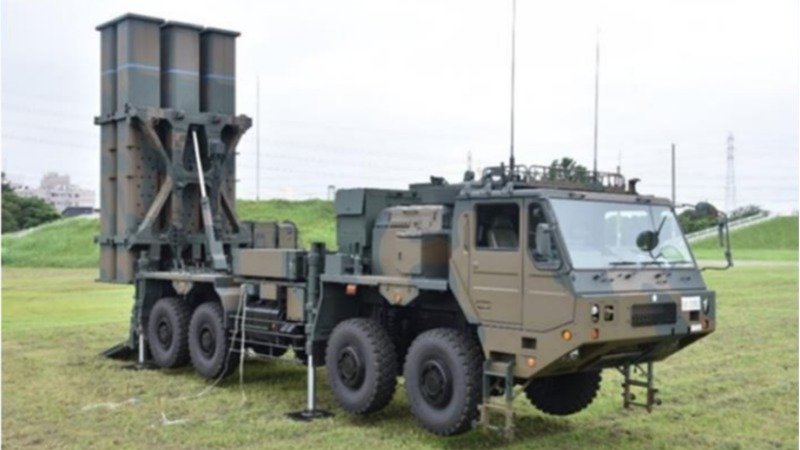
On March 3, the Okinawa Defense Bureau of Japan’s Ministry of Defense (JMOD) released materials from a briefing held the previous day in Yonaguni Town regarding plans to deploy a medium-range surface-to-air missile unit on Yonaguni Island located close to Taiwan.
In the briefing materials,[1] JMOD is seeking local residents’ understanding regarding its plans to deploy an upgraded version of the Type-03 Medium Range Surface-to-Air Missile (Modified), or “Chu-SAM Kai”, on Japan’s westernmost inhabited island, citing growing Chinese military activity in the region and North Korea’s missile program.
R&D on the latest upgrades to the Chu-SAM Kai was initiated in fiscal year (FY) 2023 to enhance the system’s capability to counter short-range ballistic missiles (SRBMs) and the emerging threat of hypersonic glide vehicles (HGVs).
Defense Minister Shinjiro Koizumi first set out a concrete timeline on February 24, announcing plans to deploy the missile system by FY 2030 on Yonaguni. He also visited the island in November last year, when he discussed the deployment plan with the local government amid heightened tensions with China.[2]
The Okinawa Defense Bureau’s March briefing materials detail how the vehicle-mounted mobile missile system operates and the air defense role it is expected to play for both Yonaguni itself and the southwest Nansei Islands.
The Bureau also outlines plans for Japan Self-Defense Force (JSDF) reinforcements, facility construction at Camp Yonaguni, and measures to mitigate the impact on the surrounding area.
System Overview: Type-03 Chu-SAM and Its Upgrades
The system planned for deployment on Yonaguni represents the latest iteration of the Type-03 Chu-SAM, a vehicle-mounted medium-range surface-to-air missile system that originally entered service in 2003.[3]
A modified “Kai” variant was introduced in 2017,[4] improving the system’s ability to intercept aerial threats in the terminal phase, including cruise missiles and anti-ship missiles. This version features enhanced targeting capabilities as well as improved networking functions to extend operational coverage.[5]
The upgraded version of the Type 03 Chu-SAM Kai that will be deployed Yonaguni is intended to enhance performance against more challenging aerial threats: short-range ballistic missiles (SRBMs) and hypersonic glide vehicles (HGVs). Under development since FY2023, this upgraded Chu-Sam Kai reportedly entered mass production in December of last year as Japan seeks to expedite deployment.[6]
Beyond these upgrades, Japan is also engaged in early-stage development to extend the Type-03’s interception capabilities to include medium-range ballistic missiles (MRBMs).[7]
Yonaguni Deployment by FY2030: Strategic Role
In its briefing materials,[8] the Okinawa Defense Bureau highlights how the upgraded Chu-SAM Kai system on Yonaguni is expected to integrate into Japan’s layered and integrated air and missile defense architecture, coordinated through JADGE (Japan Aerospace Defense Ground Environment).

The Bureau aims to demonstrate how deployment on Yonaguni would strengthen the lower layer of this defense system, particularly in intercepting low-altitude cruise missiles in an island environment.

The briefing materials also illustrate the kind of aerial capabilities that the upgraded Chu-SAM Kai is intended to counter.
These include aircraft such as the Russian-made, China-operated Sukhoi Su-35; air-to-surface missiles carried by platforms such as China’s Xi’an H-6 bomber; and cruise missiles, including China’s CJ-20, which can also be launched from H-6 aircraft.
The materials also include an image that appears to correspond to a North Korean hypersonic missile tested in 2022.[9]

The Bureau emphasizes to residents that the Type-03 system is purely defensive, designed only to intercept incoming threats and lacking any counterstrike capability. It also notes that similar units are already deployed across Japan, while Yonaguni remains the only major island in the southwestern Nansei region without Chu-SAM air defense coverage.[10]
Yonaguni Personnel Reinforcements and Infrastructure Development
The Bureau’s briefing materials indicate that preparations for the planned FY2030 deployment of the upgraded Chu-SAM Kai system at Camp Yonaguni will involve both JSDF personnel restructuring and infrastructure development.
JMOD will increase the number of JSDF personnel at Camp Yonaguni to around 270. In FY 2026, reinforcements will be made to existing units and new units established, to include a JGSDF electronics warfare unit and a JASDF surveillance squadron. The JGSDF Anti-aircraft Artillery Group responsible for actually operating the upgraded Chu-SAM Kai is scheduled to be formed later in FY2030, in line with the system’s scheduled deployment.
Turning to infrastructure development, land acquisition by JMOD is due to be completed by this month. This will be followed by initial surveys in FY2026, more concrete surveys and design measures in FY 2027. Construction will then run from FY2028 through to the system’s deployment in FY2030.
Camp facilities will include administrative buildings, new barracks, an indoor shooting range, and an outdoor training ground.
Considerations for Yonaguni Residents
The Okinawa Defense Bureau particularly highlights community assistance measures that JMOD will undertake to reduce the impact of the new defense facilities.
The ministry is to offer subsidies to Yonaguni Town for development and improvement of public infrastructure. These include a community center and wireless communications infrastructure and facilities related to firefighting, water supply, waste disposal, and fisheries.
JMOD also highlights how it aims to provide assistance for the construction of evacuation shelters in response to requests from both the mayor of Yonaguni Town and the Diet in Tokyo. These underground facilities are designed to accommodate local residents for up to two weeks and form part of Tokyo’s contingency planning in case of an armed attack.
The bureau also informs residents that radar systems for the upgraded Chu-SAM Kai operate at frequencies comparable to those used by mobile phones and are not expected to pose risks to human health or cause interference with television or mobile phone signals.
Conclusion
JMOD’s planned deployment of an upgraded variant of the Type-03 “Chu-SAM Kai” Medium-Range Surface-to-Air Missile System (modified) on Yonaguni Island by FY2030 can be expected to play a significant part in Tokyo’s overall deterrence-by-denial strategy against Chinese activities in the vicinity of Japan’s Nansei Islands.
The Okinawa Defense Bureau’s March 2 briefing to Yonaguni residents emphasises that the Type-03 system is purely defensive, and illustrates how the system is intended to intercept a variety of missile threats in the terminal phase.
However, the briefing comes amid JMOD’s broader push to strengthen Japan’s counterstrike capabilities. This is exemplified by the March 9 arrival of a modified “Kai” version of the Type-12 surface-to-ship missile system at a GSDF base in Kumamoto, Kyushu.[11]
The Type-12 Kai is believed to have a range of approximately 1,000 km, compared to around 200 km for the original variant that was designed to target hostile vessels approaching Japan. Its extended range could enable strikes from Kumamoto against land-based targets along parts of China’s coastline as well as most of North Korea.[12]
Such long-range systems are unlikely to be deployed to Yonaguni or elsewhere in the Nansei Islands in the near term, given the need for careful calibration in Tokyo’s deterrence posture. However, shorter-range, non-Kai Type-12 missiles configured for targeting approaching ships could eventually complement the Type-03’s aerial defense function on Yonaguni, particularly as both systems are already co-deployed on other major islands in the Nansei region.
Notes:
[1] JMOD, “与那国駐屯地への中距離地対空誘導弾部隊の配備に関する説明会” [Briefing session regarding the deployment of a medium-range surface-to-air missile unit to Camp Yonaguni], March 2, 2026, https://www.mod.go.jp/rdb/okinawa/effort/strategy/images/080303YonaguniCyoJyuminSetsumeikaiShiryo.pdf.
[2] Jesse Johnson, “Japan to deploy missiles to Yonaguni Island by fiscal 2023, defense chief says”. Japan Times, February 24, 2026, https://www.japantimes.co.jp/news/2026/02/24/japan/koizumi-japan-missiles-yonaguni-fiscal-2030/.
[3] Rikuzi Chousadan, “03式中距離地対空誘導弾” [Type 03 medium-range surface-to-air guided missile], https://rikuzi-chousadan.com/soubihin/yuudoudan/type03chuu.html.
[4] JMOD, “Introduction to the Equipment of the Japan Self-Defense Forces”, p.20, https://www.mod.go.jp/atla/en/policy/pdf/handout_FY2018.pdf.
[5] ATLA, “Joint Systems Development Division”, https://www.mod.go.jp/atla/en/soubi_system.html.
[6] Alain Servaes, “Japan enters hypersonic missile defense era with mass production of Improved Type 03 Chu-SAM Kai”. Army Recognition, December 28, 2025, https://www.armyrecognition.com/news/army-news/2025/japan-enters-hypersonic-missile-defense-era-with-mass-production-of-type-03-chu-sam-kai.
[7] ATLA, “⑦03式中距離地対空誘導弾(改善型)能力向上型” [⑦ Type 03 Medium-Range Surface-to-Air Guided Missile (Modified) Capability Improved Type], 7-2. In: プロジェクト管理対象装備品等の現状について(取得プログラムの分析及び評価の結果の概要等)(令和7年4月17日)[Current Status of Project-managed Equipment (Summary of Analysis Results of and Evaluations of Acquisition Programs) (April 17, 2025)], https://www.mod.go.jp/atla/soubiseisaku/project/gaiyo_r070417.pdf.
[8] JMOD, “与那国駐屯地への中距離地対空誘導弾部隊の配備に関する説明会” [Briefing session regarding the deployment of a medium-range surface-to-air missile unit to Camp Yonaguni], March 2, 2026, https://www.mod.go.jp/rdb/okinawa/effort/strategy/images/080303YonaguniCyoJyuminSetsumeikaiShiryo.pdf.
[9] Justin McCurry, “North Korea conducts fresh ‘hypersonic missile’ launch”. The Guardian, January 11, 2022, https://www.theguardian.com/world/2022/jan/11/north-korea-has-fired-possible-ballistic-missile-says-japan.
[10] On slide 21 of the briefing materials, the Bureau provides a map of Japan’s southwest region highlighting that Chu-SAM units are already deployed to Yonaguni’s immediate northeast on the following islands: Amami Oshima, Okinawa, Miyakojima, and Ishigaki-jima.
[11] Nikkei Shimbun, “陸自、熊本・健軍に長射程ミサイルの発射機など搬入 反撃能力へ配備” [JGSDF has delivered long-range missile launchers and related equipment to Kengun, Kumamoto, to enhance counterstrike capabilities], March 9, 2026, https://www.nikkei.com/article/DGXZQOUA082M40Y6A300C2000000/.
[12] The Diplomat, “Tokyo deploying domestically developed counterstrike capabilities”. Indo-Pacific Defense Forum, March 22, 2026, https://ipdefenseforum.com/2026/03/tokyo-deploying-domestically-developed-counterstrike-capabilities/.
This article was originally posted on NSBT Japan, the first defense and security industry network in Japan. The publication provides the latest information on security business trends both within Japan and overseas. Asian Military Review began exchanging articles with NSBT Japan in April 2024.
Read the original article here.
