


The Mobile Ad Hoc Network Cloud High Mobility Radio system has achieved an important milestone with a deployment in a major multinational exercise.
The United States Army’s Mobile Ad Hoc Network Cloud High Mobility Radio (MCHMR) system is better known as ‘MC Hammer’ (yes, really). MCHMR forms a key part of the US Army’s Next Generation Command and Control (NGC2) operational/tactical level Command and Control (C2) architecture. In the army’s own words, NGC2 will fundamentally change how its manoeuvre force performs C2 by overhauling command and control architectures used by the manoeuvre force at tactical (battalion and brigade) level through to division and corps (operational) levels. NGC2 is working to breakdown existing C2 stovepipes in the land manoeuvre force. Much of this effort rests on improving communications between the force’s constituent parts. The initiative is led by the army’s Capability Programme Executive for Command, Control, Communications and Networks. NGC2 links into the US Department of Defence’s (US DOD’s) Combined, Joint All-Domain Command and Control (JADC2) system. The CJADC2 is the facilitator for the US DOD’s Multi-Domain Operations philosophy.
NGC2 and the Combat Cloud
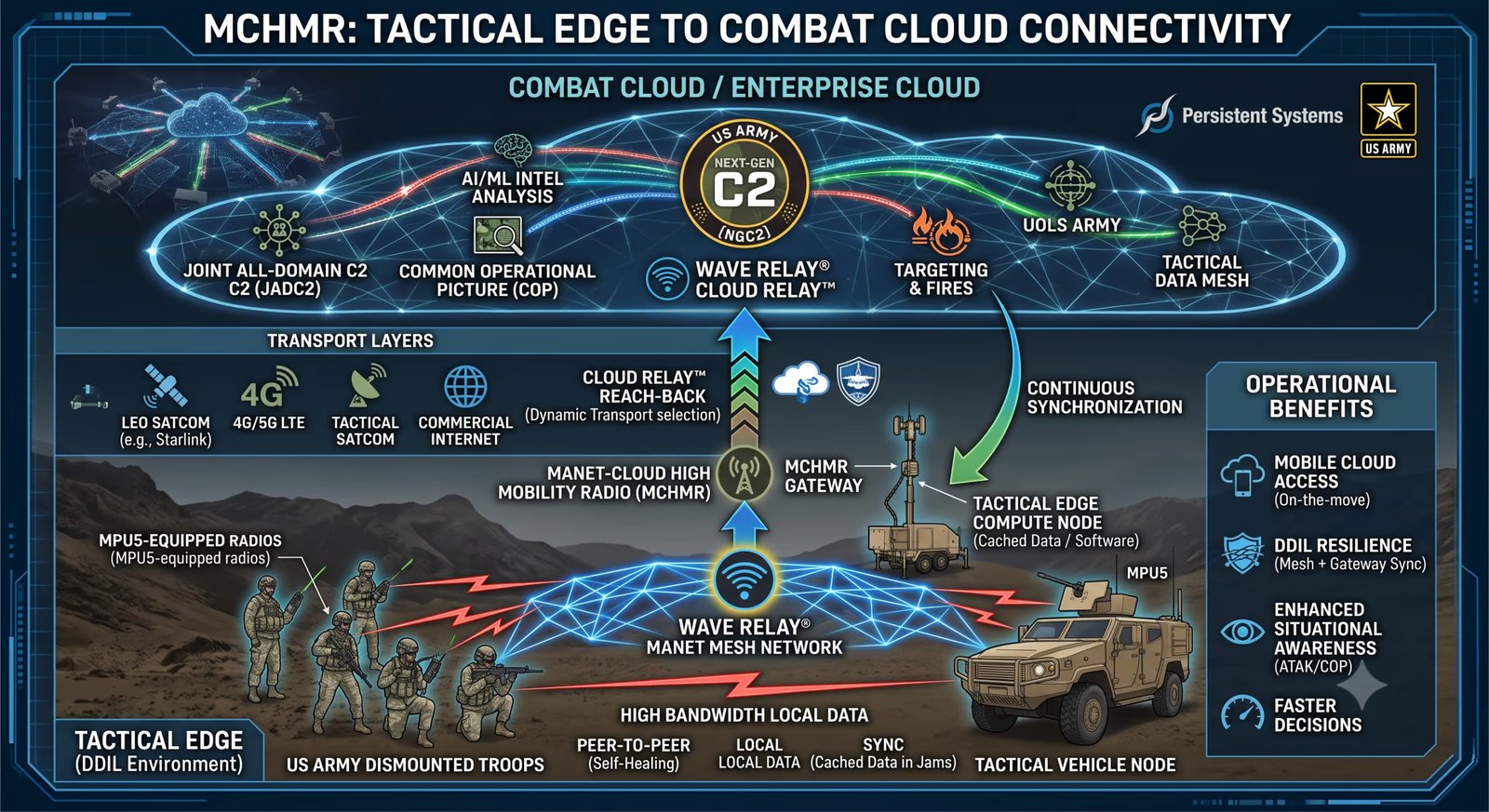
To comprehend how the MCHMR works, it is necessary to understand the composition of the NGC2 architecture: The NGC2’s infrastructure layer encompasses the computing hardware that NGC2 needs to function. The transport layer includes radio communications hardware and software to move voice and data traffic around the NGC2 network, and between its constituent elements. The data layer is the system’s brain linking the NCG2 with the assets mentioned above. This layer contains artificial intelligence and machine learning approaches to aid tactical and operational decision-making. It is also the layer accommodating the Combat Cloud where tactical and operational data will be uploaded to and downloaded from. Finally, the application layer represents the point where the user interacts with the NGC2 network and its data.
In a nutshell, the MCHMR is the hardware and software ensemble allowing US Army and Marine Corps land manoeuvre units to access the NGC2 Combat Cloud at, or near, the tactical edge. From a hardware perspective, the MCHMR is built around Persistent Systems’ MPU5 handheld, multiband tactical radio and its Wave Relay waveform. These radios host mobile ad-hoc networks which in turn provide access to the Combat Cloud either directly, via satellite communications and/or using fourth- or fifth-generation cellular communications. For example, a dismounted soldier using the Android Tactical Assault Kit can upload or download relevant data to and from the Combat Cloud via the MCHMR regardless of their location provided they are connected to the MCHMR network via their MPU5 radio.
African Lion 2026
According to US Army documents, the force began to adopt the MPU5 transceiver from circa 2017. MCHMR began to evolve from 2022 as the MDO philosophy, and its CJADC2 manifestation, gathered momentum. Between 2023 and 2024 the MCHMR architecture was put through its paces during several joint exercises involving the US Army in the Asia-Pacific region.
The capability achieved a critical milestone this May when it was employed at the joint tactical forces level during the African Lion 2026 exercises. According to a written statement provided to Armada by Persistent Systems, MCHMR’s deployment allowed US Army participants, and their Moroccan counterparts, to communicate via the architecture. African Lion 2026 took place in Ghana, Morocco, Senegal and Tunisia and involved 5,600 participants from 40 countries, according to the US Army.
Expanding connectivity is a key goal of ongoing MCHMR development, the written statement continued: “The power of MCHMR is the ability to integrate and share data across multiple units and organisations”. Once the army has completed its’ MCHMR fielding it is expected that the force will “establish an extended network that enhances connectivity and interoperability with partner and allied forces”.
Ownership of the MCHMR is expected to be maintained at the level of the brigade headquarters vis-à-vis the US Army manoeuvre force: “This will give commanders the ability to operate independently from high-level echelons in the event of communications degradation. Additionally, all data from the lowest level will be accessible within the Brigade Command element”.
Assessment
The ongoing deployment of MCHMR demonstrates that the MDO philosophy, and its CJADC2 manifestation, is far from being solely a doctrinal ambition but is crystalising into tangible capability. Not only will the US Army manoeuvre force benefit from Combat Cloud access at the tactical edge, but so will sister services and allies. Tactical connectivity is also being enhanced via initiatives like the Integrated Tactical Network. These networking improvements enhance situational awareness and hence decision-making superiority. The multiplicity of communications links soldiers now benefit from provides resilience and redundancy. The more connectivity personnel have, the more links need to be detected, identified, located and attacked by hostile kinetic, electronic and cyber effects.
by Dr. Thomas Wihtington
