


Both the US and China seek new airlifters capable of reaching remote, far-flung bases in the Pacific theatre, and among the options they are considering are wing-in-ground-effect (WIG) craft.
Ground effect occurs when flying just a few metres above the ocean or ground, and drag is reduced by the proximity to the water, preventing the formation of wingtip vortices and thus increasing the wing’s efficiency. Famously, the Soviets built a range of very large ekranoplans, of which only the Lun-class entered service. Dubbed the ‘Caspian Monster,’ they were treated as ships within the Soviet Union’s Caspian flotilla. Only one was completed, but it fell into disuse after the collapse of the USSR.
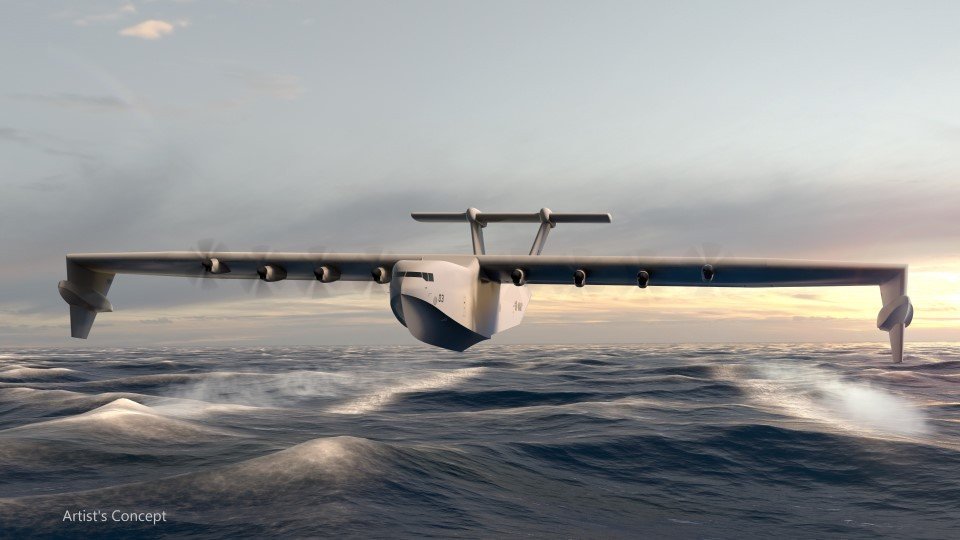
The US Defense Advanced Research Projects Agency (DARPA), responsible for developing emerging technologies, has been working on an ekranoplan for the US military called the Liberty Lifter. Two companies, General Atomics and Boeing’s Aurora Flight Sciences, were asked to generate concepts, and last year Aurora was selected to build the Liberty Lifter demonstrator by 2027. This WIG craft must have the payload capacity of a USAF C-17 and operate in weather conditions as extreme as Sea State 5. The craft, as envisioned, would fly “at speeds far exceeding existing sealift platforms,”
In June 2025, DARPA completed its preliminary work on Liberty Lifter and, after restructuring the programme to focus on the highest technical risks, its simulation successes and materials testing demonstrated the viability of the Liberty Lifter concept. Instead of constructing a demonstrator aircraft, DARPA is collaborating with industry and US DoD stakeholders to accelerate the transition of its findings and enable the rapid deployment of platforms utilising the technologies.
Meanwhile, the US company REGENT Craft announced the formation of REGENT Defense and revealed a new line of innovative maritime craft designed for military use. The Seaglider WIG craft is created to assist the US and its allies in countering the increasing maritime threat posed by China in the Indo-Pacific region.

In March 2026, REGENT announced a US$10 million contract with the Marine Corps Warfighting Laboratory to validate Seaglider use across logistics, ISR, MEDEVAC, launched effects, and other mission-critical areas. It has also formalised development relationships with US Special Operations Command (USSOCOM) and the US Coast Guard Research and Development Center, supporting innovation in agile, next-generation maritime mobility.
The Seaglider’s design provides an exceptional combination of high-speed, long-range, and low-signature capabilities, all at significantly lower cost than traditional transportation solutions. REGENT Defence is also developing the Squire, an autonomous Seaglider drone, which made its flight on 13 April.
China has developed a jet-powered ekranoplan, although it is considered a concept demonstrator rather than a fully operational vessel for the People’s Army Navy. It is believed that the Chinese ekranoplan would be used for the rapid resupply of its remote Pacific Island garrisons and to support amphibious landings.

by David Oliver
