

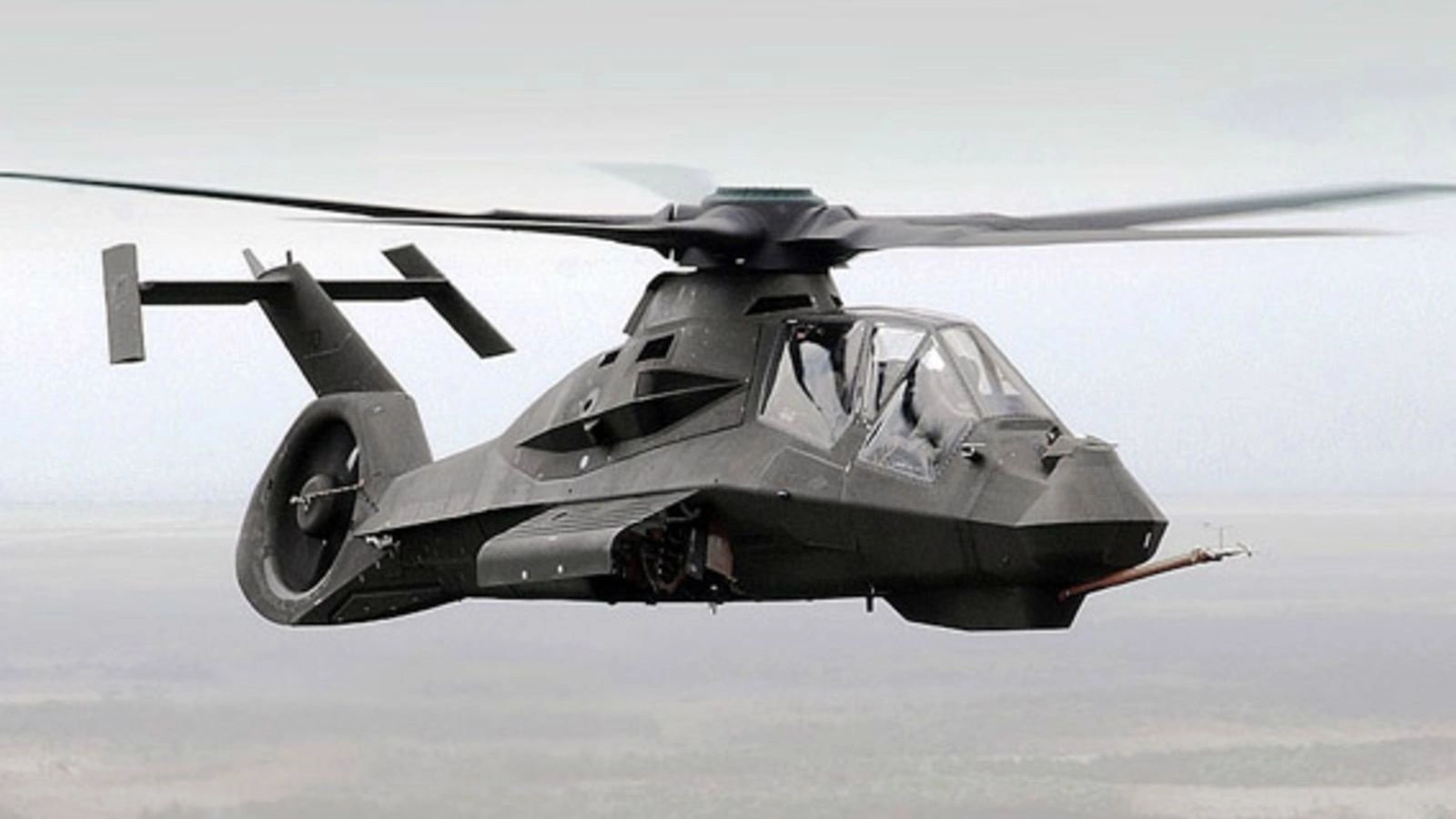
There are military aircraft that become legends because they dominated wars. Then there are the strange ghosts, the machines so ambitious, so unnervingly futuristic, that they never really got the chance to prove themselves. The RAH-66 Comanche belongs squarely in that second category.
At first glance, it looked less like a helicopter and more like something borrowed from a stealth-fighter sketchbook. Angular fuselage. Hidden weapons. Whisper-quiet rotor design. Even now, decades later, the aircraft still feels oddly modern, almost suspiciously modern. You could park it beside some current rotorcraft concepts and nobody would blink.
That’s the weird part.
The Boeing–Sikorsky RAH-66 Comanche first flew in 1996, back when the internet screamed through dial-up modems and GPS still felt exotic to most civilians.
Yet the helicopter carried ideas that modern armies are still trying to perfect: stealth reconnaissance, sensor fusion, digital battlefield networking, low thermal visibility.
In some ways, the Comanche wasn’t built for the wars America fought in the early 2000s. It was built for wars people imagined were coming next.
And it came with a jaw-dropping price tag.
The U.S. Army spent roughly $7 billion developing the program before canceling it in 2004. Only two prototypes were ever completed. No combat missions. No operational squadrons. Just two sleek machines and a mountain of unanswered “what if?” questions.
Still, the helicopter never vanished from aviation culture. Mention the Comanche stealth helicopter in military forums or among rotorcraft engineers and watch the conversation ignite almost instantly. Some call it a financial disaster. Others insist it was decades ahead of its time.
Honestly? Both arguments have teeth.
This post digs deep into the story of the RAH-66 Comanche, its origins, technology, stealth design, weapons systems, cancellation, and the strange legacy it left behind in modern military aviation.
What Was the Boeing–Sikorsky RAH-66 Comanche?
The story of the RAH-66 Comanche didn’t really begin with stealth. It began with panic. Or, more accurately, Cold War anxiety wrapped in Pentagon paperwork.
Back in the early 1980s, the U.S. Army looked at its helicopter fleet and saw a problem looming over the horizon. The aging OH-58 Kiowa scout helicopter was becoming vulnerable, while attack platforms like the AH-1 Cobra were nearing the edge of their technological usefulness.

Soviet air defenses were improving fast. Radar systems were sharper. Surface-to-air missiles were deadlier. Flying low and loud over enemy territory suddenly looked… suicidal.
So the Army launched the LHX program, short for Light Helicopter Experimental. That bland name hid an almost sci-fi ambition: build a helicopter that could sneak through heavily defended airspace, gather intelligence, attack targets, and survive long enough to return home.
Easy on paper. Brutal in reality.
Two aerospace giants, Boeing and Sikorsky Aircraft, teamed up to tackle the challenge. Their vision eventually became the Boeing–Sikorsky RAH-66 Comanche, a helicopter designed around stealth from the very beginning, not as an afterthought.
That distinction mattered.
Most helicopters of the era looked like flying toolboxes with missiles attached. The Comanche looked sculpted. Curved surfaces reduced radar reflections. Weapons disappeared into internal bays. Even the landing gear tucked itself away neatly to cut radar signature. Engineers obsessed over everything, right down to how heat escaped from the engines.
And noise? Surprisingly important.
The Comanche’s rotor system was engineered to be dramatically quieter than conventional helicopters. Army planners believed enemy troops might hear a traditional helicopter long before seeing it.
The RAH-66 Comanche aimed to change that equation entirely, slipping through contested airspace like a rumor rather than a thunderstorm.
Its first flight came in 1996. For a brief moment, it seemed the future of military aviation had arrived early.
RAH-66 Comanche Specifications
If you strip away the mythology surrounding the RAH-66 Comanche, what remains is still an astonishing machine. Not just because it looked futuristic, but because nearly every inch of it was engineered with a specific battlefield problem in mind.
The helicopter measured roughly 44 feet (13.4 meters) in length and carried a two-person crew seated in tandem formation. Pilot in the back, mission commander in front. Pretty standard layout. But almost everything else felt unconventional.

The fuselage used extensive composite materials instead of traditional aluminum-heavy construction. That helped reduce weight and radar visibility at the same time. Engineers even shaped panel edges and air intakes to scatter radar waves away from enemy sensors. It borrowed stealth philosophy from aircraft like the Lockheed F-117 Nighthawk more than from traditional helicopters.
Under the skin sat two LHTEC T800 turboshaft engines, each producing around 1,563 shaft horsepower. Combined, they pushed the aircraft to speeds approaching 200 mph (324 km/h), fast for a reconnaissance helicopter.
Here’s where the Comanche became genuinely strange for its era: it carried weapons internally.
Most helicopters hang missiles and rockets externally, which increases radar signature dramatically. The RAH-66 Comanche tucked much of its weaponry inside retractable bays to preserve stealth characteristics.
| Specification | RAH-66 Comanche |
| Crew | 2 |
| Length | 44 ft (13.4 m) |
| Engines | 2× LHTEC T800 |
| Maximum Speed | ~200 mph |
| Combat Radius | ~300 miles |
| Main Armament | 20mm XM301 cannon |
| Missile Capacity | Hellfire & Stinger missiles |
| Status | Canceled in 2004 |
One overlooked detail? The retractable XM301 20mm cannon mounted beneath the nose. When not firing, it folded back into the fuselage to reduce radar exposure. That kind of design obsession bordered on paranoia, which, honestly, is exactly what stealth engineering often requires.
The helicopter also integrated advanced digital avionics years before such systems became common. Multifunction cockpit displays, fly-by-wire controls, helmet-mounted targeting systems, it was less analog gunship and more airborne battlefield computer.
In hindsight, the Comanche almost feels like a helicopter designed by people who secretly wanted to build a stealth jet instead.
Weapons and Combat Systems
The RAH-66 Comanche wasn’t designed to bulldoze through enemy lines like a flying tank. That was the Apache’s job.
The Comanche hunted differently. It was meant to slip in quietly, spot targets before anyone knew it was there, strike fast, and disappear before radar operators could finish their coffee.
That philosophy shaped every weapon system onboard.

The most distinctive feature was its pair of internal weapons bays mounted along the fuselage. When closed, the helicopter maintained a much smaller radar cross-section. When combat started, the bay doors snapped open in seconds, exposing missiles before sealing shut again. It looked oddly theatrical in test footage, almost shark-like.
The standard stealth configuration typically carried:
| Weapon | Purpose |
| AGM-114 Hellfire Missiles | Anti-armor strikes |
| AIM-92 Stinger Missiles | Air-to-air defense |
| Hydra 70 Rockets | Ground attack |
| XM301 20mm Cannon | Close combat support |
In low-threat situations, external pylons could also be added, increasing payload dramatically. But doing that sacrificed stealth. It’s a little like putting a roof rack on a sports car, you gain utility, lose elegance.
The XM301 cannon deserves special attention because it perfectly captures the Comanche mindset. Mounted on a retractable turret beneath the nose, the 20mm gun could fire around 750 rounds per minute.
Yet when not in use, it folded inward to preserve the helicopter’s stealth profile. Engineers were obsessed with minimizing exposure. Everything had to hide.
Then came the electronics. This is where the aircraft quietly jumped ahead of its generation.
The RAH-66 Comanche featured sophisticated sensor fusion systems capable of combining battlefield data into a unified picture for the crew. Thermal imaging, night vision, radar warning systems, laser targeting, it all fed into advanced cockpit displays. In the mid-1990s, that level of digital integration was unusually ambitious for a helicopter.

And perhaps most importantly, the aircraft was built for information warfare as much as physical combat. The Comanche could scout targets and relay battlefield intelligence to other aircraft, artillery units, or command centers in near real-time.
Today that sounds normal. Back then? It sounded almost absurdly futuristic.
Why the RAH-66 Comanche Was Revolutionary
Military aircraft are usually judged by obvious numbers, speed, firepower, armor, range. The RAH-66 Comanche flipped that logic upside down. Its greatest weapon wasn’t really its missiles or cannon. It was absence.
Absence of noise. Absence of radar return. Absence of warning.
That’s what made the helicopter revolutionary.
For decades, helicopters had one unavoidable weakness: everybody could hear them coming. Long before pilots reached the battlefield, the signature whoomp-whomp-whomp of rotor blades announced their arrival like a marching band.
The Comanche tried to erase that problem. Its five-blade main rotor and enclosed tail rotor system dramatically reduced acoustic signature. Army testing suggested enemy troops might hear it only when it was dangerously close already.

That changes battlefield psychology in a huge way.
The helicopter also pushed stealth far beyond what most rotorcraft designers thought practical. Radar-absorbent materials coated parts of the airframe. Exhaust systems reduced infrared heat visibility. Weapons disappeared into internal bays. Even small details, like flush-mounted antennas and retractable landing gear, served the larger mission of avoiding detection.
And then there was networking.
The RAH-66 Comanche was designed for an emerging military idea called network-centric warfare. Instead of acting like isolated aircraft, future combat platforms would share information instantly across the battlefield.
The Comanche could identify targets deep behind enemy lines and transmit data directly to artillery units, ground commanders, or attack helicopters nearby.
That sounds ordinary now because modern militaries depend on interconnected systems constantly. But during the 1990s, the concept still felt experimental. In many ways, the Comanche anticipated how 21st-century warfare would actually evolve.
Interestingly, some aviation historians argue the helicopter’s biggest problem was timing. It arrived in a strange transition period, after the Cold War but before drones fully reshaped reconnaissance doctrine. Had the program emerged ten years earlier, it might have become indispensable. Ten years later, perhaps it would’ve integrated seamlessly with unmanned systems.
Instead, the Comanche stealth helicopter landed awkwardly between eras. Too advanced for old doctrine. Too expensive for changing priorities.
That tension haunted the aircraft from the beginning.
Why Was the RAH-66 Comanche Canceled?
The cancellation of the RAH-66 Comanche still sparks arguments in defense circles because, on paper, the helicopter looked extraordinary. Advanced stealth technology. Sophisticated avionics. Powerful reconnaissance capabilities. So why kill it after spending billions?
The short answer: the world changed faster than the helicopter did.
When the Comanche program began during the Cold War, U.S. military planners imagined massive armored conflicts against the Soviet Union in Europe. The helicopter was designed to sneak through dense enemy air defenses, locate Soviet armor formations, and survive in terrifyingly hostile airspace.

Then the Soviet Union collapsed.
Suddenly the Pentagon’s strategic map looked completely different. By the late 1990s and early 2000s, America was increasingly focused on counterinsurgency operations, urban warfare, and asymmetric conflicts in places like Afghanistan and Iraq. Expensive stealth reconnaissance helicopters started looking less urgent compared to drones, satellites, and upgraded existing aircraft.
Money became impossible to ignore.
The Army originally planned to purchase over 1,200 Comanches, but rising development costs forced repeated reductions. Eventually, estimates suggested the total program could exceed $40 billion if full production continued.
That’s a brutal number, even by Pentagon standards.
| Program Factor | Impact on Cancellation |
| Rising development costs | Budget pressure |
| Cold War ending | Reduced strategic need |
| UAV advancement | Alternative reconnaissance options |
| Delays & redesigns | Increased uncertainty |
| Existing helicopter upgrades | Cheaper solution |
Another issue lurked beneath the headlines: technology creep.
The RAH-66 Comanche kept absorbing new requirements as military technology evolved. Every few years, engineers were asked to integrate fresh electronics, software updates, communications systems, and survivability improvements.
The helicopter became trapped in a cycle common to ambitious defense projects, by the time one version was nearly ready, planners already wanted the next version.
Meanwhile, drones were quietly stealing attention.
Unmanned aerial vehicles could conduct reconnaissance missions without risking pilots’ lives, often at far lower operational costs. That shift fundamentally weakened one of the Comanche’s core justifications.
In 2004, the U.S. Army officially canceled the program after roughly $7 billion in development spending. Only two prototypes had been completed.
And just like that, one of the most futuristic helicopters ever built became a museum piece before it ever entered active service.
Legacy of the Comanche Program
The RAH-66 Comanche never entered combat, never rolled off production lines in large numbers, and never became the Army’s next great helicopter. Yet its influence still hangs over modern military aviation in ways that are easy to miss unless you know where to look.
A lot of the technology that felt wildly experimental in the 1990s now seems normal. Low-observable shaping. Reduced infrared signatures. Sensor fusion. Digital cockpit systems. Quiet rotor design.
The Comanche pushed all of those ideas forward at once, almost recklessly. It was less a helicopter and more a flying technology laboratory.
That’s part of why aviation enthusiasts still obsess over it.
The aircraft also changed how the Pentagon viewed giant defense programs. After spending roughly $7 billion before cancellation, military planners became far more cautious about projects that combined cutting-edge technology with constantly evolving mission requirements. The Comanche became a textbook example of what happens when innovation outruns budget reality.
And visually? The helicopter still refuses to age.
Even today, the angular stealth profile of the RAH-66 Comanche looks futuristic beside many modern aircraft. That’s rare. Most military machines eventually look trapped in their decade. The Comanche somehow escaped that fate.
In a strange way, its greatest achievement may have been proving that stealth helicopters were possible long before the military truly needed them.
