

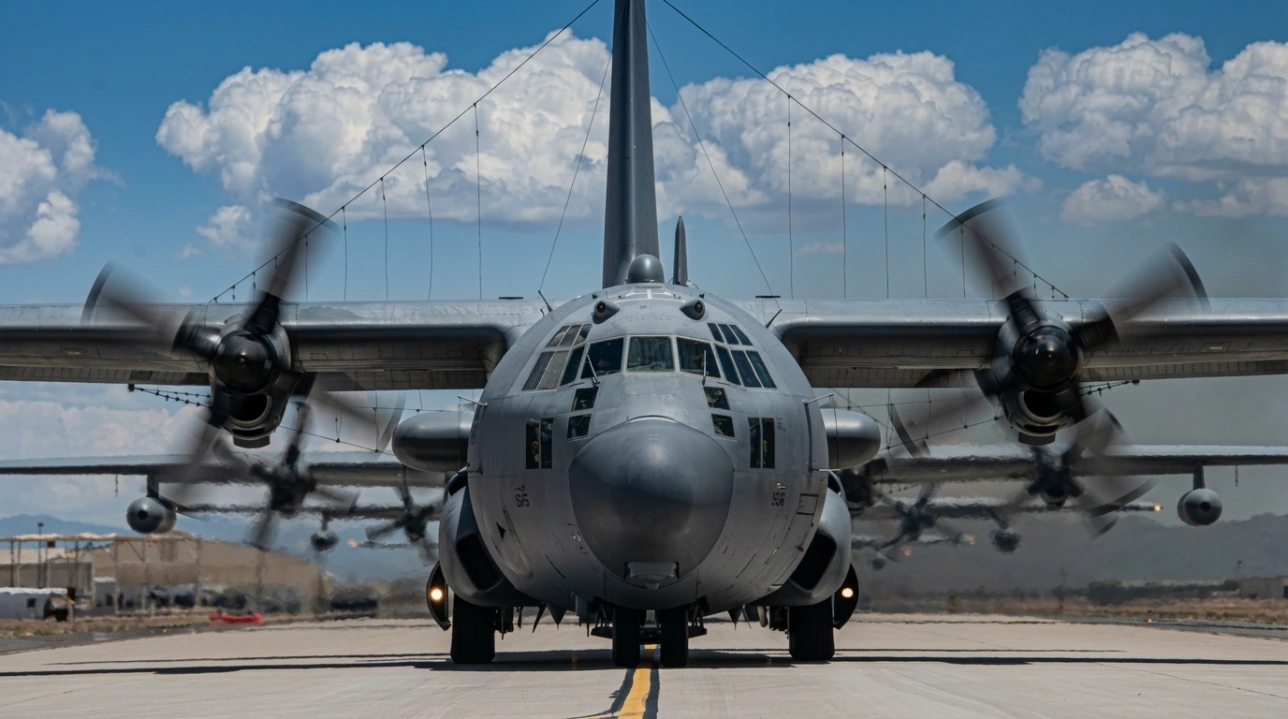
For more than four decades, the EC-130H Compass Call fought a battle most people could never see.
Rather than relying on conventional weapons, this unusual U.S. Air Force aircraft operated in the electromagnetic environment, helping disrupt adversary communications and command-and-control systems.
Now, its long career is ending.
On September 2, 2026, the final operational EC-130H Compass Call, aircraft 73-1590, completed its last flight from Davis-Monthan Air Force Base in Arizona. The aircraft is scheduled for formal retirement on September 18.
There was a fitting detail to that final flight: an EA-37B Compass Call flew alongside it.
That image captures the bigger story. The EC-130H Compass Call is leaving after nearly 44 years of service, but the electronic-attack mission is moving forward on a newer platform.
The EC-130H began life as a heavily modified C-130H and became a key U.S. electronic-warfare asset across decades of military operations.
So what made the EC-130H Compass Call so important and why is the EA-37B taking over?
The answer starts with the unusual mission this aircraft was built to perform.
What Was the EC-130H Compass Call?
The EC-130H Compass Call was never a conventional combat aircraft. Its defining weapon was the ability to influence the electromagnetic environment rather than physically engage a target.
Built from the C-130H Hercules, the aircraft was heavily modified to carry specialized electronic-warfare equipment, operators and mission systems. That large airframe gave Compass Call something particularly valuable: the space and endurance needed for a complex electronic-attack mission.
The program dates back to the late Cold War. The first EC-130H Compass Call flew in 1981, with the aircraft entering operational service in the early 1980s. It was operated by the U.S. Air Force’s 55th Electronic Combat Group at Davis-Monthan Air Force Base, Arizona.
So, what exactly did it do?
In broad terms, Compass Call was designed to interfere with adversary command, control and communications. Instead of physically destroying communication infrastructure, the system could disrupt the electromagnetic pathways used to coordinate forces.
That made the EC-130H Compass Call an unusual kind of battlefield support aircraft.
Read also: Top 5 Best Electronic Warfare Aircraft in the World in 2026
Imagine a military network as a conversation happening across a crowded room. Conventional weapons might target the room itself. Compass Call was designed to interfere with the conversation, making it harder for information to move between the people who needed it.
The aircraft could therefore contribute to wider operations without necessarily being the most visible platform in the sky.
And its role was broader than simply “jamming.” The Air Force describes Compass Call as a tactical weapon system designed to deny, degrade and disrupt adversary command-and-control communications and limit their ability to coordinate operations.
After more than four decades, that mission remains relevant.
What changed was the technology surrounding it and eventually, the aging C-130H airframe carrying it.
EC-130H Compass Call Specifications
The EC-130H Compass Call may have looked like a conventional C-130 Hercules from the outside, but its specifications reveal how much the aircraft was adapted for electronic warfare.
The platform retained the basic characteristics of the C-130 family, including four turboprop engines and a large airframe. Inside, however, the aircraft carried a specialized electronic-attack mission system and a much larger crew than a standard transport configuration.
According to U.S. Air Force specifications, the EC-130H was powered by four Allison T56-A-15 turboprop engines, each producing 4,910 propeller-shaft horsepower. It had a maximum takeoff weight of 155,000 pounds (69,750 kg), a published range of 2,295 miles (3,694 km) and a maximum speed of about 300 mph (Mach 0.52) at 20,000 feet.
| Specification | EC-130H Compass Call |
| Primary role | Electronic warfare and offensive counter-information |
| Airframe | Modified C-130 Hercules |
| Powerplant | 4 × Allison T56-A-15 turboprops |
| Power | 4,910 shp each |
| Length | 97 ft 9 in (29.3 m) |
| Wingspan | 132 ft 7 in (39.7 m) |
| Height | 38 ft 3 in (11.4 m) |
| Maximum takeoff weight | 155,000 lb (69,750 kg) |
| Maximum speed | 300 mph (Mach 0.52) |
| Range | 2,295 miles (3,694 km) |
| Service ceiling | 25,000 ft (7.6 km) |
| Combat crew | 13 |
| Initial operating capability | 1983 |
One of the most distinctive specifications was the 13-person combat crew. Four personnel handled aircraft flight and navigation, while nine operated the electronic-warfare mission equipment installed in the cargo/mission compartment.
That crew arrangement highlights what made the EC-130H Compass Call different from a normal transport aircraft. The airframe was essentially the platform; the real specialization was inside it.
Its published “armament” was also unusual: non-kinetic energy waveforms rather than conventional weapons. The Air Force describes the system as being designed to disrupt adversary command-and-control communications and support electronic attack operations.

These specifications help explain both the aircraft’s strengths and its eventual limitation. The large C-130-based platform provided space, crew capacity and endurance for a complex mission, but the aging airframe eventually became increasingly difficult to sustain.
That is one reason the Air Force began shifting the Compass Call mission to the EA-37B.
Where Did the EC-130H Compass Call See Combat?
The EC-130H Compass Call built its reputation through a long list of U.S. and coalition operations. Its first combat mission came during Operation Just Cause in Panama in 1989, marking the beginning of a combat career that would span more than three decades.
From there, EC-130H Compass Call appeared in operations across very different theaters. U.S. Air Force records identify missions connected to Desert Storm, Kosovo, Haiti, Libya, Iraq, Serbia and Afghanistan, among others.
The aircraft’s role could change depending on the operation, but the central objective remained consistent: influence the electromagnetic environment and make it harder for adversary forces to coordinate through communications networks.
Afghanistan became one of the clearest examples of how heavily the capability was used. The 41st Expeditionary Electronic Combat Squadron maintained a sustained presence supporting Operation Enduring Freedom and later Operation Freedom’s Sentinel.

By 2018, Air Force reporting said EC-130H crews had accumulated nearly 42,000 combat hours supporting coalition operations in and around Afghanistan.
EC-130H Compass Call also supported operations against ISIS in the Middle East. In that environment, electronic warfare became part of a broader effort to limit the ability of opposing forces to coordinate activities and respond effectively. The Air Force described the aircraft as a low-density, high-demand asset, reflecting how specialized the capability was.
That operational history explains why the EC-130H Compass Call became such an important asset despite its relatively small fleet.
It was not everywhere at once. Instead, its value came from being available when commanders needed a specialized electronic-attack capability.
But years of continuous deployments came with a cost. The same aircraft that proved its value across multiple conflicts was also accumulating flight hours, maintenance demands and age-related limitations.
That eventually became the central question: how long could the EC-130H Compass Call continue performing a demanding mission on an aging airframe?
Why Is the EC-130H Compass Call Retiring?
The retirement of the EC-130H Compass Call is not primarily about the mission becoming obsolete. It is about the aircraft carrying that mission reaching the limits of an aging design.
The EC-130H Compass Call was built around the C-130H Hercules, a platform that dates back decades. While the airframe proved remarkably durable, maintaining an aircraft fleet that has accumulated years of intensive operational use becomes increasingly difficult and expensive.
The Air Force has also faced growing demands on its depot maintenance system. By the final years of the program, the remaining EC-130H Compass Call aircraft were approaching or reaching programmed maintenance limits, creating additional challenges for keeping the fleet available.
There was another problem: service-life extension was becoming harder to justify.

U.S. Air Force budget documentation indicated that extending an EC-130H Compass Call’s service life could require roughly $14 million per aircraft for up to two additional years. That expense would provide only a temporary solution for an airframe already approaching retirement.
The issue was particularly important because electronic warfare is a specialized mission. The United States could not simply retire the aircraft and accept a long-term capability gap. Instead, the Air Force began transitioning the Compass Call mission to the EA-37B, a newer platform designed specifically for the next generation of electronic attack.
This created a gradual handover rather than an abrupt end.
The EC-130H Compass Call could continue supporting the mission while the EA-37B entered testing, training and operational development. At the same time, elements of the existing Compass Call mission equipment were transitioned to the new aircraft, preserving valuable technology and operational experience.
In that sense, the retirement is best understood as a platform transition.
The EC-130H Compass Call’s airframe is reaching the end of its practical service life. The electronic-warfare mission itself is moving forward.
What Happened During the EC-130H Compass Call’s Final Flight?
The final flight of the EC-130H Compass Call was more than another training sortie. It marked the closing chapter of one of the U.S. Air Force’s longest-running airborne electronic-warfare programs.
On September 2, 2026, the final operational EC-130H, aircraft 73-1590, departed Davis-Monthan Air Force Base in Arizona for its last flight. The roughly six-hour sortie carried the callsign VOLT01, according to Air Force reporting.
There was also a symbolic element to the mission.
Flying alongside the retiring EC-130H was an EA-37B Compass Call, the aircraft that will carry the mission into its next phase. Seeing both platforms together provided a visual representation of the transition already underway across the U.S. electronic-warfare community.
For the crews who operated the EC-130H Compass Call, the flight represented decades of accumulated experience. The aircraft had served since the early 1980s and supported operations across multiple regions, building a reputation as a highly specialized electronic-attack platform.

But the final flight was also about continuity.
The Air Force is not retiring the Compass Call mission. Instead, it is retiring the aging aircraft that carried it and moving the capability onto a newer platform.
The transition is expected to become formal with a retirement ceremony scheduled for September 18, 2026, at Davis-Monthan.
That makes the September 2 flight an important milestone rather than an isolated farewell. After more than four decades, the EC-130H’s operational chapter is closing, but the next chapter is already visible in the EA-37B flying beside it.
And that raises the key question: how does the EA-37B actually replace such a specialized aircraft?
How Does the EA-37B Replace the EC-130H Compass Call?
The EA-37B Compass Call is not simply a newer version of the EC-130H. It represents a fundamental change in the platform carrying the electronic-attack mission.
The aircraft is based on the Gulfstream G550, a business-jet platform adapted for military electronic warfare. Compared with the C-130H-based EC-130H, the EA-37B offers a faster, higher-altitude and more efficient platform, characteristics that can improve how the mission is conducted in a modern contested environment.
The change also reflects a broader shift in military aircraft design. Instead of adapting a large transport aircraft to carry an electronic-warfare system, the Air Force is moving the mission onto a platform designed around speed, altitude, endurance and modern mission architecture.
Importantly, the transition does not mean throwing away everything developed for Compass Call.
Around 70% of the EC-130H’s mission equipment has been reported as being cross-decked to the EA-37B. That allows the Air Force to retain significant elements of an established capability while introducing newer technologies and systems architecture.

The aircraft was initially designated EC-37B, but the Air Force redesignated it EA-37B in October 2023 to better reflect its electronic-attack role.
The difference is therefore both physical and technological.
The EC-130H Compass Call provided the space and endurance needed to operate a highly specialized electronic-warfare system. The EA-37B brings that mission into a smaller, faster and more modern package.
For crews and commanders, the most important point is continuity. The aircraft is changing, but the underlying objective remains familiar: use the electromagnetic spectrum to influence adversary communications and command-and-control capabilities.
That makes the EA-37B less a replacement that starts from zero and more a new generation of the Compass Call mission.
What Does the EC-130H Retirement Mean for U.S. Electronic Warfare?
The retirement of the EC-130H Compass Call closes one era of U.S. electronic warfare while opening another.
For more than four decades, the aircraft demonstrated how control of the electromagnetic spectrum could support military operations without relying on conventional weapons. Its long service also provided the U.S. Air Force with operational experience in a mission that has become increasingly important as modern forces depend on connected communications and data networks.
The transition to the EA-37B reflects that changing environment.

The new aircraft is designed around a more modern platform and electronic-warfare architecture, giving the Air Force an opportunity to combine lessons from the EC-130H program with newer technology. The reported transfer of much of the existing mission equipment also illustrates that the transition is evolutionary rather than a complete reset.
At the same time, the retirement highlights a broader challenge for advanced military capabilities: technology can remain operationally relevant even when the platform carrying it reaches the end of its service life.
That distinction matters.
The EC-130H Compass Call’s retirement does not signal the end of airborne electronic attack. Instead, it shows how the Air Force is adapting the mission to a different generation of aircraft and a more demanding electromagnetic environment.
The September 2026 farewell therefore carries significance beyond a single aircraft’s final flight. It marks the end of the EC-130H Compass Call’s operational chapter while establishing the EA-37B as the next platform for the Compass Call mission.
The story also illustrates how electronic warfare has evolved from a highly specialized capability into an increasingly important element of modern air operations.
The aircraft may be changing, but the contest for control of the electromagnetic spectrum is far from over.
