

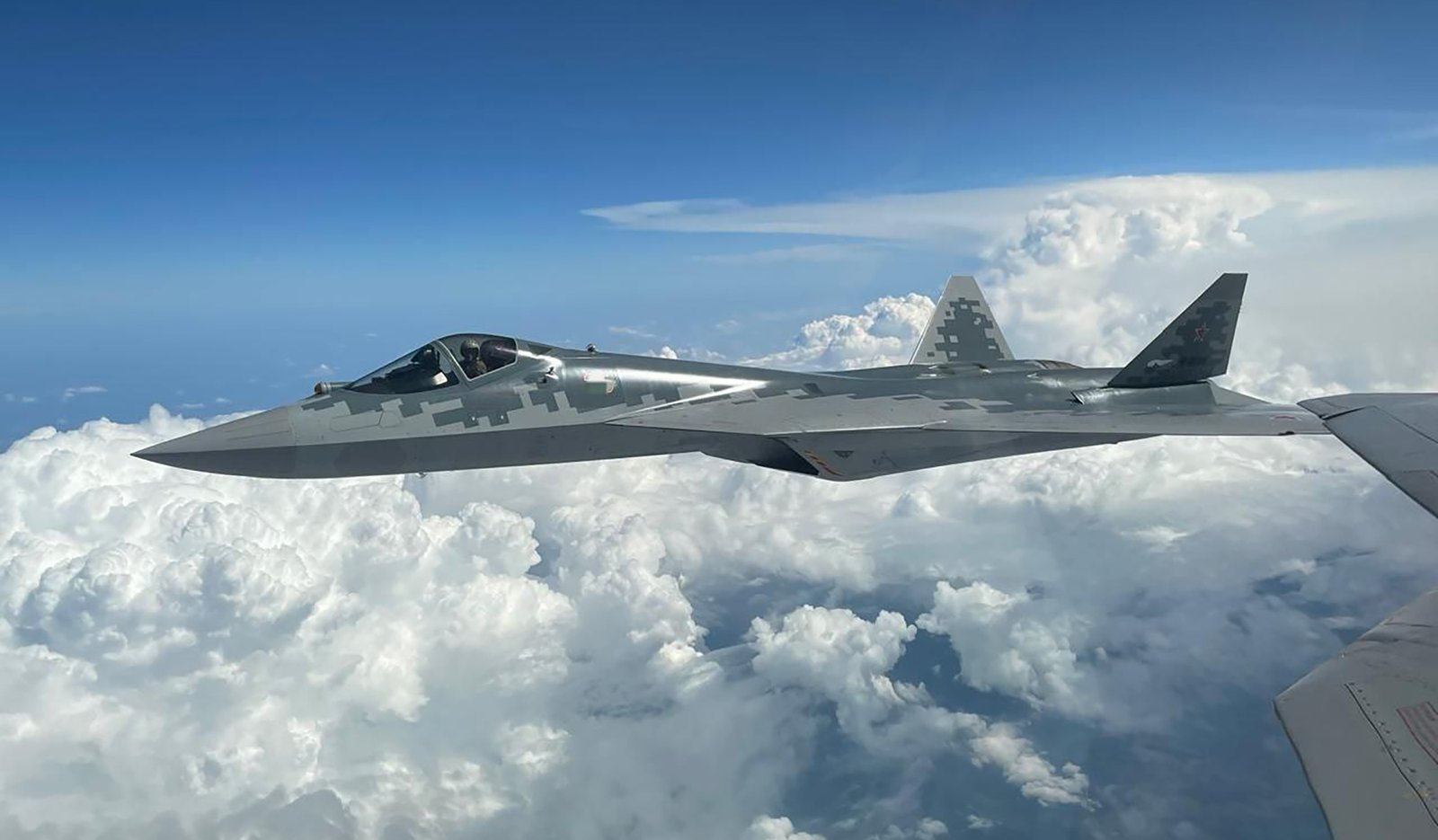
Russia’s Su-57 Felon, its most advanced fifth-generation fighter aircraft, has been employed only sparingly during the war in Ukraine. According to Israeli defense analysts, the aircraft’s limited operational use reflects several strategic considerations and underscores a broader lesson about modern air warfare: even highly advanced combat aircraft face significant risks when operating in airspace protected by capable air defense systems.
Long-Range Strikes from Russian Airspace
Rather than flying deep into Ukrainian territory, Russia has primarily used the Su-57 to launch long-range stand-off missiles while remaining inside Russian-controlled airspace. This approach allows the aircraft to contribute to combat operations while minimizing the risk of exposure to Ukrainian air defenses.
Israeli analysts estimate that Russia currently operates fewer than 30 Su-57s, making every aircraft a valuable strategic asset. “Losing even one aircraft in a conflict such as Ukraine would represent a significant blow to Russia’s image,” one Israeli analyst said towards the author.
A Scarce and Expensive Asset
Another factor limiting the Su-57’s employment is the aircraft’s cost and production rate. According to the analysts, the fighter is both expensive and difficult to manufacture, particularly under the impact of Western sanctions that continue to restrict Russia’s access to critical military technologies and industrial components.
The analysts also note that, despite Ukraine relying in part on legacy air defense systems such as the Patriot, Russia appears unwilling to expose its most advanced fighter to the possibility of being shot down.
Su-57 – Intelligence Risks
Beyond the immediate military consequences, Israeli analysts believe Russia is also concerned about the intelligence implications of losing a Su-57 over Ukrainian territory.
A crash inside Ukraine could provide the United States and its allies with access to sensitive technologies, allowing them to examine the aircraft’s radar, avionics, electronic warfare systems, and other classified capabilities. And even though the Su-57 program continues to advance, although production remains relatively modest.
Russia has begun forming its first operational combat squadron with the aircraft, which was developed by the Sukhoi Design Bureau using experience gained from the highly capable Su-35 fighter.
Western sanctions on military technology exports, however, continue to slow Russia’s broader defense modernization efforts, including further development and production of the Su-57.
Su-57 also plays a role in Russia’s broader defense export strategy. Before the war in Ukraine, the aircraft was viewed as a potential export platform for key partners. However, according to Israeli analysts, Russia’s reduced industrial capacity following the 2022 invasion has significantly lowered the likelihood of countries such as Iran receiving the Su-57 in the near future.
Performance Still Largely Unknown
Although the Su-57 has entered operational service, relatively little is publicly known about its actual combat performance. Western analysts continue to assess the aircraft as a potential challenge to NATO air forces, while comparative studies have evaluated its capabilities against earlier Russian fourth-generation fighters using Energy Maneuverability Theory to determine whether the aircraft represents a significantly greater challenge for modern air defense systems.
For now, Israeli analysts conclude that Russia’s cautious employment of the Su-57 in Ukraine illustrates a central reality of modern warfare: even the most advanced fighter aircraft are not immune to the threat posed by dense and effective integrated air defense systems.
Author: Arie Egozi, Israel Correspondent
Click here to read the latest issue of ESD.
