

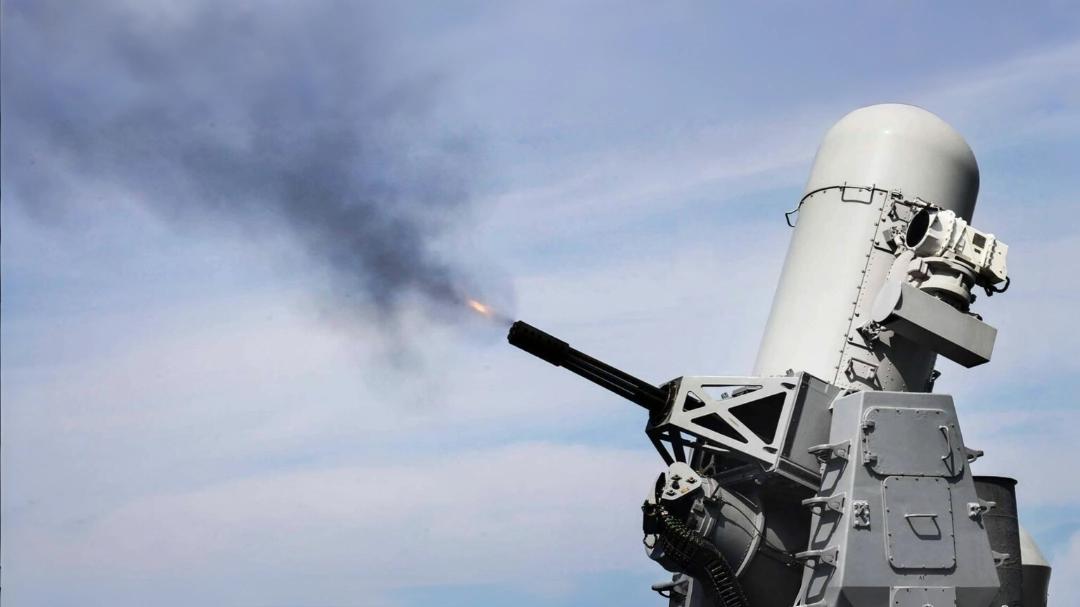
There’s a moment in modern naval combat that feels almost cinematic, an incoming missile screaming toward a ship at supersonic speed, radar alarms blaring, seconds ticking down.
No time for debate. No room for error. And then, almost instinctively, a compact turret swivels, locks on, and unleashes a storm of metal so dense it looks like a solid beam.
That’s the Phalanx CIWS.
If you’ve ever wondered how warships survive in an era where missiles travel faster than sound and smarter than ever, this system is a big part of the answer.
The Phalanx Close-In Weapon System (CIWS) isn’t just another naval gun, it’s the last safety net. The final reflex. The thing that steps in when everything else has already failed.
Here’s what makes it fascinating: it doesn’t wait for human hesitation. The system detects, tracks, calculates, and fires, often in complete autonomy. In less time than it takes you to blink, it can decide whether something is a threat… and eliminate it.
We’re talking about a 20mm radar-guided Gatling gun capable of firing thousands of rounds per minute. Not warning shots. Not guesswork. Precision chaos.
And yet, despite all that raw firepower, the Phalanx CIWS isn’t about aggression, it’s about survival. Ships rely on layered defenses, and this system sits at the very inner circle, where failure isn’t an option anymore.
So if you’ve ever asked yourself, “What actually protects a warship at the last second?”, you’re in exactly the right place.
What Is Phalanx CIWS?
At its core, the Phalanx CIWS is exactly what its name suggests, a Close-In Weapon System designed to deal with threats that have already slipped through every other layer of defense. Think of it less like a sword and more like a reflex. It doesn’t patrol. It reacts.
The word “phalanx” itself comes from ancient Greek warfare, a tight formation of shields and spears, meant to stop anything that got too close. That metaphor still holds up surprisingly well. Only now, instead of bronze shields, you’ve got radar and a six-barrel Gatling gun spinning at absurd speed.
So what does it actually do?
In simple terms, the CIWS system watches the sky and sea around a ship constantly. When it detects something hostile, say, an anti-ship missile closing in at Mach speed, it doesn’t wait for lengthy commands. It tracks the target, predicts its path, and fires a dense stream of 20mm rounds to physically tear it apart before impact.
And here’s the interesting part: it operates in layers of awareness. Early-warning radars might spot a threat dozens of kilometers out. Missiles or larger defense systems try to intercept first. But if those fail, or the timeline collapses, the Phalanx CIWS becomes the last line of defense.
It’s not built for long-range elegance. It’s built for split-second decisions in tight spaces.
You’ll often see it described as a “point-defense system,” which is just a technical way of saying: this thing protects exactly what it’s sitting on. No more, no less.
Missiles. Aircraft. Fast attack boats. Even drones now. If it’s close, and dangerous, the Phalanx doesn’t hesitate.
How Phalanx CIWS Works
Imagine giving a machine the job of watching the horizon 24/7, never blinking, never second-guessing, and then trusting it to pull the trigger faster than any human could. That’s essentially how the Phalanx CIWS operates.
It follows a tight loop: detect → track → decide → engage. Sounds simple. In reality, it’s a blur of calculations happening in fractions of a second.
First comes detection. The system uses its own radar (you’ll notice that distinctive white dome) to scan for incoming threats. Not just anything moving, but objects behaving like a threat. Speed, trajectory, angle… it’s all analyzed on the fly. A seagull? Ignored. A sea-skimming missile? That’s a different story.
Once something suspicious pops up, tracking kicks in. The radar locks onto the target and continuously updates its position. Meanwhile, the onboard computer predicts where that object will be, not where it is. That distinction matters, because at these speeds, aiming “at” the target would miss entirely.
Then comes the decision phase. In automatic mode, the system decides on its own whether to fire. No dramatic countdown. No human confirmation needed. Just a quiet, binary conclusion: threat or no threat.
And finally, engagement. The M61 Vulcan Gatling gun spins up and releases a stream of rounds so dense it almost behaves like a wall. The goal isn’t a single hit. It’s saturation, overwhelming the target until it breaks apart.
What’s slightly unsettling (and impressive) is how little time all of this takes. We’re talking seconds. Sometimes less.
By the time a human fully processes what’s happening, the Phalanx has already done its job… or tried to.
Key Specifications of the Phalanx CIWS
Numbers don’t tell the whole story, but with the Phalanx CIWS, they get pretty close. This is one of those systems where raw specs translate directly into real-world survival.
Let’s lay out the essentials first:
| Specification | Detail |
| Caliber | 20mm |
| Gun Type | M61 Vulcan Gatling gun |
| Rate of Fire | ~4,500 rounds per minute |
| Effective Range | ~1.5 km |
| Ammunition Capacity | ~1,550 rounds |
| Radar System | Ku-band search & track radar |
| Operation Mode | Autonomous / Manual |
Now, those numbers might look like a spec sheet from a manual, but pause on that rate of fire for a second. 4,500 rounds per minute. That’s roughly 75 rounds every second. Not individual shots you can count, more like a continuous stream, almost liquid in behavior.
And range? Around 1.5 kilometers doesn’t sound like much until you remember the context. At missile speeds, that distance disappears in seconds. The CIWS system isn’t meant to reach far, it’s meant to react instantly when everything gets uncomfortably close.
The ammunition is another interesting piece. Those rounds aren’t just standard bullets; many are designed to maximize impact and fragmentation. The goal isn’t elegance, it’s disruption. Break the missile, destabilize it, reduce its chances of hitting intact.
Also worth noting: the radar system is fully integrated. Unlike larger defense setups that rely on external sensors, the Phalanx CIWS carries its own eyes and brain. It’s self-contained. Independent. Almost stubbornly so.
In a way, these specs reflect a philosophy: don’t overcomplicate the final layer of defense. Make it fast. Make it reliable. And make it hit hard enough that nothing gets through.
History and Development of the Phalanx CIWS
The Phalanx CIWS didn’t appear out of nowhere, it was born from a very specific kind of fear. Late Cold War anxiety, to be precise.
By the 1960s and ’70s, anti-ship missiles were getting faster, lower, and far more accurate. Traditional naval guns? Too slow. Missile defenses? Not always reliable. There was a gap. A dangerous one.
So the idea emerged: what if a ship had something like a mechanical reflex? A system that didn’t rely on human reaction time at all.
Development kicked off under what would eventually become General Dynamics. Early prototypes looked… a bit experimental, honestly. Bulky, complex, not quite ready for prime time. But the core idea, automated close-in defense, was too important to ignore.
By 1980, the first operational versions of the Phalanx CIWS were deployed on U.S. Navy ships. And that changed things. Suddenly, vessels had a last-ditch safeguard that didn’t panic, hesitate, or get overwhelmed.
Through the years, the system quietly evolved. Not flashy upgrades, more like steady refinements. Better tracking. Smarter targeting. Improved reliability. Each version learned from real-world deployment, not just lab testing.
And then came global adoption. Today, more than 15 countries use some form of the CIWS system, from major naval powers to smaller fleets that need dependable ship protection without overly complex infrastructure.
There’s an interesting pattern here: while many military technologies come and go, replaced by something newer and shinier, the Phalanx keeps getting upgraded instead of retired. That says something.
It wasn’t just built for a moment in history, it was built for a problem that hasn’t gone away.
Comparison with Other CIWS Systems
The Phalanx CIWS gets a lot of attention, but it’s not the only player in the close-in defense game. Different navies have taken slightly different approaches to solving the same terrifying problem: what do you do when a missile is seconds away from impact?
Let’s start with the Dutch system, Goalkeeper CIWS. On paper, it looks similar, autonomous, radar-guided, built for last-ditch defense. But instead of a 20mm gun, it uses a larger 30mm cannon. Fewer rounds per minute than Phalanx, but each shot hits harder. You could say Phalanx relies on volume, while Goalkeeper leans into impact.
Then there’s Russia’s AK-630. This one also uses a multi-barrel rotary cannon, much like Phalanx, but traditionally with less advanced targeting systems, at least in earlier versions. It’s brutally fast, but historically more dependent on external radar and fire control systems rather than being fully self-contained.
Now, a more modern twist: SeaRAM. Instead of firing bullets, it launches missiles. That gives it a longer engagement range and potentially higher kill probability, but at the cost of complexity and limited ammo count. Once you’ve fired your missiles, that’s it until reloaded.
So where does Phalanx fit in all this?
It’s the minimalist of the group. Self-contained, highly automated, and relentlessly focused on doing one job well, close-range interception. No reliance on external systems. No overcomplication.
But there’s a trade-off. Its effective range is shorter than missile-based systems like SeaRAM. That means less reaction time. Less margin for error.
In practice, many modern ships don’t choose one, they layer them. Missiles first. Guns last.
Because when things get close, really close… simplicity tends to win.
Advantages and Limitations of the Phalanx CIWS
The Phalanx CIWS has a reputation for being brutally effective, but like any system, it’s not flawless. Its strengths are very real. So are its constraints. And the interesting part? They’re often two sides of the same coin.
Let’s start with what it does exceptionally well.
First, automation. The system can operate almost entirely on its own, detecting, tracking, and engaging threats without waiting for human input. In a scenario where seconds matter (and they always do), that’s not just convenient, it’s critical.
Then there’s the rate of fire. That staggering stream of 20mm rounds creates a dense cloud of projectiles. Instead of relying on precision alone, the CIWS system overwhelms incoming threats. It’s like trying to fly through a steel storm. Not ideal for anything made of metal and fuel.
Reliability also deserves a mention. The system has been refined over decades, and navies trust it because it tends to work when needed, no drama, no hesitation.
But here’s where things get complicated.
The biggest limitation? Range. With an effective reach of roughly 1–1.5 km, the Phalanx operates in a very tight window. If it engages, it means everything else has already failed or been bypassed. There’s no backup after this.
Another concern is engagement time. At high speeds, a missile can cover that final distance in seconds. That leaves very little room for error, or multiple attempts.
And then there’s something less obvious: debris risk. Even if the system successfully destroys a missile, fragments can still hit the ship. Not catastrophic, usually, but not harmless either.
So, the Phalanx CIWS isn’t a perfect shield. It’s more like a last reflex, fast, powerful, and absolutely vital… but ideally never the first thing you rely on.
Future of the Phalanx CIWS
At first glance, the Phalanx CIWS might seem like a relic, something that peaked decades ago and is now just… hanging on. But that’s not really what’s happening. If anything, it’s being quietly reshaped for a very different kind of battlefield.
The biggest shift? Threats are getting smaller, cheaper, and more numerous. Not just supersonic missiles anymore, but drone swarms, loitering munitions, fast attack boats, things that don’t always behave in neat, predictable ways. That forces the CIWS system to evolve beyond its original mission.
Recent upgrades focus less on brute force (it already has plenty of that) and more on awareness and precision. Better sensors. Improved tracking algorithms. The ability to pick out real threats in cluttered environments without overreacting.
There’s also a growing trend toward layered integration. Systems like SeaRAM extend defensive reach by pairing missile interception with Phalanx-style targeting. It’s not about replacing the gun, it’s about buying more time before the “last line” is needed.
And despite all the buzz around lasers and futuristic defenses, the Phalanx still fills a role that newer tech hasn’t fully replaced: immediate, reliable response under pressure.
Not flashy. Not experimental. Just consistently effective when things get uncomfortably close.
