

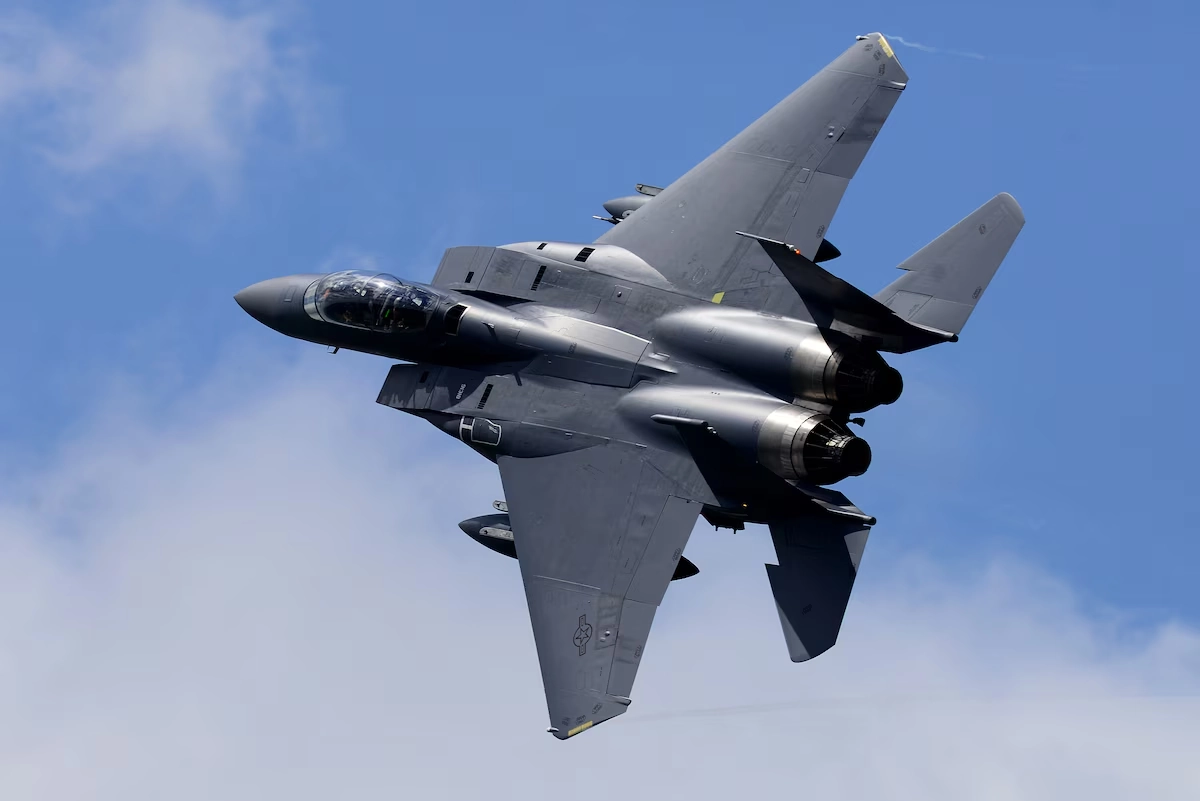
Picture a jet thundering off the runway at dusk, heavy with bombs, fuel tucked into its sides like clenched fists, radar sweeping the dark ahead. This isn’t a sleek dogfighter built for air shows or glossy posters. This is a working aircraft. A problem-solver.
The F-15E Strike Eagle was designed to go long, go low, and come back, preferably after ruining someone’s night.
What makes the F-15E Strike Eagle so fascinating isn’t just raw power (though it has plenty of that). It’s the contradiction baked into its DNA.
Take an air-superiority fighter famous for speed and agility, then ask it to lug precision bombs across hundreds of miles, in bad weather, at night, while still being able to win a fight if jumped. That’s not a small ask. And yet, for decades, the Strike Eagle has made it look almost routine.
While stealth aircraft tend to steal headlines, the F-15E has quietly carried much of the real workload. Desert Storm. Afghanistan. Iraq. Syria.
Mission planners keep calling on it for one simple reason: it delivers. With a two-person crew, advanced sensors, and a payload that can mix air-to-air missiles with bunker-busting bombs, the Strike Eagle doesn’t need ideal conditions. It thrives in the messy middle of modern warfare.
In this post, we’ll explore why the F-15E Strike Eagle endures, how its design choices shaped its combat record, how crews actually use it, and why newer jets haven’t pushed it aside.
What Is the F-15E Strike Eagle, Really?
At a glance, the F-15E Strike Eagle looks familiar, twin tails, broad wings, unmistakably “Eagle.” But calling it just another F-15 variant misses the point. The Strike Eagle isn’t an upgrade in the usual sense. It’s a role reversal.
The original F-15 was built with a single obsession: dominate the air. Speed, climb rate, radar reach, everything pointed toward winning dogfights before the enemy even knew one was coming.

The F-15E takes that heritage and bends it in a new direction. Instead of asking, “Can we shoot down the other guy?” it asks, “Can we fly deep into hostile territory, hit something valuable, and survive whatever comes next?”
That shift changes everything.
The Strike Eagle is a dual-role, all-weather strike fighter, optimized for long-range precision attack but still deadly in air-to-air combat. It carries a two-person crew: a pilot up front and a Weapon Systems Officer (WSO) in the back.
Think of it like a quarterback and a strategist sharing the same cockpit. While the pilot flies, the WSO manages sensors, targeting pods, radar modes, and weapons, especially during complex night or low-level missions.
One of its defining features is the conformal fuel tanks mounted along the sides of the fuselage. They don’t hang like traditional drop tanks, which means less drag and more range without sacrificing weapon stations.
The result? A jet that can strike targets hundreds of miles away, loiter if needed, and still sprint home at supersonic speed.
In practical terms, the F-15E Strike Eagle sits in a rare sweet spot. It bridges the gap between air dominance fighters and dedicated bombers. Not flashy. Not stealthy. Just relentlessly capable, and that’s exactly why it’s still relevant.
History and Development: Turning an Air Superiority Icon into a Night Stalker
The F-15E Strike Eagle didn’t emerge from a clean-sheet design. It was born out of a slightly uncomfortable question the U.S. Air Force asked itself in the early 1980s: What if our best fighter could also replace aging strike aircraft without losing its edge? That question kicked off the Enhanced Tactical Fighter (ETF) program, and set the stage for a surprisingly radical transformation.
At the time, the Air Force needed a deep-strike platform to succeed aircraft like the F-111 Aardvark. Long range. Heavy payload. All-weather capability.
Boeing (then McDonnell Douglas) looked at the existing F-15 airframe and saw unused potential. The bones were strong, powerful engines, generous internal space, and excellent aerodynamics. What it lacked was specialized strike hardware and a crew setup capable of managing complex attack missions.

The first F-15E flew on December 11, 1986, and entered operational service in 1989. That’s a fast turnaround for such a fundamental role shift.
The key was integration, not reinvention. Engineers added terrain-following radar, upgraded navigation systems, reinforced landing gear, and the now-famous two-seat cockpit.
The airframe was strengthened to handle heavier loads and repeated low-level flights, which are brutal on a jet over time.
Then came the real test: combat.
During Operation Desert Storm, the Strike Eagle proved it wasn’t an experiment. Flying mostly at night, often in bad weather, F-15E crews hunted high-value targets, Scud missile sites, airfields, command bunkers, deep inside hostile airspace.

One often-cited stat says it all: Strike Eagles flew about 2,200 sorties in the Gulf War and delivered roughly 60% of the precision-guided munitions dropped by the coalition.
That performance locked in the F-15E’s future. It wasn’t just a modified fighter anymore. It was a cornerstone.
Design & Features: Built to Carry the Load and Keep Flying
If the F-15E Strike Eagle has a personality, it’s stubbornly practical. Every major design choice serves a purpose, and almost none of them are about looking good on a poster.
Start with the airframe. Compared to earlier F-15 variants, the Strike Eagle is structurally beefed up. Reinforced longerons, stronger landing gear, and higher allowable takeoff weights let it haul serious ordnance without complaining. Fully loaded, an F-15E can tip the scales at over 81,000 pounds, yet it still climbs like it’s offended by gravity.
Then there are the conformal fuel tanks (CFTs), arguably the jet’s most misunderstood feature. They hug the fuselage instead of hanging beneath the wings, carrying roughly 9,800 pounds of fuel while preserving aerodynamic efficiency.

The trade-off? A bit of added weight and radar signature. The payoff? Range. Lots of it. Strike Eagles can hit distant targets without tankers glued to their wings every step of the way.
Avionics are where the F-15E quietly flexes. Early models used the AN/APG-70 radar, capable of both air-to-air and ground-mapping modes. Modernized jets now field AESA radars, dramatically improving detection range, target tracking, and resistance to jamming. Pair that with targeting pods like LANTIRN, Sniper, or LITENING, and crews can identify and strike targets with unnerving precision, often from miles away, in pitch darkness.
Inside the cockpit, function rules. Large multi-function displays, hands-on-throttle-and-stick controls, and smart sensor fusion reduce workload during high-stress missions. The split responsibilities between pilot and WSO aren’t a luxury, they’re survival tools.
In short, the F-15E Strike Eagle isn’t elegant. It’s engineered to work late, fly far, and come home dirty.
Performance & Specifications: When Numbers Tell a Very Loud Story
The F-15E Strike Eagle doesn’t rely on mystique or stealth to earn respect. It earns it the old-fashioned way, by putting up numbers that still look aggressive decades after first flight. On paper, it’s impressive. In the air, it’s borderline unfair.
Power comes from two Pratt & Whitney F100-PW-229 engines, each generating about 29,000 pounds of thrust with afterburner.
Together, they give the Strike Eagle a thrust-to-weight ratio that lets it accelerate hard even when fully loaded. This is not a bomber lumbering toward its target. It’s a strike aircraft that can dash, climb, and evade when things get uncomfortable.

Top speed sits around Mach 2.5 at altitude, though in real combat that’s less important than how fast it can move while carrying weapons and fuel.
The F-15E excels there. With conformal fuel tanks and external stores, it maintains high subsonic or supersonic cruise profiles without feeling strained. Combat radius stretches beyond 790 miles, depending on loadout and mission profile, enough to reach deep targets without constant refueling.
Here’s a quick snapshot of key specs:
| Specification | F-15E Strike Eagle |
| Crew | 2 (Pilot + WSO) |
| Max Speed | ~Mach 2.5 |
| Combat Radius | ~790+ miles |
| Service Ceiling | ~60,000 ft |
| Max Takeoff Weight | ~81,000 lbs |
| Engines | 2 × F100-PW-229 |
What’s striking is how well these numbers age, many newer aircraft trade raw performance for stealth or cost savings. The Strike Eagle doesn’t. It brute-forces flexibility, speed when needed, range when required, and payload almost all the time.
It’s less a scalpel, more a multitool. Heavy. Sharp. Reliable.
Armament & Combat Capabilities: A Flying Toolbox of Controlled Violence
The F-15E Strike Eagle isn’t picky about how it solves problems. Its real strength lies in how many options it brings to the fight, and how quickly crews can switch between them.
Let’s start with the obvious: payload. The Strike Eagle can carry up to 23,000 pounds of weapons, spread across multiple hardpoints. That’s bomber territory, except this “bomber” can also dogfight.
Internally, it houses the M61A1 20mm Vulcan cannon, a six-barrel reminder that even in the missile age, close-range solutions still matter.

For air-to-air combat, the F-15E typically carries AIM-120 AMRAAMs for beyond-visual-range engagements and AIM-9 Sidewinders for close encounters. This isn’t theoretical capability either.
Strike Eagles routinely fly with mixed loadouts, ready to protect themselves while executing strike missions. Few aircraft balance that dual mindset as naturally.
Where things get interesting is air-to-ground. The Strike Eagle is cleared for a staggering range of ordnance:
In combat, crews often describe the jet as a “Swiss Army knife with afterburners.”
During operations in Iraq and Afghanistan, F-15Es shifted mid-mission from deep strike to close air support, responding to troops on the ground within minutes. That flexibility saved lives, and built trust.
What ties it all together is sensor fusion. Radar, targeting pods, off-board data links, they talk to each other. The result is faster decisions, cleaner strikes, and fewer surprises.
The Strike Eagle doesn’t just hit hard. It hits smart, adapts fast, and rarely shows up unprepared.
Operational History: Where the F-15E Strike Eagle Earned Its Reputation
Some aircraft build legends in theory. The F-15E Strike Eagle built its reputation the hard way, mission by mission, usually at night, often in bad weather, and almost always where the stakes were high.
Its combat debut came during Operation Desert Storm in 1991, and it didn’t tiptoe in. Strike Eagles were tasked with some of the most demanding missions of the war: hunting mobile Scud launchers, striking heavily defended airfields, and knocking out command-and-control nodes deep inside Iraq. These weren’t clean, daylight bombing runs. Crews flew low, used terrain-following radar, and relied heavily on LANTIRN pods to navigate and identify targets in total darkness. Losses occurred, lessons were learned, and tactics improved fast.

After the Gulf War, the F-15E never really stood down. In the Balkans during the 1990s, it enforced no-fly zones and conducted precision strikes in complex political airspace.
Post-9/11, Strike Eagles became a near-constant presence over Afghanistan, where endurance and flexibility mattered more than raw speed. One jet could loiter, provide close air support, then pivot to a deliberate strike, all in the same sortie.
In Iraq and Syria, the pattern repeated. F-15Es were often the aircraft commanders trusted for time-sensitive targets. Need a bridge dropped, a bunker cracked, or troops covered under fire? The Strike Eagle showed up.
What’s telling is longevity. Decades in, mission planners still assign the F-15E to high-value, high-risk tasks. Not because it’s new. Because it’s proven, and boringly reliable in the best possible way.
Operators & Global Use: One Airframe, Many Strategic Personalities
The F-15E Strike Eagle may wear U.S. Air Force markings most famously, but its influence stretches far beyond American runways. What’s interesting isn’t just who flies Strike Eagle variants, it’s why they chose it.
For the USAF, the F-15E fills a niche that never quite disappears. It’s the aircraft commanders lean on when missions are complex, politically sensitive, or simply too important to risk on a single-role platform. Deep strike one night, armed overwatch the next. Few jets shift gears so comfortably.
International operators saw that flexibility and adapted it to their own strategic realities.
- Israel’s F-15I Ra’am emphasizes long-range strike and survivability. Built with unique avionics and electronic warfare systems, it reflects Israel’s need to reach distant, heavily defended targets, fast.
- South Korea’s F-15K Slam Eagle is optimized for maritime strike and peninsula defense, integrating local weapons and sensors to counter regional threats.
- Singapore’s F-15SG focuses on sensor fusion and situational awareness, a necessity for operating in dense airspace with little margin for error.
- Saudi Arabia operates one of the largest Strike Eagle fleets outside the U.S., using it for regional deterrence and precision strike.
Here’s a simplified snapshot:
| Country | Variant | Primary Focus |
| USA | F-15E | Deep strike, CAS, interdiction |
| Israel | F-15I | Long-range precision strike |
| South Korea | F-15K | Maritime & regional defense |
| Singapore | F-15SG | Sensor-heavy multirole ops |
Same blueprint. Different priorities. That adaptability is the Strike Eagle’s quiet export success story.
What’s notable is what didn’t change. The airframe. The two-seat concept. The emphasis on payload and range. Even proposals like the semi-stealth F-15 Silent Eagle never replaced the core idea, just refined it.
The Strike Eagle didn’t survive by reinventing itself every decade. It survived by evolving where it mattered, and ignoring trends that didn’t.
