

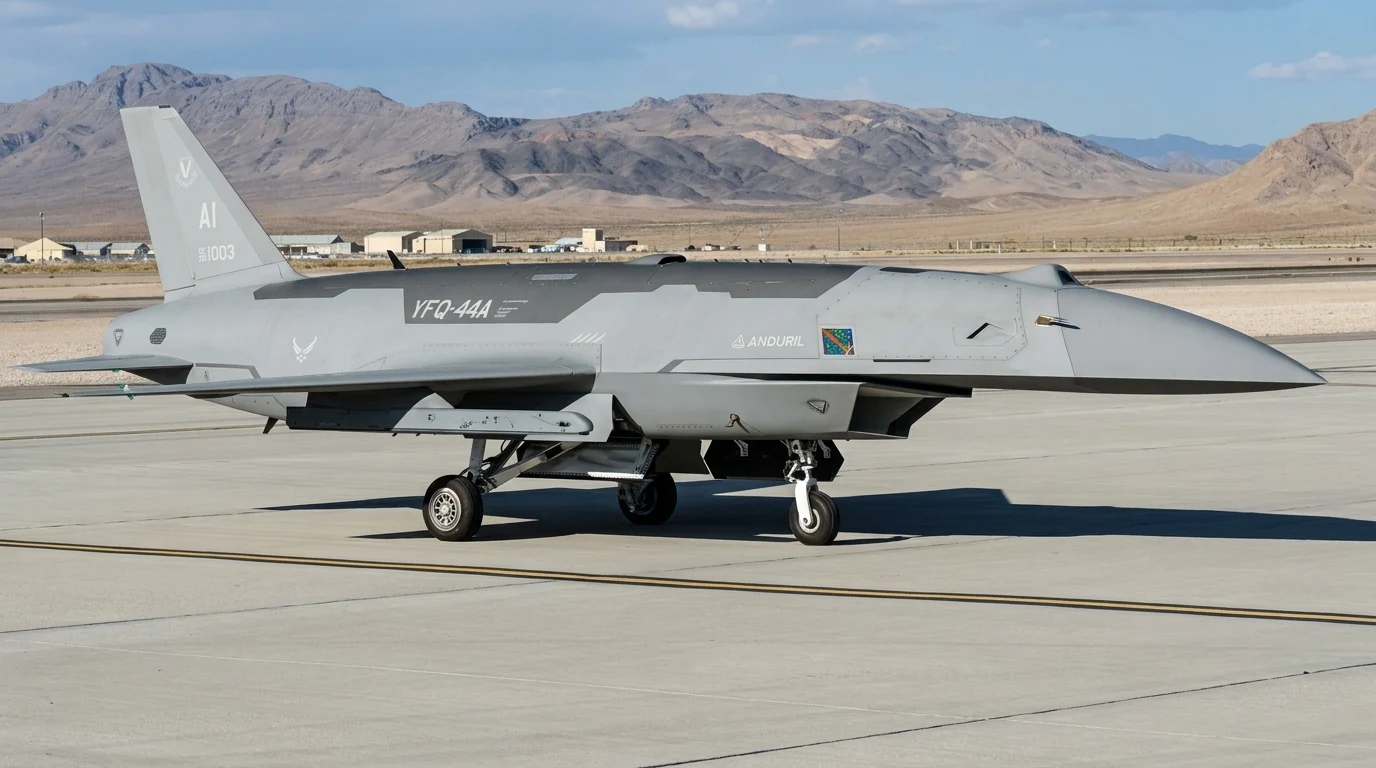
The U.S. Air Force is building a fighter that does not need a pilot in the cockpit.
That sounds like a simple drone story. It isn’t.
The FQ-44 Fury sits at the center of a much bigger change in how the United States plans to build airpower. Instead of putting every mission on a small fleet of very expensive crewed fighters, the Air Force wants autonomous aircraft that can fly alongside them, carry weapons, extend sensors and add more aircraft to the force.
The numbers explain the thinking. The Air Force says it plans to have 500 Collaborative Combat Aircraft by 2032, with a longer-term goal of roughly 1,000 combat-ready semi-autonomous systems.
That’s not a side project.
Anduril’s FQ-44 Fury is one of two Increment 1 CCA designs selected for production. The other is General Atomics’ FQ-42 Vengeance. In June 2026, the Air Force awarded both companies engineering, manufacturing and production contracts, with at least 150 aircraft planned for the first increment by the end of the decade.
The logic is fairly blunt.
A modern fighter is expensive, a trained pilot is hard to replace and high-end aircraft cannot be everywhere at once. A semi-autonomous aircraft changes that math.
The FQ-44 Fury is meant to give an F-35 or future crewed fighter another set of sensors, another weapons carrier and another aircraft in the formation without putting another pilot into danger.
And the concept is no longer confined to computer models.
In July, a YFQ-44A flew alongside F-35s during testing at Creech Air Force Base. The F-35 was not yet controlling the Fury, but the two aircraft were already operating together in the same test environment.
A month earlier, the FQ-44 Fury had also fired an AIM-120 AMRAAM at a simulated target during a live-fire test.
So the real question isn’t whether the U.S. is experimenting with drone fighters.
It already is.
The better question is why Washington thinks it needs hundreds of them.
What Is the FQ-44 Fury?
The FQ-44 Fury is the U.S. Air Force’s name for Anduril’s entry in the Collaborative Combat Aircraft program, a class of unmanned aircraft designed to work with crewed fighters rather than simply replace them.
That distinction matters.
The common description is “AI fighter drone,” but that can make the aircraft sound more independent than it really is. The Air Force describes CCAs as semi-autonomous systems intended to operate as part of a larger force, with human pilots and commanders still central to the mission.
The FQ-44 Fury began life as the YFQ-44A, Anduril’s prototype for the first CCA increment. In September 2026, the Air Force formally gave it the FQ-44 designation and the name Fury. General Atomics’ competing aircraft received the FQ-42 Vengeance designation at the same time.
Its role is easier to understand through the phrase “collaborative combat aircraft.”
The FQ-44 Fury is supposed to add capacity around a crewed fighter. Depending on the mission, that could mean carrying extra weapons, extending sensor coverage or taking on tasks that would otherwise require another crewed aircraft.
It also gives the Air Force something traditional fighters struggle to provide: more aircraft without requiring a pilot for every airframe.
And that is where the FQ-44 Fury becomes more than another military drone.
The Air Force is not buying it as a remote-controlled aircraft that someone flies with a joystick from hundreds of miles away. The aim is to build enough autonomy into the platform that it can handle parts of a mission while remaining under human direction.
The hardware is only half the story.
The other half is the software that tells the aircraft how to navigate, sense its surroundings and carry out assigned tasks. The Air Force has treated that autonomy layer as a major part of the CCA program, rather than something added after the aircraft is built.
So calling the FQ-44 Fury a “drone fighter” is useful for a headline.
But the better description is a semi-autonomous combat aircraft designed to team with human-piloted fighters.
That difference explains almost everything about why the U.S. is building it.
Why Is the U.S. Building Drone Fighters?
The simplest answer is cost and risk. The deeper answer is that the U.S. wants more aircraft in the air without putting a pilot inside every one.
A modern crewed fighter packs enormous capability into a single platform, but that capability comes with a price. The F-35, for example, requires a trained pilot, support crews, fuel, maintenance and a large logistics chain. Losing one aircraft also means losing a highly trained aviator.
The FQ-44 Fury changes that tradeoff.
A CCA can be sent into missions where a crewed aircraft might face higher risk. It can also add another sensor or weapons platform to a formation without requiring another pilot. The Air Force sees this as a way to increase the number of combat aircraft available to commanders while keeping the most valuable crewed platforms focused on tasks that require human judgment.
Quantity matters here.
The Air Force’s current plan calls for at least 500 CCAs by 2032, with a broader goal of around 1,000 combat-ready systems. Those numbers would give commanders far more aircraft to spread across a large area than a force built entirely around expensive crewed fighters.
But calling CCAs “cheap fighters” misses the point.

The Air Force has previously described the target cost of a CCA as roughly one-third the cost of a crewed fighter, although the final operating cost of the FQ-44 remains tied to production volume, software and support requirements.
And there’s another reason for the shift.
A pilot can only fly one aircraft at a time.
A semi-autonomous system does not remove that limit entirely, but it can let one crewed fighter work with additional unmanned aircraft. That could give an F-35 a wider sensor picture or more options during a mission without adding another cockpit to the formation.
I think this is the more useful way to view the FQ-44 Fury.
It isn’t being built because the U.S. suddenly believes human pilots are obsolete. It is being built because relying on a small number of very expensive aircraft creates its own limits.
The Fury is an attempt to add mass without simply buying more of the same thing.
FQ-44 Fury Specifications and Performance
The FQ-44 Fury specifications are still partly hidden, which is unusual for an aircraft that has already entered production. The Air Force has confirmed the aircraft’s role, designation and test milestones, but it has not released a full production data sheet covering speed, range, weight and dimensions.
That leaves a lot of numbers floating around online.
Some are based on earlier versions of the Fury design rather than the production aircraft. They are useful for understanding the concept, but they should not be treated as final specifications.
| Specification | FQ-44 Fury |
| Manufacturer | Anduril Industries |
| Official designation | FQ-44 Fury |
| Prototype designation | YFQ-44A |
| Aircraft type | Uncrewed Collaborative Combat Aircraft |
| Crew | 0 onboard |
| Powerplant | Not officially disclosed by the Air Force |
| Maximum speed | Not officially disclosed |
| Combat radius | Not officially disclosed |
| Service ceiling | Not officially disclosed |
| Maximum takeoff weight | Not officially disclosed |
| Weapons stations | Publicly reported as 2 on the earlier design |
| Air-to-air weapon | AIM-120 AMRAAM tested |
| Autonomy system | Anduril Lattice |
| Primary role | Human-machine teaming and multi-mission combat support |
The table may look less impressive than a typical fighter specification sheet.
That’s because the missing numbers are part of the story.
Earlier reporting on the Fury concept suggested an aircraft roughly 20 feet long with a 17-foot wingspan, a maximum speed near Mach 0.95 and a ceiling around 50,000 feet. Those figures have been widely repeated, but they trace back to an earlier design and should be treated as indicative rather than confirmed production data.
The weapons picture is clearer.

A YFQ-44A conducted a live-fire test with an AIM-120 AMRAAM in July 2026. The aircraft has also been seen fitted with air-to-ground weapons during ground testing, although that does not prove those weapons are already cleared for operational use.
Anduril’s own description points to another major feature: an open and modular design intended to accept different sensors and payloads as missions change.
That may matter more than the final top-speed figure.
The Fury is being built as a software-driven combat platform that can change roles without requiring an entirely new aircraft. Its value will come from what it can carry, how well its autonomy works and how reliably it can operate with crewed fighters.
So when you see a precise FQ-44 range or weight listed online, check the source first.
For the production Fury, several of those numbers simply remain undisclosed.
How Will the FQ-44 Fury Work With the F-35?
The FQ-44 Fury is not being built to replace the F-35. It is being built to make the F-35 more useful.
That sounds simple, but the difference changes how the whole formation could work.
Imagine an F-35 operating with several autonomous aircraft nearby. The crewed fighter could remain focused on the mission while the Fury provides extra sensors, carries weapons or handles assigned tasks farther from the pilot. The point isn’t to create another F-35 without a cockpit. It’s to spread the workload across several aircraft.
The U.S. Air Force is already testing the basic pieces.
During a July 2026 exercise at Creech Air Force Base, YFQ-44A Fury aircraft operated in airspace shared with crewed fighters and other CCAs. Air Force personnel also tested the aircraft in a more realistic operating setting, including refueling, weapons loading and rapid turnaround work.

Then came a bigger step.
Anduril confirmed in September that Fury had actually flown in formation alongside F-35 fighters during the July testing. But the F-35 was not controlling the Fury at that point. Fury was running its own Mission Autonomy system while operating near the crewed aircraft.
That distinction matters more than the headline.
The Air Force has not demonstrated a finished “F-35 commands a swarm” capability. It has demonstrated that the aircraft can share airspace and operate together while the human-machine teaming system is still being developed.
Anduril is working toward what it calls “quarterback integration,” where a crewed aircraft could direct or task autonomous aircraft. Initial work has already taken place in hardware and software simulations, with live testing planned.
Weapons are part of the equation too.
In July, a YFQ-44A successfully conducted a live-fire test involving an AIM-120 against a digital target.
So the Fury’s future role is becoming clearer.
The F-35 provides the human decision-maker. The Fury adds another aircraft to the fight.
What Can the FQ-44 Fury Carry and Do?
The FQ-44 Fury is being designed as a combat aircraft, not just a surveillance drone. Its recent weapons testing shows why the U.S. Air Force wants the platform to carry real weapons while working alongside crewed fighters.
The clearest example came in July 2026.
A YFQ-44A successfully conducted a live-fire test involving an AIM-120 AMRAAM, a radar-guided air-to-air missile widely used by U.S. and allied fighters. The test used a digital target during the weapons trial, giving the Air Force a chance to assess the aircraft’s ability to support an air-to-air engagement without placing a pilot in the test aircraft. That is a meaningful step.
But it would be a mistake to treat one successful test as proof that Fury is already a fully operational unmanned fighter. It isn’t.
The aircraft is still being tested, and several parts of its final mission set remain under development. Public information also does not provide a complete weapons loadout or final performance data.
Air-to-ground weapons are another developing area.

Images released in September showed a YFQ-44A fitted with air-to-ground munitions during ground testing. The configuration demonstrates that the aircraft is being prepared to carry this type of weapon, but the available evidence does not show that those weapons have already been flight-tested from Fury.
That’s an easy detail to miss.
The broader CCA concept also gives Fury potential roles beyond carrying missiles. The aircraft can serve as an additional sensor platform, extend the reach of a crewed formation and perform assigned tasks through its mission autonomy system.
So the useful question isn’t simply, “How many missiles can FQ-44 Fury carry?”
It’s what the aircraft can contribute to a formation.
An F-35 could remain the crewed command element while Fury adds another sensor or weapon carrier. If the software and communications links mature as planned, the same basic aircraft could be assigned different jobs depending on the mission.
The AIM-120 test proves one part of that concept.
The rest still has to be demonstrated in flight.
How Autonomous Is the FQ-44 Fury?
The FQ-44 Fury is autonomous, but it is not simply a robot fighter making its own decisions. That distinction matters because the entire CCA program depends on giving the aircraft enough independence to reduce pilot workload without removing human control from the mission.
The Air Force uses the term semi-autonomous for this reason.
Instead of requiring a person to control every movement, the FQ-44 Fury’s mission autonomy system can handle parts of navigation and mission execution. The human side of the team can assign tasks and manage the larger mission while the aircraft deals with actions that do not need constant input.
That approach is a lot more practical than trying to remotely fly every CCA like a traditional drone.
Think about an F-35 pilot managing several aircraft. If that pilot had to manually steer every FQ-44 Fury through every turn, the concept would quickly become unworkable. The pilot already has sensors, communications, threats and mission decisions to manage.
The software has to carry some of the load.
Anduril’s Lattice software sits at the center of the company’s approach to autonomous systems. The company has been developing mission autonomy that can let aircraft perform assigned tasks while operating as part of a larger human-led force. The Air Force has also treated autonomy software as a separate part of the CCA effort, rather than locking the aircraft to one fixed software package.
But here’s the catch.

The public tests have not demonstrated a fully mature system where an F-35 pilot can freely command multiple Fury aircraft in combat. During the 2026 F-35 and FQ-44 Fury flights, the aircraft operated together, but direct control from the F-35 had not yet been demonstrated.
That gap matters.
The hardware is moving quickly. The harder challenge may be making the software, communications and human controls reliable enough for real missions.
The FQ-44 Fury doesn’t need to think like a human pilot.
It needs to follow its assigned mission, react to changing conditions and keep the human operator from becoming the bottleneck.
That’s the real promise of autonomous combat aircraft.
Why Does the U.S. Need Hundreds of FQ-44-Type Aircraft?
The FQ-44 Fury only makes sense at scale. A few unmanned fighters would add useful capability, but hundreds could change how the U.S. Air Force spreads sensors, weapons and risk across a large theater.
The numbers are already substantial.
The Air Force says it wants at least 500 Collaborative Combat Aircraft by 2032, with a broader target of about 1,000 combat-ready semi-autonomous systems. That is a very different force structure from simply adding a few more F-35s.
Why so many?
Because aircraft numbers become a problem when each platform is expensive and crewed.
A large fleet of CCAs could spread across multiple operating locations instead of concentrating capability in a smaller number of high-value aircraft. Some could support crewed fighters. Others could carry weapons or sensors. The exact mix would depend on the mission and the software loaded onto the aircraft.
Production speed is part of the plan too.

Anduril is building its Arsenal-1 manufacturing facility in Ohio around high-volume production of autonomous military systems. Company officials have said the facility could eventually support production of up to 150 Fury aircraft per year. That figure represents planned factory capacity, not the number of aircraft already ordered or operational.
That distinction matters.
It is easy to read “150 aircraft per year” and assume the Air Force is about to receive that many every year. It isn’t that simple. Funding, contracts, testing, supply chains and acceptance rates all determine how quickly aircraft actually enter service.
Still, the industrial model tells us something.
The U.S. is trying to make autonomous aircraft more like a repeatable product than a small batch of hand-built fighters.
And there is a reason for that approach.
If an unmanned aircraft costs less than a crewed fighter, the Air Force can accept a different level of risk. If production can also move faster, commanders gain more options when force levels change.
That’s the bet behind the FQ-44 Fury.
Not one perfect aircraft.
A much larger number of useful ones.
