

NATIONAL HARBOR, Md.—For the past four years, the idea of autonomous drone warfare like Collaborative Combat Aircraft has been discussed as a future concept, rather than near-term reality.
But now that promised vision appears imminent, with the Air Force promising at least 1,000 such drones by 2032.
Air Force Secretary Troy Meink kicked off AFA’s 2026 Air, Space & Cyber conference by promising the service will have at least 500 CCAs by then. And going a step further, he also predicted USAF will field an additional 500 Massed Modular Aircraft—a new semi-autonomous aircraft intended to inherit the MQ-9 Reaper’s strike and intelligence, surveillance, and reconnaissance missions, but at a lower price.
These new aircraft will complement the high-end sixth-generation bomber and fighter now in development.
“The F-47 and B-21 are phenomenal aircraft,” Meink said. “They will be able to do things no other aircraft have ever done before. However, they’re not going to fully meet the mass or scale of combat power we need. But when we pair manned aircraft with lower-cost autonomous systems, we will be able to unlock combat power at scale.”
Industry has heard the Air Force loud and clear, and at this year’s Air, Space & Cyber Conference, the concept was on full display, with vendors large and small touting their MMA and CCA offerings.
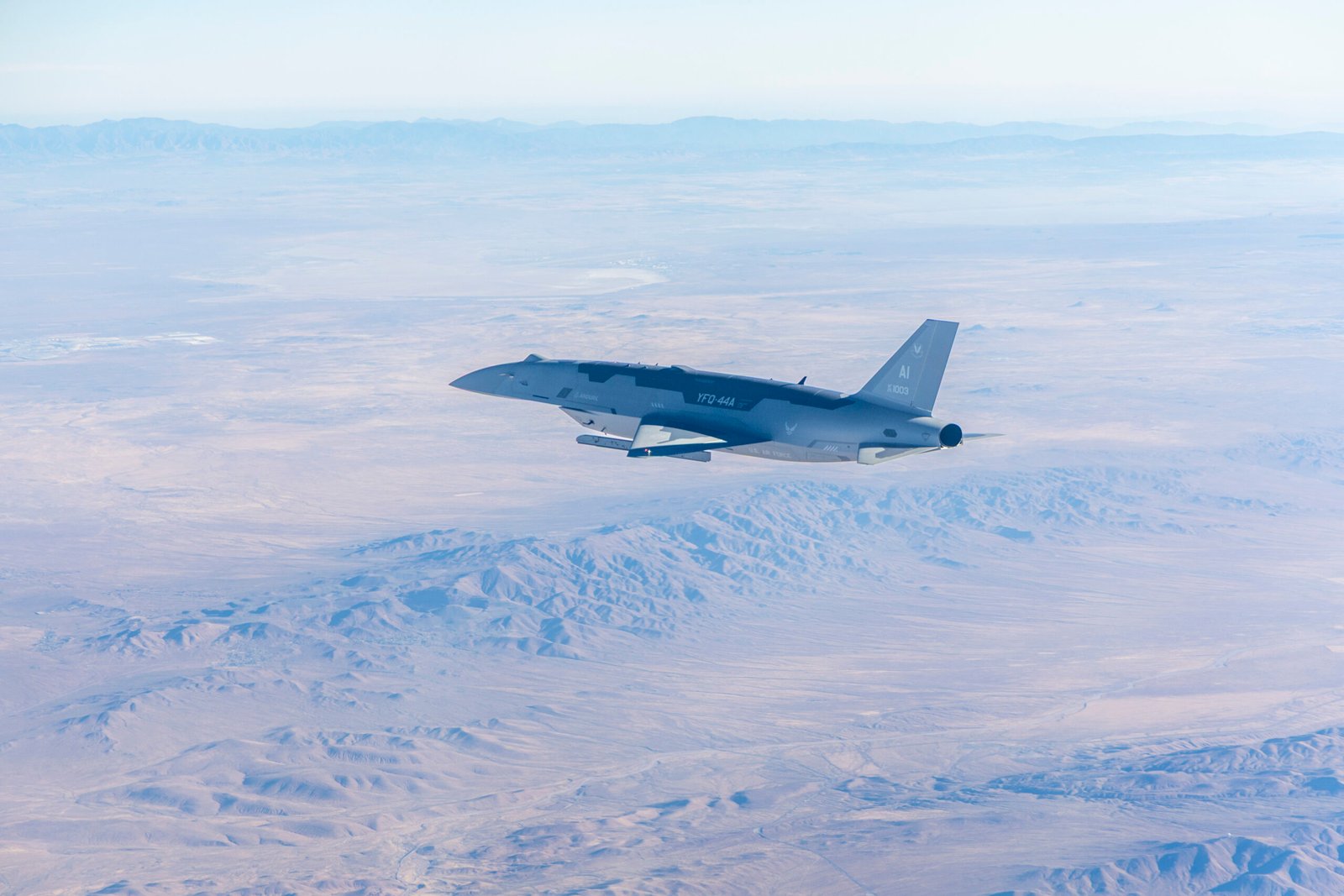
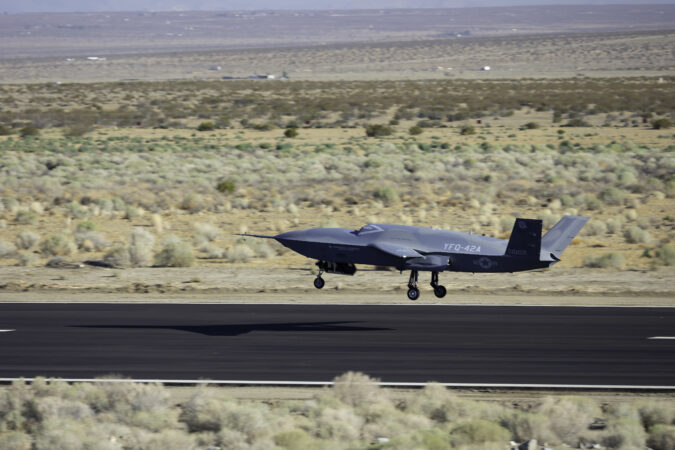
General Atomics Aeronautical Systems and Anduril Industries, as they did last year, highlighted their FQ-42A and FQ-44A aircraft, which represent the first series—or increment—of CCAs. Meink confirmed the FQ-42A’s nickname will be Fury and disclosed the FQ-44A’s nickname will be Vengeance.
Lockheed Martin, the world’s largest defense contractor and the maker of the manned F-35 Lightning II and F-16 Fighting Falcon, built its display around a fullscale model of its tailless Vectis CCA drone, predicting the aircraft will fly in 2027. And in a sign of how bullish Lockheed is about the burgeoning CCA market, Lockheed said it would build five Vectis drones before it even has a contract.
Swarm Aero, a California startup, unveiled a full-scale model of Gamera, a Group 5 drone about the size of an MQ-9 Reaper that it wants to offer for the MMA mission. And Shield AI displayed its roughly half-size model of X-Bat, an autonomous drone design powered by an F100 engine that would take off and land vertically. General Atomics, the grandaddy of drone makers, released images of its new Wildfire drone, another candidate for the MMA program.
But it is the FQ-42 and FQ-44 CCAs that are drawing the most near-term attention, as plans emerge for their move from test articles to production. General Atomics announced it is ready to produce six FQ-42s a month to meet Air Force requirements and could ramp up higher if needed. Anduril, which moved the FQ-44 into production in March at its Arsenal-1 facility in Columbus, Ohio, said it has capacity to build 150 annually.
Meink said Sept. 14 that the Air Force wants to field an initial 100 MMA drones by 2029, upping the service’s previous estimates. When asked about those expanded plans, he noted the aircraft’s projected low cost—$10 million or less for a bare airframe—and the importance of being able to combine strike and recon.
The MQ-9 mission “is a very important mission,” Meink said. “We’re looking at how we do that with a mix of different platforms. … The ability to bring low-cost mass is a driver here, and we expect these to be significantly cheaper than even the MQ-9s or the CCA.”
Pricing for an MQ-9B, the larger, next-generation model now available, depends on sensors and other factors, but starts around $25 million. The Air Force is now aiming for a $20 million price target for CCAs, again for just the aircraft.
Meink said the Air Force anticipates multiple MMA types produced by different manufacturers, similar to its competitive approach to developing CCAs. Asked if 500 MMAs is a ceiling or a floor, Meink said it would depend on budget, but “I think it should probably be much higher than that.”
The Air Force plans for CCAs to develop iteratively over time, as technology and innovations advance. The next increment in the cycle is still in the conceptual stage, but officials expect to define the objectives in mid-2027 and to winnow the competitive field to six or fewer.
Gen. Dale White, director of critical major weapon systems for the Air Force, told reporters at the conference the Air Force and industry are still hashing out what the second CCA increment will look like.
“It’s getting defined as every day goes by,” White said. In addition to acquisition leaders like himself, operators are also getting a say in what they want, and that’s going to increase over time because conditions aren’t uniform from region to region.
“The challenges I may have in the Indo-Pacific theater could be very different [from those] in the [U.S. Central Command] theater and different again in the [European Command] theater,” White said. “So how do we take all of those different requirements and make sure we have a [CCA] capability that can address many different mission sets across many different requirement centers?”
Operational Use
As autonomy advances, the Air Force is pushing ahead with new operational concepts. The Air Force’s Experimental Operations Unit at Creech Air Force Base, Nev., is the epicenter for that work. Brig. Gen. Timothy Helfrich, the portfolio acquisition executive for fighters and advanced aircraft, said the unit is operating CCAs “multiple times a week” as it develops and applies new thinking.
In December, CCAs will be included in a large-force engagement exercise for the first time, at Emerald Flag at Eglin Air Force Base, Fla.
EOU commander Lt. Col. Lyndon Bartlett said that will be CCAs’ “first dip of the toe in an actual force integration,” a crucial step.
“That will, in [my] mind, be the first time that we will ever do some CCA end-to-end kill chain live,” Bartlett said. “That’s the first time we’ll ever be integrated in a fourth- and fifth-gen combined [offensive counter-air] push. It’ll be small, but those type of building blocks are where, I think, you get the intangibles like trust in the CCA.”
In 15 months since its June 2025 establishment, Bartlett said, his team members have been “pleasantly surprised” by the ease of maintenance of the unmanned CCAs, and what a comparatively small footprint they require compared to a manned jet.
In a series of recent Agile Combat Employment exercises, Bartlett said, “we’re at a one-to-one maintainer-to-airplane ratio, which is crazy small.” That is a small fraction of what a manned fighter jet typically requires.
That simplicity matches well to the concept of “cross-functional” Airman generating CCA sorties even when those duties are beyond their standard job descriptions.
“Because they’re a little bit simpler, because their role is so focused, what we found is that any [Airman] can be trained to generate sorties, to load weapons,” Bartlett said. “We’ve done some of those things already, and we’re going to do a lot more experimentation over the next couple of years.”
The EOU now has both FQ-42 and FQ-44 airframes, with Anduril’s model arriving in August and General Atomics’ in September.
Jason Levin, Anduril’s senior vice president for air dominance and strike, said his company’s Fury prototype took part in two exercises with the EOU.
The July exercise, at Creech, demonstrated that a single Air Force operator could launch and recover an aircraft on his own after just a few hours of training.
“The Air Force was operating mission autonomy by themselves, which was a first,” Levin said. “They were flying multiple times a day, operating mission autonomy without Anduril personnel–they were on-site kind of helping, but it was really the Air Force operating that.
Fury also flew in the same airspace as crewed fighters during the exercise, using its mission autonomy, which helped to build trust among the Airmen flying with it.
General Atomics, meanwhile, said Vengeance has flown in formation with piloted F-35A Lightning II and F-15E Strike Eagle jets, en route to future test flights in which fighter pilots will command the drones.
Lt. Gen. Jason Hinds, commander of U.S. Air Forces in Europe-Air Forces Africa, said his command is thinking of how to incorporate CCA operations, including using them to boost—or even take over—USAFE’s integrated air missile defense mission.
“You don’t always have to have a human in a cockpit to be able to defend against a one-way attack drone or defend against a cruise missile,” Hinds said. “You could use a CCA to be able to conduct that mission set.”
If a hostile nation invaded a NATO ally, said Hinds, who also commands NATO’s Allied Air Command, the Air Force could also use CCAs to attack adversaries’ air defense systems, or attack invading forces.
NATO allies—particularly Germany, the Netherlands, and some Scandinavian countries—are watching CCA experiments, Hinds said, with some taking their own steps toward the concept. Hinds predicted Sweden, among others, will start to experiment with CCAs in the European theater in the next few years.
“You’re going to see a lot more interest from other nations inside Europe,” Hinds said.
As the autonomous era begins, Lt. Gen. Christopher Niemi, the Air Force’s Chief Modernization Officer, said during a panel discussion that the service faces a massive cultural shift—one he acknowledged will face significant pushback from today’s pilots.
“I can imagine a day in the future, 10 years [from now], maybe more, where a CCA autonomy algorithm does a better job flying a fighter airplane than I did as a captain,” Niemi said. “That hurts my ego a little bit. But at the same time, I see that this trend is happening, and we’ve got to find a way to do that.”
Meink challenged attendees to come up with an operational concept that was more challenging than urban driving, suggesting that the progress in self-driving cars over the past decade has proven that such skills can be automated. Niemi agreed.
But experienced pilots counter that there are a host of differences between flying combat operations and driving in a controlled urban environment, ranging from speed to the addition of flight’s vertical dimension. Autonomous driving, which has taken years longer to perfect than most experts predicted a decade ago, has vastly more data to pull from than CCA operators do, pilots say.
Most importantly, the incentives are different. On the road, drivers are doing their best to act responsibly and predictably. In combat, however, rival pilots are doing their best to be disruptive and surprising. Those are challenges that could take time to master.
But Niemi is undeterred in his future vision and convinced those pilots are wrong. “As you institutionalize these capabilities,” he said, “it’s not too surprising that maybe fighter pilots are not too enthusiastic about the idea of fielding a capability [that] will start to replace some of what they do—how they define themselves.”
Pentagon Editor Chris Gordon contributed reporting.
