

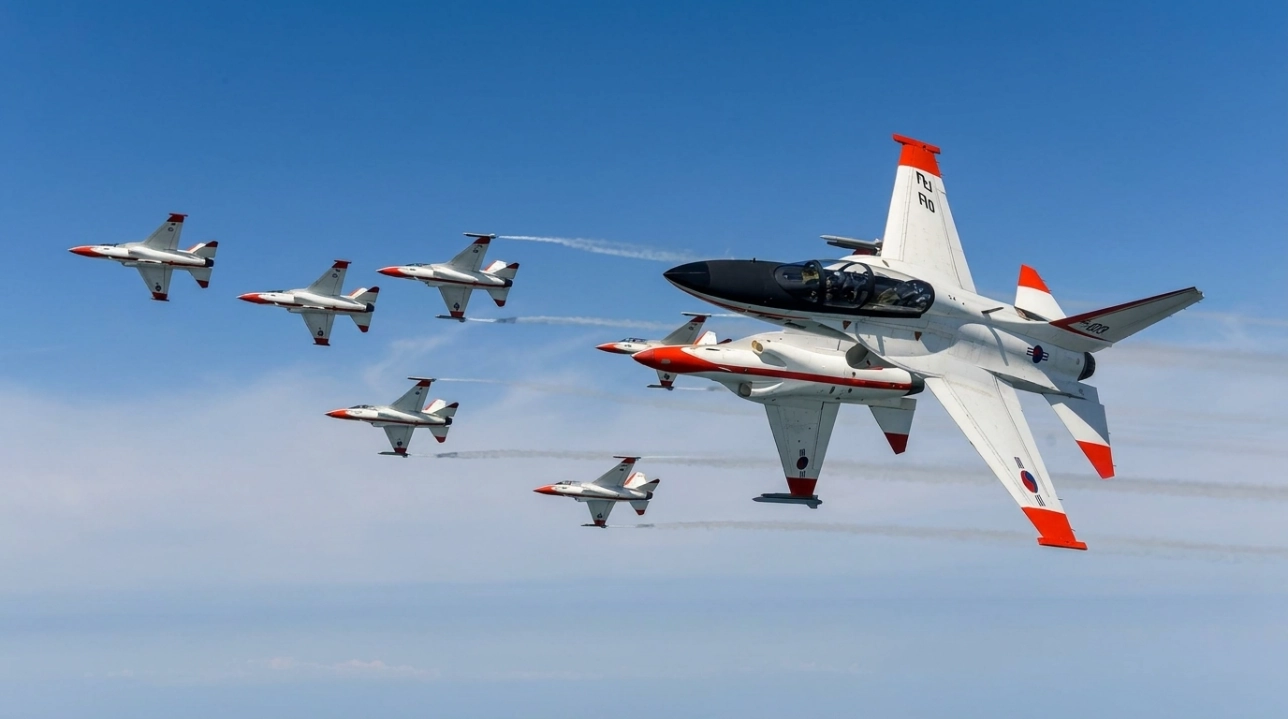
A trainer jet is not supposed to become one of Asia’s most interesting military aircraft families.
The KAI T-50 Golden Eagle did exactly that.
Developed by Korea Aerospace Industries with Lockheed Martin, the KAI T-50 Golden Eaglewas built to prepare pilots for modern fighter aircraft. But its design left room for much more. The same basic platform eventually produced the TA-50 lead-in fighter trainer and the FA-50 light combat aircraft.
That distinction matters.
The KAI T-50 Golden Eagle itself is primarily a trainer. The FA-50 is a different variant with a much stronger combat role. Treating them as the same aircraft is one of the easiest mistakes to make when looking at the Korean jet family.
Asia’s growing interest is easier to understand when the variants are viewed together.
Indonesia is a good example. In July 2026, Korea Aerospace Industries completed delivery of six additional T-50i aircraft, bringing Indonesia’s T-50i fleet to 22 aircraft. Indonesia was also the first overseas customer for the T-50 family.
Malaysia and the Philippines add another layer. Both have selected FA-50 variants, showing how the same aircraft family can be adapted for different air-force needs.
The reason isn’t simply speed.
The KAI T-50 Golden Eagle can reach about Mach 1.5, giving student pilots experience with a supersonic aircraft before they move to larger frontline fighters. Its two-seat layout also keeps an instructor in the cockpit during advanced training.
That’s a smart place for the KAI T-50 Golden Eagle to sit.
A modern air force needs pilots who can handle complex fighters, but using frontline aircraft for every training hour is an expensive way to build that experience.
The KAI T-50 Golden Eagle offers another step.
And its growing family of variants explains why Asia is paying attention.
What Is the KAI T-50 Golden Eagle?
The KAI T-50 Golden Eagle was designed around a simple problem: fighter pilots need serious jet experience before they are ready for frontline aircraft.
A basic trainer cannot provide all of that experience.
The KAI T-50 Golden Eagle fills the gap with supersonic performance, a fighter-style cockpit and a two-seat configuration that keeps the instructor close to the student. Korea Aerospace Industries developed the aircraft with Lockheed Martin, and the T-50 first flew in 2002 before entering service with the Republic of Korea Air Force in the mid-2000s.
The choice of speed was deliberate.
The KAI T-50 Golden Eagle can reach around Mach 1.5, which puts it well beyond the performance of many conventional trainer aircraft. It also uses the General Electric F404-GE-102 engine, producing about 17,700 pounds of thrust.
But calling it a “small fighter” misses the original purpose.
The KAI T-50 Golden Eagle was built as an advanced trainer. Its job is to help pilots develop the skills needed before moving into more demanding aircraft. High-speed flight is only part of that. The bigger benefit comes from giving pilots a jet that behaves more like the aircraft they will eventually operate.
This is where the KAI T-50 Golden Eagle family gets interesting.
KAI developed the TA-50 as a lead-in fighter trainer, adding systems that allow pilots to train with weapons and radar. The FA-50 goes further, turning the basic design into a light combat aircraft.
So the KAI T-50 Golden Eagle is best understood as the foundation of a family rather than a single aircraft with one job.
That approach has given KAI something useful in export markets. One country may need an advanced trainer. Another may want a light fighter. Both can start with the same basic aircraft architecture.
That flexibility is a big part of the KAI T-50 Golden Eagle’s story in Asia.
Read also: Top 5 Best Military Trainer Aircraft and What Makes Them Effective
KAI T-50 Golden Eagle Specifications and Performance
The KAI T-50 Golden Eagle was designed to give pilots fighter-like performance before they step into a frontline aircraft.
That starts with the engine.
The T-50 uses a General Electric F404-GE-102 turbofan, producing about 17,700 pounds of thrust. KAI lists a top speed of roughly Mach 1.5, while the aircraft can operate at altitudes up to about 48,000 feet. Those figures put it firmly in the advanced jet trainer class.
Here are the core specifications:
| Specification | KAI T-50 Golden Eagle |
| Primary role | Advanced jet trainer |
| Engine | 1 × GE F404-GE-102 |
| Engine thrust | About 17,700 lb |
| Maximum speed | About Mach 1.5 |
| Service ceiling | About 48,000 ft |
| Crew | 2 |
| Length | About 13.1 m |
| Wingspan | About 9.4 m |
| Maximum takeoff weight | About 23,638 lb |
The speed is the number most people notice first. But for training, the more useful feature is how that performance changes the pilot’s workload.
A pilot learning to manage a supersonic aircraft has to deal with much higher speeds, shorter reaction times and different energy management than someone flying a basic trainer. The T-50 gives instructors a platform built around those demands.
The two-seat cockpit matters too. An instructor can sit behind the student during advanced sorties instead of relying entirely on ground instruction or post-flight review.
There is also a common misconception here.
Mach 1.5 does not make the KAI T-50 Golden Eagle a fighter.

The aircraft’s original role is advanced training, and its design reflects that. The KAI T-50 Golden Eagle adds systems for lead-in fighter training, while the FA-50 takes the architecture into the light-combat category.
That progression is exactly why the specifications matter.
The KAI T-50 Golden Eagle doesn’t need the payload or sensor suite of a heavy fighter to do its training job. It needs enough speed and performance to make the transition to one less painful.
And for an air force building a fighter pilot pipeline, that can be more useful than simply having the fastest trainer available.
How Did the KAI T-50 Golden Eagle Become More Than a Trainer?
The KAI T-50 Golden Eagle became more interesting when KAI stopped treating the aircraft as only a training platform.
The basic KAI T-50 Golden Eagle was built to teach advanced fighter skills. But air forces often need something between a trainer and a full-size combat aircraft. That gap created room for the TA-50 and later the FA-50.
The change was not just about adding weapons.
The KAI T-50 Golden Eagle was developed as a lead-in fighter trainer, giving pilots experience with radar, weapons systems and tactical work before they move to more capable fighters. It keeps the basic T-50 design but adds equipment that makes training closer to an operational fighter environment.
Then comes the FA-50.
This is where the family moves into a different category. The FA-50 is a light combat aircraft derived from the KAI T-50 Golden Eagle design. It can carry weapons and perform missions that go beyond pilot training, while retaining the basic flight characteristics of the original platform.
That progression is easy to oversimplify.

People often refer to every aircraft in the family as the “T-50,” but the differences matter. A T-50 used mainly for advanced training is not equipped or employed in exactly the same way as an FA-50 configured for combat missions.
The architecture is shared. The mission is not.
That gives KAI a useful export model. A country can buy the T-50 for advanced training, while another customer can choose an FA-50 when it needs a light fighter with a larger operational role.
Indonesia illustrates the first path with its T-50i fleet, while Malaysia and the Philippines have chosen FA-50 variants. The aircraft family therefore fits several points in the fighter pipeline rather than competing for only one job.
And that may be the smartest part of the design.
The KAI T-50 Golden Eagle did not need to become a completely different aircraft to reach a new market. KAI built a family around the same basic platform, then changed the equipment and mission focus to match what each customer needed.
Why Is Indonesia Still Buying the KAI T-50 Golden Eagle?
Indonesia’s continued investment in the KAI T-50 Golden Eagle says a lot about what an air force actually needs from a trainer.
In July 2026, Korea Aerospace Industries completed delivery of six additional T-50i aircraft to Indonesia. That brought the Indonesian fleet to 22 T-50i aircraft, making the country one of the platform’s established overseas operators. Indonesia was also the first foreign customer for the T-50 family.
Why keep buying the same basic platform?
Because replacing a trainer fleet is not just about buying airframes.
Once pilots, instructors and maintenance crews are familiar with an aircraft, adding more of the same type can reduce the disruption that comes with introducing an entirely new training system. The existing infrastructure and experience also become useful when the fleet grows.
For Indonesia, the T-50i provides a clear bridge between basic flight training and more demanding fighter operations.

That role matters because the Indonesian Air Force operates a mix of aircraft with very different capabilities. Pilots eventually moving toward platforms such as the F-16 need a training aircraft that can prepare them for high-speed flight and a more fighter-like cockpit environment.
The T-50i is not meant to replace those aircraft.
That’s the key point.
Its job is to handle the training stage efficiently, while keeping pilots away from unnecessary hours on more expensive operational fighters.
There is also a broader Korean aerospace connection. Indonesia has worked with South Korea on the KF-21 fighter program, giving the T-50 relationship a place inside a wider defense-industrial partnership.
The T-50i purchase therefore looks less like a one-off aircraft order and more like a continuation of an established training pipeline.
For Indonesia, familiarity has value. And in military aviation, a training system that already works is not something you replace just for the sake of having something new.
Why Are Malaysia and the Philippines Expanding the FA-50 Family?
Indonesia is buying the T-50i. Malaysia and the Philippines have taken a different route, choosing the FA-50 variant.
That difference is useful because it shows how the same Korean aircraft family can answer very different needs.
Malaysia has ordered 18 FA-50M aircraft under its Fighter Lead-In Trainer Light Combat Aircraft program. The Malaysian version is built around both pilot training and operational missions, with KAI adding systems such as an AESA radar and provisions for modern targeting equipment.
The Philippines has also expanded its FA-50 fleet. Manila ordered 12 additional FA-50 Block 70 aircraft, adding to an existing fleet of FA-50PH aircraft. The new aircraft are intended to strengthen both training and operational capacity, with deliveries planned from 2028.
Put those decisions next to Indonesia’s T-50i purchase and a pattern starts to appear.
| Country | Variant | Main direction |
| Indonesia | T-50i | Advanced pilot training |
| Malaysia | FA-50M | Fighter training and light combat |
| Philippines | FA-50 Block 70 | Training and operational missions |
The important point isn’t that one version is better than another. Each country is buying around its own force structure and requirements.
Malaysia, for example, needs a platform that can serve as a fighter lead-in trainer while also adding useful combat capacity. The Philippines has a different fleet mix and has already operated the FA-50, so adding more aircraft builds on an existing system.
This is where KAI’s approach makes sense.

Instead of selling one fixed aircraft, the company can offer different versions of a common design. A customer focused on pilot training can choose the T-50. Another that wants more operational capability can move toward the FA-50.
That’s a powerful export model.
It also explains why the T-50 Golden Eagle deserves attention beyond South Korea. The aircraft is no longer just a Korean training program. Its derivatives are being shaped around the very different needs of Asian air forces.
What Makes the FA-50 Attractive to Asian Air Forces?
The appeal of the FA-50 is fairly simple: it gives an air force more than a trainer without forcing it to buy a full-size fighter for every mission.
That middle ground matters.
Modern fighter aircraft are expensive to buy and even more expensive to keep flying. Yet air forces still need aircraft for pilot training, routine readiness work and missions that do not always require a heavy multirole fighter.
The FA-50 was built around that gap.
It keeps the basic flight characteristics of the KAI T-50 Golden Eagle, including its supersonic performance, but adds equipment for operational missions. Depending on the version, that can include radar, tactical systems and a range of air-to-air and air-to-ground weapons.
Malaysia’s FA-50M shows how far the concept can go. The aircraft ordered by Kuala Lumpur includes an AESA radar, while KAI has also discussed beyond-visual-range missile capability for future Malaysian aircraft.
But there’s a catch.

The FA-50 is still a light combat aircraft. It does not carry the same fuel, payload, sensor capacity or range as larger fighters such as the F-16 or other heavier multirole platforms.
That isn’t necessarily a weakness.
A smaller aircraft can be useful precisely because the mission does not always demand a larger one. An air force can use it for training and selected operational tasks while reserving its more capable fighters for missions that need greater range, payload or sensor reach.
The common mistake is to compare the FA-50 with a high-end fighter as if they were built for exactly the same job.
They weren’t.
The better comparison is between mission requirements and aircraft cost.
For countries building or expanding fighter fleets, the FA-50 offers a way to connect pilot training with operational capability using one aircraft family. That combination helps explain why the platform has found customers in several Asian markets.
What Does the KAI T-50 Golden Eagle Mean for Asia’s Air Forces?
The KAI T-50 Golden Eagle matters to Asian air forces because it solves a problem that sits between basic training and frontline combat.
A pilot cannot jump from a simple trainer straight into a modern fighter and be expected to master everything at once. The aircraft, sensors, speed and workload are simply too different.
The KAI T-50 Golden Eagle provides the bridge.
Indonesia’s 22 T-50i aircraft show how the platform can serve a dedicated training role. Malaysia’s 18 FA-50M aircraft and the Philippines’ additional FA-50s show another path, where the same basic family adds light combat capability.
That flexibility is probably the strongest part of KAI’s approach.
An air force does not have to buy the exact same configuration as another customer. The T-50 can focus on advanced pilot training, while the TA-50 and FA-50 add equipment and systems for more demanding tactical roles.
Here’s the practical point: training hours are not free.

Every time a frontline fighter flies a training mission, it uses fuel, maintenance capacity and airframe life. A dedicated advanced trainer can absorb much of that workload while still giving pilots experience with supersonic flight and fighter-style handling.
The FA-50 takes the idea one step further.
It gives countries that need additional operational capacity an aircraft that can perform selected combat missions without being positioned as a replacement for every high-end fighter.
That’s why the KAI T-50 Golden Eagle family keeps appearing in Asian procurement plans.
The aircraft is not trying to do everything. It doesn’t need to.
Its value comes from filling the space between a basic trainer and a more expensive frontline fighter, then giving customers the option to move toward a light combat configuration when their requirements demand it.
For anyone tracking Asian air-power modernization, that is the useful detail to watch: not just how many T-50s are sold, but which variant each country chooses and what job it expects that variant to perform.
