

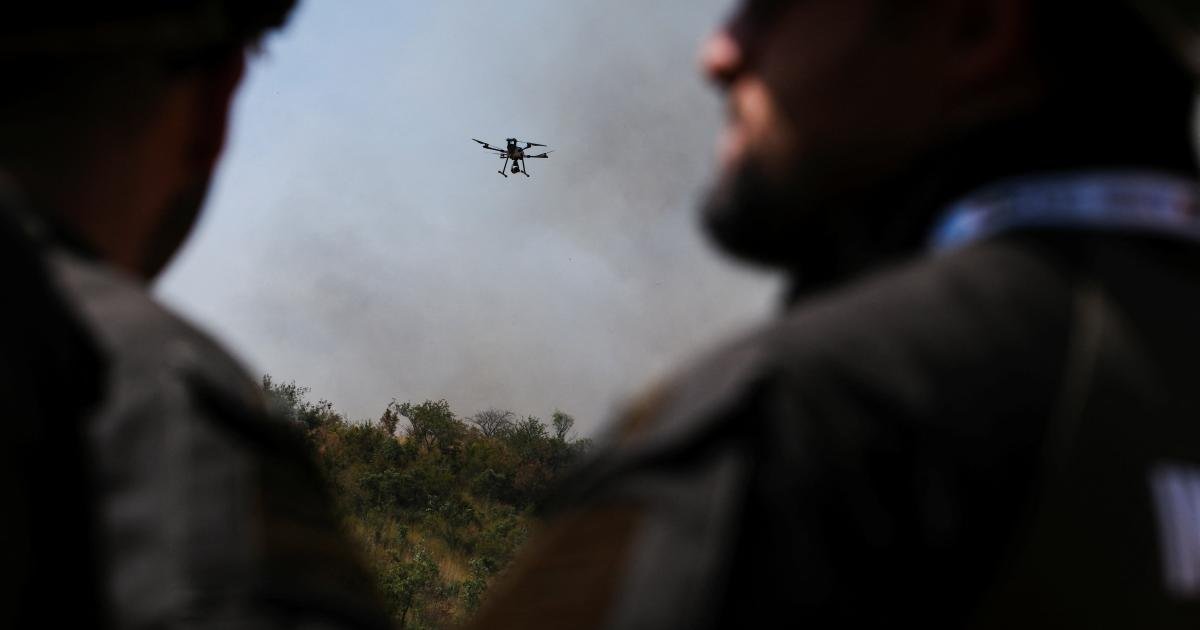
On June 22, 2025, fiber-optic first-person-view drones operated by the Azawad Liberation Front (FLA), a Tuareg rebel group, slammed into a convoy of Russian Africa Corps and Malian armed forces vehicles in northern Mali. Footage shows the drones striking two trucks, then cuts to fighters posing beside the wreckage. The significance was unmistakable: a little over a year after fiber-optic drones first appeared in Ukraine, a rebel group with scant resources had deployed the cutting-edge technology to humiliate two comparatively superior state actors.
A decade earlier, the use of armed drones in African airspace looked very different. In 2011, the United States conducted the first drone strike on the continent, targeting senior leaders of the Somali Islamist group al-Shabab. At the time, Washington held a near monopoly in drone capability: only the world’s most advanced militaries had the access and technical expertise to employ the $20 million Predator drone used in the attack. That monopoly has since collapsed. Over the past decade, at least 37 African militaries have acquired drones of varying sophistication and cost.
Drones have allowed African states’ small, lightly equipped forces to extend their reach across vast territories where state authority is contested. But over the last four years, armed nonstate actors in more than a dozen countries have begun to acquire and experiment with drones of their own, using them to enable ground operations, drop mortars, and conduct suicide attacks. They are now deploying these small uncrewed systems, many of which can be assembled from widely available and inexpensive parts, more effectively than states, who continue to rely on foreign governments for supply. In doing so, they have demonstrated that the gap between less-resourced and better-resourced adversaries has narrowed since the dawn of the drone wars, threatening the air dominance once enjoyed by states across the world.
African governments cannot hope to regain the military advantage by employing the strategies of a decade ago. Nor can they rely on foreign governments that have other incentives to provide them with the necessary firepower. Instead, they must learn to develop their own drones and integrate them into militaries built specifically for the irregular warfare required to defeat the insurgents that threaten them.
AIR TRAFFIC CONTROL
Africa’s drone race began in Libya and Ethiopia. During its second civil war, which officially lasted from 2014 to 2020, Libya became the world’s most active drone battlefield. The country’s relatively open terrain, along with extensive weapons supply lines from external state actors, turned the war into a testing ground for emerging technology. The Tripoli-based Government of National Accord and the Benghazi-based Libyan National Army exchanged thousands of drone strikes, culminating in the 2020 battle for Tripoli. During the battle, Bayraktar TB2 drones supplied to the GNA by Turkey loitered just beyond the range of the LNA’s Russian-supplied air defenses and provided critical air support to GNA forces as they beat back an LNA attack on the capital. The failure of the LNA offensive ultimately led to the 2020 cease-fire that ended hostilities.
Drones played an even more consequential role in Ethiopia’s 2020–22 conflict with the rebel Tigray Defense Forces (TDF). By late 2021, a TDF offensive had advanced to within 65 miles of Addis Ababa, the country’s capital and seat of the African Union. Desperate, Ethiopian Prime Minister Abiy Ahmed turned to Iran, Turkey, and the United Arab Emirates for drones, which inflicted heavy casualties, targeted the TDF’s vulnerable communications and supply lines, and turned the imminent collapse of the government into a sweeping defeat for the TDF. As a former Tigrayan officer involved in the offensive later told The Economist, “We could have captured Addis easily . . . . It was those fucking drones . . . . We had no way of shooting them down.”
The outcome of the Libyan and Ethiopian conflicts turned on a small number of capable drones, employed alongside capable infantry and mechanized forces. The GNA and the Ethiopian armed forces’ access to superior drone technology allowed them to repel an exposed, invading adversary whose forces were concentrated. Other states took notice.
WE’RE NOT IN ADDIS ANYMORE
In the years since, dozens of countries across Africa, seduced by the idea of affordable access to the air, have acquired long-endurance drones to deal with their adversaries, regardless of whether those adversaries used the same tactics as the LNA or the TDF.
Today, the most significant threat facing African governments is a different type of insurgency: militant groups expanding their reach across the Sahel, the Lake Chad Basin, and Somalia. After a wave of military coups between 2020 and 2023 led to the expulsion of French, U.S., and UN forces, juntas in Mali, Burkina Faso, and Niger turned to Turkish Bayraktar and Akinci drones to repel the groups. These drones appeared to offer the juntas an affordable way to compensate for the loss of Western arsenals and troops. And the initial results were promising: uncrewed airpower allowed Mali to overwhelm rebel groups and recapture territory in the country’s north that had been under FLA control for more than a decade.
Yet unlike in Libya or Ethiopia, the use of drones has not strengthened state control. In fact, the juntas’ extensive use of drones in the fight against these insurgents has coincided with the erosion of their control over their own territory. The al-Qaeda affiliated Jamaat Nasr al-Islam wal-Muslimin (JNIM), which has coordinated attacks with the FLA, and Islamic State Sahel Province are advancing in Burkina Faso, Mali, and Niger and encroaching into northern Benin, Côte d’Ivoire, western Nigeria, and Togo, regions long considered relatively stable and insulated. They have done so with limited resistance from state armies, which have prioritized airpower to the exclusion of cultivating more capable ground forces, on-the-ground-intelligence networks, or public services in remote areas far from centers of state power.
Insurgents have quickly adapted to the age of drone warfare, in part by exploiting mass civilian casualties caused by military drone strikes, generating communal resentment against the Burkinabe, Malian, and Nigerien governments. When Burkina Faso’s military killed dozens of civilians in a 2024 strike, for example, JNIM responded by organizing rescue operations and deploying medical personnel. In northeastern Nigeria, Boko Haram militants have entrenched themselves in remote areas cut off from most government services, using anger over civilian casualties to recruit fighters.
In addition to using drone casualties against states, Islamist groups have learned how to nullify the advantages of their enemies’ air superiority. Having spent years dodging airstrikes, they have adopted advanced evasion tactics to compensate for the growing reach of state drones. Militants operate mostly in small units, employ light vehicles and weapons, and infiltrate underserved localities beyond the reach of state forces. In Somalia, for example, al-Shabab fighters have eschewed convoys of land cruisers for motorcycles and wooden farm carts to blend in with civilians and better evade U.S. and Somalian government drone strikes. These tactics serve two purposes: dispersed, disguised forces are harder to identify as targets from above, and the fear of being mistaken for insurgents creates an atmosphere of unrest among civilians, poisoning relations between governments and the communities they need to win over.
Most important, insurgents are rapidly acquiring and using drones themselves, sometimes to devastating effect. The proliferation of small uncrewed systems since the outbreak of the war in Ukraine has made it possible for nonstate actors to purchase drones and drone parts directly from online commercial platforms and use them for intelligence gathering and attacks. The FLA’s attacks on Malian and Russian armed forces stand out for their sophistication, but the FLA is hardly the only group to make drone capabilities a major part of its offensive strategy, both to drop explosives and to direct fighters. Between September 2023 and and April 2025, JNIM launched over a dozen coordinated drone operations in Burkina Faso, Mali, and Togo, including to film propaganda videos, conduct kamikaze attacks, and guide ground assaults using drone-gathered intelligence, surveillance, and reconnaissance data. In total, nonstate actors have used armed drones in at least 17 countries across Africa.
As uncrewed systems technology continues to advance and the cost to acquire and weaponize such systems continues to fall, the assumptions that led African governments to embrace drone warfare no longer hold. In short, these states cannot expect uncontested access to the air.
WEAPONIZED DEPENDENCE
While insurgent groups gain proficiency in buying, building, and integrating small uncrewed systems, African governments remain largely dependent on drone technology they have purchased from state actors outside the continent. In turn, foreign governments use drone sales as instruments of influence, leveraging arms relationships to negotiate trade deals and deepen military ties, upending the traditional balance of power between conventional forces in the region.
Close to 90 percent of Africa’s military drones, almost all of which are in the hands of African governments, come from external suppliers. A decline since 2020 in the sale of drones from the United States, whose systems tend to be pricier and whose leaders have been reluctant to sell to autocratic African regimes with spotty human rights records, has opened the door for China, whose cheap, effective drones now account for a quarter of all those procured by African states, to become the continent’s largest supplier. The net effect has been a shift of Africa’s defense partnerships away from traditional Western suppliers and toward a more diverse marketplace that includes middle-power producers such as Iran, Israel, Turkey, and the United Arab Emirates. These manufacturers offer an explicitly transactional approach, selling the technology to whoever is willing to pay. For African governments seeking to diversify their security partnerships and hedge against great-power competition, it is an attractive bargain.
But the diversification of the continent’s drone supply chains has been destabilizing. The ease with which outside powers can produce and export drones and the outsize effect of those drones on conventional warfare has made African conflicts particularly prone to foreign meddling. Foreign drones have turned civil conflicts into destabilizing proxy wars, a dynamic that reached its apogee in Sudan. TB2 drones supplied by Turkey, and Mohajer and Ababil drones supplied by Iran helped the undermanned Sudanese Armed Forces identify and target entrenched positions of its rival Rapid Support Forces in 2025, pushing the RSF out of Khartoum. The RSF retaliated with a massive strike on the Port of Sudan, the SAF’s de facto capital, using suicide attack drones supplied by the UAE, which backs the RSF to access trade routes and gold mines in Darfur.
Because foreign sponsors can sell drones to their local partners at relatively low costs while relying on them to do most of the fighting, drones have made it easier for outside powers to prolong conflicts without paying the price typically associated with direct military intervention. In Sudan, the human cost of this drawing out has been staggering. At least 150,000 Sudanese have been killed, millions more are facing starvation, and 12 million have been displaced, the most of any active conflict.
Sudan is an extreme case, but it is illustrative of the same broader dynamic as the failures in the Sahel: simply acquiring the latest drone technology guarantees neither success in armed conflict nor sovereignty over important defense capabilities. To prevail against increasingly sophisticated threats, African states must develop their own uncrewed systems and adapt and integrate them into their own fighting forces.
BUY LOCAL
Wars in Africa, a continent in which the median GDP is around $20 billion, are usually fought by small, short-handed armies in regions with limited physical and digital infrastructure. Attempting to fight well-disguised, mobile insurgencies with equipment supplied by countries possessing vastly different military experiences and tactics optimized for high-intensity, interstate conflict, as many African states have tended to do, is a recipe for failure.
Africa’s armies must instead adapt emerging drone and counterdrone technologies to suit their resources, operating environments, and threats. Rather than continue to fight insurgents using the methods of Africa’s early drone wars, they must find ways to better incorporate drones into irregular conflict. They must also resist the temptation to acquire airpower at the cost of other critical capabilities, including infantry and forces trained in policing, civil-military affairs, and administering justice. Ideally, drones should be used in tandem with these capabilities, and alongside mobile strike teams and tactical vehicles, not as standalone systems tasked with taking on militant groups by themselves. These less glamorous capabilities will ultimately determine whether African states can hold and govern the territory drones help them take back.
At least 11 African countries already produce drones, including Kenya, Nigeria, South Africa, and Morocco, which has recently announced drone training and coproduction partnerships with Israel and the United States. Others should follow, reallocating some of the resources they currently spend acquiring foreign drones to begin building up domestic industries. They could float incentives, including access to critical minerals that can be used to build drone components, to entice experienced drone manufacturers to transfer their knowledge and skills. African drone production should focus on low-cost, attritable drones, similar to those used by states adversaries, to reduce dependence on the more expensive long-endurance combat drones procured almost exclusively from abroad.
If paired with the right types of other capabilities and training, drone strikes can still play an important role in combating insurgencies. Building domestic capabilities will allow African governments to develop and refine cost-effective drone and counterdrone technology tailored to neutralizing the arsenals of criminal networks and armed nonstate actors. Greater control over drone production will yield returns beyond the battlefield, as well. It will reduce reliance on foreign suppliers and increase the resilience of Africa’s defense industrial base, providing African governments with leverage to resist the foreign meddling that has tended to intensify conflicts and prevent their resolution. The benefits could be global. China has established dominance over the global supply of commercial drones and components through heavy state subsidies. A thriving African drone manufacturing sector, drawing on local labor, expertise, inputs, and raw materials, could offer meaningful competition.
Just as they have for a decade now, drones are likely to continue to play decisive roles in the continent’s—and world’s—most important conflicts. And as the drone revolution continues apace, the equalizing effect of low-cost drones will make integration into existing capabilities, systems, and force structures—not technological supremacy—the key determinant of those conflicts’ outcomes. As long as African militaries continue to outsource their technology to foreign powers and strategies to autonomous systems, they will be out-innovated by insurgents again and again.
Loading…
