

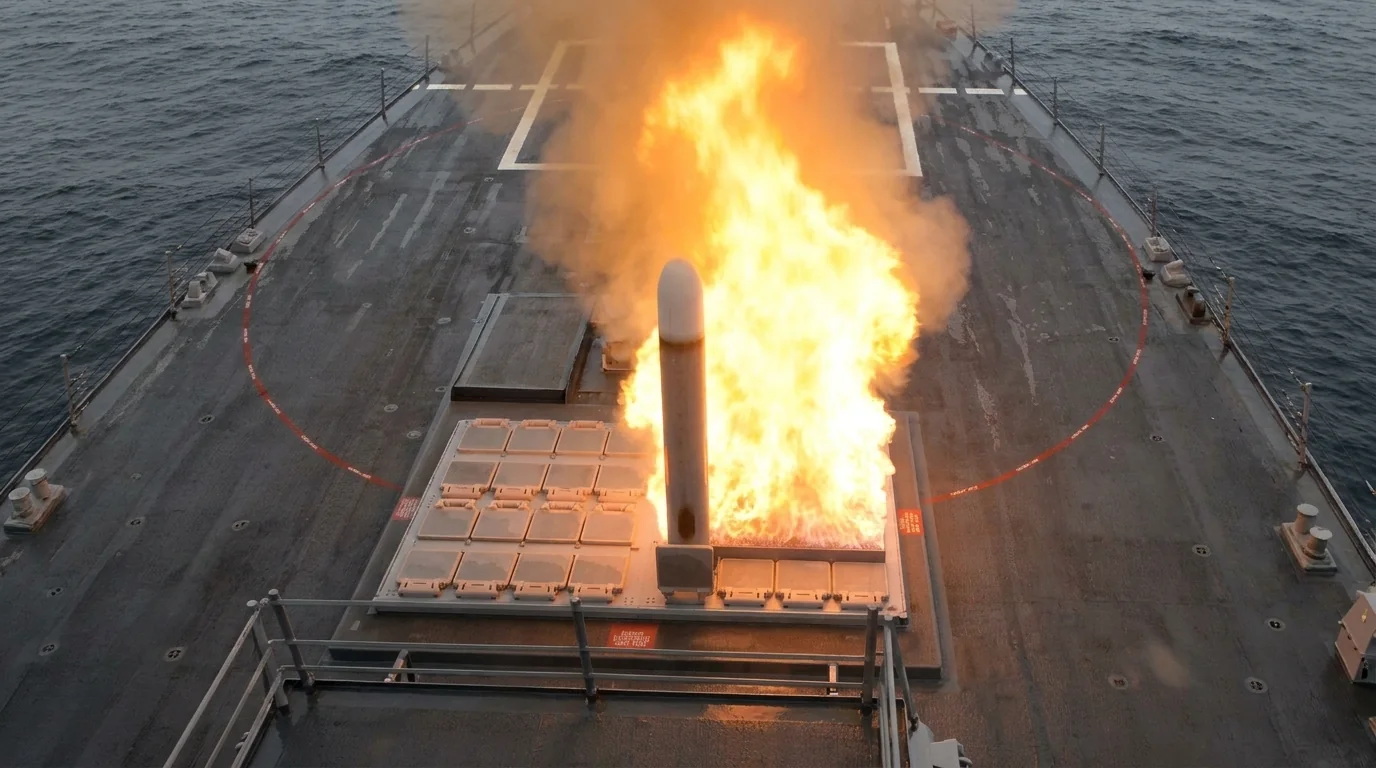
There’s a reason naval planners obsess over what sits below a warship’s deck. Not the radar. Not the guns. The launch cells.
Because in modern sea combat, the ship carrying the most adaptable weapons often controls the fight.
And that is where the Mk 41 VLS changed everything.
Before the Mk 41 Vertical Launching System, many warships depended on trainable launchers, mechanical arms swinging missiles into firing position one at a time.
Effective? Sure, for their era. But against saturation attacks, supersonic threats, submarines, and long-range strike missions happening almost simultaneously… those systems started looking like rotary telephones in the smartphone age.
The Mk 41 VLS flipped the script.
Instead of thinking of a warship as carrying “launchers,” navies began thinking in terms of cells, modular missile silos embedded into the hull.
Each cell became a kind of weapons slot, plug in an air-defense missile, anti-submarine rocket, or land-attack cruise missile depending on mission needs. It was Lego for naval firepower, except with billion-dollar consequences.
That flexibility is why more than a dozen navies adopted the system, and why over 11,000+ Mk 41 VLS cells have reportedly been delivered worldwide. That number alone hints at its strategic gravity.
But raw numbers don’t tell the whole story.
What makes Mk 41 VLS remarkable isn’t simply missile capacity, it’s the “any missile, any cell” philosophy.
A destroyer can defend against aircraft one minute, launch Tomahawk strikes the next, then prosecute submarines without changing launch hardware. Few weapons systems quietly altered naval doctrine this profoundly.
And here’s what often gets overlooked: the Mk 41 didn’t just improve ships. It changed how fleets fight.
What Is the Mk 41 Vertical Launching System?
Imagine a warship carrying a hidden skyscraper of missiles under its deck. That’s the basic idea behind the Mk 41 VLS, though “basic” hardly does it justice.
At its core, the Mk 41 Vertical Launching System is a modular missile launching architecture designed to store, protect, and fire multiple missile types from vertical cells. But calling it a launcher is almost underselling it. It’s really a weapons ecosystem.

And that distinction matters.
Unlike older rail launchers that had to physically rotate toward a target before firing, Mk 41 VLS launches missiles straight upward from armored cells. After leaving the ship, the missile turns toward its target. Fast. Efficient. Almost elegant in a brutal kind of way.
The concept sounds obvious today, but in the 1980s it was revolutionary.
Instead of dedicating one launcher to one weapon role, the Mk 41 introduced modular 8-cell units, often combined into large batteries. A destroyer might carry 90 or more cells, each potentially loaded for a different mission.
Here’s where it gets interesting:
| Capability | Mk 41 VLS Role |
| Air Defense | Standard Missile family, ESSM |
| Land Attack | Tomahawk cruise missiles |
| Anti-Submarine | VL-ASROC |
| Ballistic Missile Defense | SM-3 interceptors |
One system. Multiple wars, really.
That flexibility birthed the famous phrase often tied to the system:
“Any missile in any cell.”
It’s a little simplified, engineering realities always complicate slogans, but strategically, that idea transformed naval combat.
And the Mk 41 VLS wasn’t built in isolation. It became tightly linked with the Aegis Combat System, giving warships the ability not just to launch, but to detect, prioritize, and engage threats in seconds. Sensor to shooter, almost seamless.
Think of it this way:
Older launchers were like specialized tools in a toolbox.
Mk 41 became the toolbox.
That’s why the system appears on Arleigh Burke destroyers, Ticonderoga cruisers, allied frigates, and even newer European and Indo-Pacific combatants.
More subtly, and this rarely gets enough attention, the Mk 41 also changed deterrence. A ship carrying 96 anonymous launch cells forces adversaries to assume every one could contain something different. Air defense? Cruise strike? Anti-submarine rockets? That uncertainty has strategic weight.
Sometimes deterrence isn’t the missile fired.
It’s the one nobody can predict.
What Missiles Can the Mk 41 Launch?
Here’s where the Mk 41 VLS stops being a launcher and starts looking like a strategic Swiss Army knife.
Because the real genius of the system isn’t the cells.
It’s what can come out of them.
The Mk 41 Vertical Launching System was built around missile flexibility, and that has made it one of the most adaptable naval weapons systems ever fielded. Air defense, ballistic missile defense, land attack, anti-submarine warfare, it can support all of them.
That’s unusual. Most launchers specialize.
Mk 41 multitasks.
Major Missiles Compatible with Mk 41 VLS
| Missile | Role | Approx. Range |
| Tomahawk | Land Attack | 1,000+ miles |
| SM-2 | Fleet Air Defense | 90–100+ miles |
| SM-3 | Ballistic Missile Defense | Exo-atmospheric |
| SM-6 | Air, Missile, Surface Strike | 200+ miles |
| ESSM | Point / Medium Air Defense | 30+ miles |
| VL-ASROC | Anti-Submarine Warfare | ~12+ miles |
Let that sink in.
One launcher can support intercepting aircraft, shooting down ballistic missiles, striking targets inland, and hunting submarines.
That wasn’t normal when the system appeared. Frankly, it still feels a bit outrageous.
Tomahawk often gets the headlines, and understandably. Long-range precision strike changed naval power projection.

But some analysts argue the SM-6 Missile may be even more transformative.
Why?
Because it blurs categories.
Air defense missile. Anti-ship weapon. Missile interceptor. Sometimes one missile starts doing the work of three. That’s a big doctrinal shift.
Then there’s ESSM, often quad-packed in one cell. Four missiles in one launch cell.
Defensive math suddenly gets ugly, for the attacker.
And maybe the most underappreciated member of the family? VL-ASROC.
It launches a rocket… carrying a torpedo. Yes, really.
Like something dreamed up in a Cold War brainstorming session after too much coffee.
And it works.
This broad Mk 41 missile compatibility is why navies prize the system. Mission needs change, threats evolve, new missiles emerge, the launcher doesn’t need replacing.
Load different canisters. New mission.
That modular logic is why discussions around future weapons, hypersonics, longer-range interceptors, next-generation strike systems, often circle back to one question:

Can it fit in Mk 41 VLS?
That tells you something. At a certain point, a weapons system stops adapting to missiles…
Missiles start adapting to the launcher.
Which Warships Use the Mk 41 VLS?
One of the clearest signs a military system works?
Everybody wants it. That’s more or less the story of the Mk 41 VLS.
Originally developed for the U.S. Navy, the Mk 41 Vertical Launching System didn’t stay an American story for long. It spread, quietly at first, then widely, until it became something close to the global standard for blue-water missile launch systems.
And not because of politics alone.
Because navies like flexible things that survive contact with reality.
Major Warships Equipped with Mk 41 VLS
| Ship Class | Country | Approx. Cells |
| Arleigh Burke-class | United States | 90–96 |
| Ticonderoga-class | United States | 122 |
| Constellation-class (planned) | United States | 32+ |
| Álvaro de Bazán-class | Spain | 48 |
| Fridtjof Nansen-class | Norway | 8 |
| Hobart-class | Australia | 48 |
| KDX-III Sejong the Great | South Korea | 128 |
Those numbers matter.
But cell counts don’t tell the whole story.
Take the Arleigh Burke-class destroyer, arguably the poster child for Mk 41 VLS ships. With 90 or 96 cells depending on flight variant, these ships can swing between missile defense escort, strike warfare, anti-submarine operations, and carrier protection almost seamlessly.

That’s not a ship carrying missiles. That’s a floating magazine with radar.
And then there’s Sejong the Great, often called one of the heaviest armed destroyers afloat.
128 VLS cells.
That’s cruiser-level firepower… on a destroyer.
Wild.
What’s fascinating is how different navies use the same launcher differently. Some emphasize air defense. Others prioritize land attack. Others load around submarine threats.
Same architecture. Different doctrine.
That adaptability helped the Mk 41 missile launcher become deeply tied to the Aegis ecosystem, especially among allied fleets. Interoperability matters. In coalition warfare, shared launch architecture can be almost as important as shared missiles.
Rarely talked about, but huge. And there’s a psychological layer too.
When a warship sails with dozens, sometimes over a hundred, unknown launch cells, adversaries have to assume each one might hold something dangerous.
Deterrence through ambiguity. Maybe that’s part of why the Mk 41 VLS endures.
It isn’t just mounted on powerful ships. It helps make them powerful.
Advantages of the Mk 41 VLS
If the Mk 41 VLS has a superpower, it’s not raw firepower.
It’s adaptability.
And in warfare, where assumptions die quickly, that may be the biggest advantage of all.
Plenty of missile launchers can fire weapons.
Fewer can reshape how a navy fights.
The Mk 41 Vertical Launching System did that.
Why Navies Value the Mk 41 VLS
| Advantage | Why It Matters |
| Multi-Mission Flexibility | One launcher supports diverse missions |
| Modular Architecture | Easy upgrades and missile integration |
| High Cell Density | More firepower in limited space |
| Missile Variety | Supports wide weapon inventory |
| Proven Reliability | Decades of operational confidence |
Let’s start with the big one:
Flexibility.
Air defense today, land strike tomorrow, anti-submarine warfare next week.
Same launcher. That’s extraordinary.
Older systems often forced mission tradeoffs, equip for one problem, sacrifice another. Mk 41 VLS softened that dilemma.
And then there’s the famous “any missile in any cell” concept. Slightly simplified? Sure.
Still revolutionary? Absolutely.
It turned warships into configurable combat platforms.
Almost software-like.

Another huge edge: modularity.
Because the launcher was designed around canisterized weapons, new missiles can often be integrated without rebuilding the ship. That matters over decades.
Ships live long. Threats change faster. Good architecture survives both.
Then there’s capacity. Cell density gives surface combatants enormous punch without giant external launchers cluttering the deck.
Cleaner silhouette. More missiles. Better survivability. Not a bad trade.
And maybe the quietest advantage is logistical.
Standardization.
When allied fleets operate similar Mk 41 VLS modules, training, sustainment, and interoperability become much easier. That rarely makes headlines, but militaries obsess over it.
For good reason.
Amateurs talk hardware. Professionals talk logistics.
There’s also survivability through readiness. Vertical launch means near-instant response against saturation attacks. Seconds matter in missile defense.
Sometimes seconds are the fight. And here’s an under-discussed point:
The Mk 41’s greatest advantage may be what it lets navies postpone.
Choosing between missions. Because with enough flexible cells, you can carry options instead of betting on one threat.
That’s strategic insurance.
And maybe that’s why, decades later, the Mk 41 missile launcher still feels modern.
It wasn’t built just to launch missiles. It was built to absorb uncertainty.
That ages well. Very well.
Limitations and Controversies
For all the admiration surrounding the Mk 41 VLS, it isn’t magic.
No serious weapons system is.
And honestly, understanding its limitations tells you more about it than praise ever could.
Because even icons have tradeoffs.
Key Limitations of the Mk 41 VLS
| Challenge | Why It Matters |
| At-Sea Reloading Difficulties | Cells traditionally reloaded in port |
| Cell Size Constraints | Future weapons may outgrow current dimensions |
| Cost and Integration Complexity | Expensive for ships and operators |
| Concentrated Magazine Risk | Damage to launcher zones can matter |
| Strategic Controversies | Political and treaty disputes |
The biggest criticism? Reloading.
Once many Mk 41 VLS cells are emptied in combat, replenishment historically meant returning to port.
That’s… not ideal in a prolonged fight.
Especially in high-end naval warfare.

People sometimes assume missiles can be casually reloaded at sea like old naval guns.
Not really.
It’s a complicated, dangerous evolution.
Recent efforts toward at-sea VLS reloading have gotten attention precisely because this limitation matters so much.
It has always been the asterisk. Then there’s cell size.
The strike-length Mk 41 is versatile, yes, but emerging hypersonic or oversized weapons may challenge existing dimensions.
And physics doesn’t negotiate.
If the missile doesn’t fit, it doesn’t fit.
Another issue? Cost.
A Mk 41 Vertical Launching System is not plug-and-play in the casual sense. Ship design, cooling, software integration, survivability engineering, it all adds up. For smaller navies, that’s a major barrier.
There’s also the concentration argument.
Packing enormous offensive and defensive capability into clustered launch banks creates efficiency… but also creates a tempting target.
Power can concentrate risk. That debate never really goes away. And then politics enters.
This gets touchy.
Some controversies around Mk 41 missile launchers, particularly in land-based contexts, have touched arms-control debates because launchers theoretically associated with defensive interceptors may raise concerns over offensive missile potential.
The launcher became geopolitical symbolism. Not just hardware. That says something.
And maybe the deeper limitation is philosophical:
The Mk 41 VLS can launch astonishing weapons, but it can’t create inventory, solve magazine depth shortages, or fix doctrine.
Technology never substitutes for strategy. It amplifies it. That’s worth remembering.
Because even one of history’s most successful naval launch systems still lives under the oldest military law there is:
Every advantage comes with a bill attached.
