

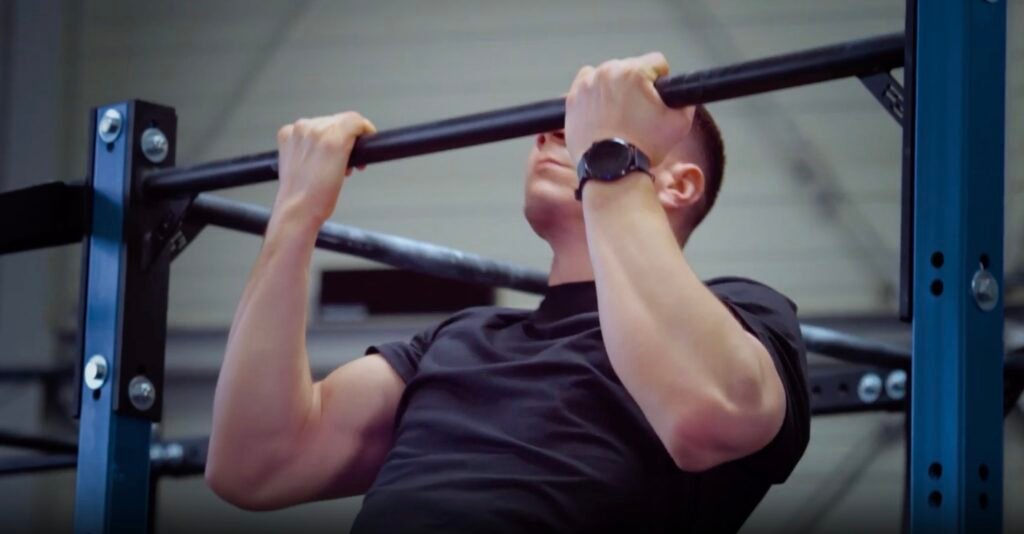
The chin up is one of the best tests of upper body strength relative to your body weight. Unlike many gym exercises, it requires you to move your entire body through space using your own strength. That makes it an excellent indicator of muscular fitness, coordination, and overall athletic ability.
If you can perform multiple strict chin ups with good form, you almost certainly have stronger pulling muscles than the average person. At the same time, the number of chin ups you should be able to perform depends on your age, sex, body weight, training history, and overall fitness level.
So what counts as good? Is five enough? Is ten impressive? And how many chin ups separate the average gym goer from someone with exceptional strength? Here is what the science says.
What Is a Chin Up?
A chin up is a bodyweight pulling exercise performed on a horizontal bar using a supinated grip, meaning your palms face toward you. You begin from a dead hang with your arms fully extended and pull yourself upward until your chin clears the bar before lowering under control.
The chin up differs from the pull up because of the grip position. A supinated grip generally places the elbows in a more favorable position and increases activation of the biceps brachii while still heavily recruiting the latissimus dorsi and other back muscles. For many people, chin ups are slightly easier than pull ups for this reason.
Despite being easier than pull ups, chin ups remain one of the most demanding bodyweight strength exercises because they require significant relative strength.
Why Chin Ups Matter
Many people judge strength by how much weight they can lift on machines or with barbells. While those exercises are valuable, chin ups reveal something different. They measure your ability to produce force relative to your own body weight.

Research consistently shows that muscular strength is strongly associated with better physical function, lower injury risk, improved metabolic health, and greater longevity. Relative strength, which is your strength compared to your body weight, is particularly important for athletic performance and everyday movement.
Being able to perform chin ups also demonstrates that your pulling muscles are well developed. These include the lats, biceps, brachialis, posterior deltoids, rhomboids, lower trapezius, forearm muscles, and core.
How Many Chin Ups Should You Be Able to Do?
There is no single perfect number, but population fitness testing, military standards, and strength coaching guidelines provide useful benchmarks.
For healthy adults, these general standards work well.
Men
- Less than 3 chin ups suggests below average upper body relative strength.
- Between 3 and 7 chin ups represents average strength.
- Between 8 and 12 chin ups is considered good.
- Between 13 and 18 chin ups is excellent.
- More than 18 strict chin ups is exceptional and indicates a very high level of relative strength.
Women
Unable to perform one chin up does not necessarily indicate poor fitness because women generally have less upper body muscle mass than men.
- One to 2 chin ups is a good starting level.
- Three to 5 chin ups is above average.
- Six to 10 chin ups is excellent.
- More than 10 strict chin ups is exceptional.
These numbers assume strict repetitions performed through a full range of motion without swinging or using momentum.
Why Relative Strength Matters More Than Absolute Strength
Imagine two people. One weighs 150 pounds and can perform 15 chin ups. The other weighs 240 pounds and can only perform 4.
The heavier athlete may actually be capable of lifting far more weight in exercises such as the deadlift or bench press, yet the lighter athlete demonstrates greater relative pulling strength because they move a smaller body mass more efficiently.
This is why gymnasts, rock climbers, and elite calisthenics athletes often perform very high numbers of chin ups despite not being particularly heavy.
Research consistently demonstrates that body composition has a major influence on bodyweight exercise performance. Higher levels of lean muscle mass improve chin up ability, while excess body fat increases the amount of weight that must be lifted without contributing to force production.
Factors That Affect Chin Up Performance
Several variables influence how many chin ups you can perform.
Body Weight
Body weight has one of the biggest effects on performance.
Every additional pound must be lifted through the full movement. Even highly muscular individuals may perform fewer repetitions simply because they are moving more total mass.
Reducing excess body fat often improves chin up performance even without significant gains in strength.
Muscle Mass
The latissimus dorsi, biceps, and upper back generate most of the pulling force.
Individuals with greater muscle cross sectional area in these muscles generally produce higher pulling forces and complete more repetitions.
Grip Strength
Many people fail chin ups because their hands fatigue before their back muscles. Research shows that grip strength correlates with overall strength, athletic performance, and even long term health outcomes. Improving forearm strength often improves chin up numbers.
Training Experience
Someone who regularly practices chin ups will almost always outperform someone who trains only machine exercises. The nervous system becomes more efficient at coordinating movement patterns through repeated practice. This explains why simply performing chin ups more frequently often produces rapid improvements during the first few months of training.
Age
Maximum strength gradually declines with age, especially after age 50. However, resistance training dramatically slows this decline. Many people in their sixties and seventies continue performing multiple chin ups through consistent training.
What Happens If You Cannot Do One Chin Up?
You are far from alone. Large numbers of adults cannot perform a single strict chin up. This is especially common among beginners, individuals carrying excess body fat, and those who have never trained pulling movements.
Fortunately, nearly everyone can build up to their first repetition through progressive training. Effective exercises include assisted chin ups, negative repetitions, lat pulldowns, inverted rows, and isometric holds. Research consistently shows that progressive overload is the most effective way to increase muscular strength. As your muscles and nervous system adapt, your first chin up becomes increasingly achievable.
What Muscles Do Chin Ups Work?
Many people think chin ups are only a back exercise.
In reality they involve nearly the entire upper body.
- The latissimus dorsi provides the primary pulling force.
- The biceps brachii contributes heavily because of the underhand grip.
- The brachialis and brachioradialis assist elbow flexion.
- The rhomboids and trapezius stabilize the shoulder blades.
- The rotator cuff maintains shoulder stability throughout the movement.
- The forearms generate grip strength.
- The abdominal muscles and spinal stabilizers help prevent swinging and maintain body position.
Electromyography research consistently demonstrates very high activation of both the lats and biceps during strict chin ups.
Are Weighted Chin Ups Worth Doing?
Once you can comfortably perform around 10 to 12 strict chin ups, adding external weight becomes an excellent progression. Weighted chin ups increase maximal pulling strength, stimulate additional muscle growth, and often improve bodyweight repetition performance when you later remove the added load.
Strength athletes frequently use weighted chin ups as one of their primary upper body exercises because they combine heavy loading with functional movement patterns.
What Does Your Chin Up Score Say About Your Fitness?
Your chin up score reflects much more than arm strength. It provides insight into your relative strength, muscular endurance, body composition, coordination, grip strength, and overall physical preparedness.
- Someone capable of performing 10 strict chin ups demonstrates significantly greater upper body fitness than the average adult.
- Reaching 15 or more repetitions places you in an elite category that relatively few recreational exercisers achieve.
- If you cannot yet perform one repetition, treat it as a goal rather than a limitation.
With consistent training, appropriate nutrition, and patience, the vast majority of healthy adults can dramatically improve their chin up performance.
The chin up remains one of the simplest and most honest tests of upper body strength. The bar never changes, gravity never gets lighter, and every additional repetition reflects meaningful improvements in your strength and fitness.
Chin Up Performance Standards
| Performance Level | Men | Women |
|---|---|---|
| Beginner | Less than 3 | 0 |
| Average | 3 to 7 | 1 to 2 |
| Good | 8 to 12 | 3 to 5 |
| Excellent | 13 to 18 | 6 to 10 |
| Exceptional | More than 18 | More than 10 |
References
- American College of Sports Medicine. (2022). ACSM’s Guidelines for Exercise Testing and Prescription. 11th ed. Philadelphia: Wolters Kluwer.
- Booth, F.W., Roberts, C.K. and Laye, M.J. (2012). Lack of exercise is a major cause of chronic diseases. Comprehensive Physiology, 2(2), pp.1143 to 1211.
- Figueiredo, T., de Salles, B.F. and Trajano, G.S. (2018). Volume for muscle hypertrophy and health outcomes. Sports Medicine, 48(3), pp.499 to 505.
- Franchi, M.V., Reeves, N.D. and Narici, M.V. (2017). Skeletal muscle remodeling in response to resistance training. Nature Reviews Endocrinology, 13(7), pp.393 to 411.
- Leong, D.P. et al. (2015). Prognostic value of grip strength. The Lancet, 386(9990), pp.266 to 273.
- Schoenfeld, B.J. (2010). The mechanisms of muscle hypertrophy and their application to resistance training. Journal of Strength and Conditioning Research, 24(10), pp.2857 to 2872.
- Schoenfeld, B.J., Ogborn, D. and Krieger, J.W. (2017). Dose response relationship between weekly resistance training volume and increases in muscle mass. Journal of Sports Sciences, 35(11), pp.1073 to 1082.
