

Editor’s note: This is the seventh article in a limited series celebrating American defense technologies born from wartime and their effects on broader national security, politics, and society. This series will run for several weeks to commemorate America’s 250th anniversary, and winners will be selected by a reader vote undertaken through our newsletter later this summer. Prior installments can be found at the Arsenal of Innovation page.
On the night of 24 March 1999, U.S. pilots flying 15,000 feet or more above the Balkans released precision-guided munitions, or “smart bombs,” onto military targets in Yugoslavia, beginning Operation Allied Force. The U.S.-led NATO operation carried out 10,000-plus strike sorties over 78 days and, despite the Yugoslav military’s robust air defense network, lost only two airplanes. The ground and air forces were virtually incapable of engaging the bombers. That incapability was due in part to a collection of technologies that made them nearly imperceptible to radar and the anti-aircraft missiles and attack aircraft that relied on it — “stealth.”
Stealth was a significant technological breakthrough. Yet the secret research and development of the B-2, America’s first stealth bomber, and similar secret programs, “posed a fundamental dilemma to American democracy.” In his address on the “military-industrial complex” in 1961, President Dwight D. Eisenhower urged a “balance” between technological advancement and the principles of U.S. governance, including the imperative of “an alert and knowledgeable citizenry.” The stealth programs’ secrecy threatened to upset that balance.
Without appropriate safeguards, government secrecy can undermine the public accountability essential to democratic government. The story of the B-2 suggests important lessons for both acquisition reform and military adoption of AI today. The reporting framework that arose out of the stealth bomber program shows that oversight of national security technology programs can be balanced with the need for government secrecy.
Sign Up for Our Newsletter
Imperatives and Innovations
By the height of the Cold War, developing a penetrating long-range bomber became of paramount importance to U.S. national security. Even if officials once believed, generally, that “the bomber will always get through,” the development of radar and improvements in radar-based anti-aircraft technologies made bombers increasingly vulnerable. Technologists began to envision a bomber that was virtually invisible to anti-aircraft radar systems.
In the late 1960s, the Northrop Corporation began working on, in former engineer Kenneth Mitzner’s words, “keeping the planes from getting shot down.” As he recalled, the work was informed by English translations of Soviet technical journals, which revealed Russian engineer Pyotr Ufimtsev’s “physical theory of diffraction.” That theory made it possible to calculate how edges scatter radar waves, allowing aircraft to be shaped so that edge diffraction and reflections are directed away from the radar receiver. Unlike the American research, the Russians were focused on missiles, not airplanes. “Even after Ufimtsev and his institute tried applying the theory to airplanes,” as Peter Westwick explains in Stealth, based principally on private interviews with Ufimtsev in 2016, “the Soviet military showed no interest.”
Northrop’s work on explaining how the theory of diffraction could be used to lower an aircraft’s radar return was not only unclassified but also nonproprietary. The Air Force made it available to Northrop’s competitor Lockheed, likely through a bidders’ library.
But starting in 1977, the work on “low observable” technologies became a closely held and rigorously guarded secret. According to Ben Rich, head of Lockheed’s Advanced Development Projects division (also known as Skunk Works), the research and development of the F-117 stealth fighter was under “the tightest security lid since the atomic bomb.” The level of secrecy imposed on the stealth bomber program was even stricter.
In 1979, the Advanced Strategic Penetrating Aircraft became the Advanced Technology Bomber. (The Air Force named the stealth bomber “B-2” in 1984.) As stealth expert Bill Sweetman observed, “The bomber included so many radical features that it presented the Soviet Union with a challenge of unknown magnitude,” while the planform remained a well-kept secret, as “its external shape could [have] provide[d] clues to its detectability.” The development of the B-2 generated other innovations, many of which are still classified.
“[A]n unusually significant scientific breakthrough”
It was partly on the urging of the National Security Agency that the Pentagon’s chief of research and development, William Perry, insisted that the stealth programs (including the F-117 stealth fighter and the stealth bomber) met the test for the strictest classification. Yet, the executive order that initially authorized the secrecy safeguards the Pentagon later applied to the stealth programs made clear that preserving public access to government information was fundamental. The very first sentence of Executive Order 11652 urged that “[t]he interests of the United States and its citizens are best served by making information regarding the affairs of Government readily available to the public.” Despite that imperative, the order sanctioned “special requirements with respect to access, distribution and protection of classified information and material.”
The Defense Department implemented this authorization by establishing the “special access program,” a designation with need-to-know access controls stricter than Top Secret. The implementing defense regulation, 5200.1-R (1972), stated that generally research and development should not be classified unless for “an unusually significant scientific ‘breakthrough’” that is unknown to other nations and advantageous to U.S. national security. It was because stealth met these criteria that its programs remained outside of the acquisition system.
One detail of secrecy that remained unsettled was how to fill a gap in the law on information security. In June 1977, a senior lawyer in the Defense Department warned a senior official in the Justice Department that the law covered only deliberate espionage and not security leaks, endorsing a Central Intelligence Agency memorandum from that month that described the gap in the law as a “‘statutory vacuum.’” Before the security clearances later issued to Northrop employees, corporate employees on the stealth programs at defense contractors in the 1970s worked under “Secrecy Agreements” authorized by another executive order that did not seem to apply to domestic contractors working stateside. This expedient filled the legal gap.
By the turn of the decade, functionaries had begun work on the B-2’s design. Designing a warplane that could fly high and far and be difficult for radar to detect meant pairing radar scattering theory and aerodynamics. Insiders knew that Northrop engineers had decided on a flying-wing design — not because it was a storied part of the firm’s heritage, but because lighter weight enabled longer range at higher altitude. Even in earlier models, though, the flying wing also reduced radar return. The planform, at first, was designed as a diamond shape with wings angled back along the leading edge. Then, a Red Team exercise against new Soviet-style integrated air defense systems in 1981 impelled a redesign. Now the bomber would have to fly both high and low. Flying fast and low meant wind gusts could cause instability. Ultimately, the fix was to add elevons closer to the center line, which inspired a change from the inboard diamond shape to a trailing edge with three adjacent chevrons.
Manufacturing presented new security challenges. Production at scale meant many thousands of new employees and thousands of security clearances. Most employees worked at Northrop’s Advanced Systems Division headquarters in Pico Rivera, a recently shuttered car factory outside Los Angeles. Northrop had to turn it into Fort Knox. In addition to flight simulators, the plant housed the autoclaves necessary to form the secret materials, another innovation of the stealth bomber program. Recurring overflights by Soviet Russian reconnaissance planes were regular confirmation that secrecy was paramount.
“[T]he secrets are emerging from the shadows”
Yet some lawmakers in Congress disagreed that stealth had to be so insulated from the normal acquisition safeguards. Soon, congressional oversight expanded. Senator John Glenn of Ohio, a former military pilot and astronaut, once complained to a staffer in the early 1980s about secret outflows of government funds that were going to “black” programs under classified government contracts. While Secretary of Defense Caspar Weinberger had insisted on keeping the program and its costs secret, Glenn warned Weinberger that his failure to declassify the B-2’s cost figures was “eroding congressional support for the program.”
Only eight members of Congress were aware of stealth programs. This arrangement was similar to the intelligence committee’s famous “gang of eight,” but instead with the armed services and defense appropriations committees — a “black” budget gang of eight.
Meanwhile, with the concept of “inherently governmental functions,” regulators of the Federal Acquisition Regulation of 1983 and 1984 sought to keep “public interest” activities separate from private industry, especially for defense. Political accountability was also in the “public interest.” Yet even after Secretary of Defense Harold Brown (Weinberger’s predecessor) deliberately disclosed stealth developments in 1980, the B-2 remained a special access program from then on, somewhat outside of the acquisition system.
An important reason oversight expanded was that the press had begun its own investigations into the secret development of stealth technologies. One journalist, Tim Weiner, won the 1988 Pulitzer Prize for his work on the secret defense budget for research and development. As newsman Rick Atkinson put it for the Washington Post, “the secrets are emerging from the shadows.”
Balancing Acts
A major turning point in stealth bomber program disclosures was when Representative Les Aspin became chair of the House Armed Services Committee. As Weiner recounts, in 1986 Aspin and minority leader Bill Dickinson authored a letter to Weinberger representing the Committee, urging certain disclosures. The warning echoed Eisenhower’s balancing act between secrecy and accountability. “Of course, there is a need for special access programs; regrettably, not everything can be done in public,” the committee acknowledged. “However, it is essential that the maximum portion of our defense effort be conducted in the open.” The missive urged disclosure of “the most basic numbers involved in” the stealth bomber and Advanced Cruise Missile programs. Weinberger did not disclose all of what the letter requested, but he did disclose some figures, as he expected such disclosures would have to come sooner or later.
Congress continued to pursue accountability, expanding oversight of the stealth programs beginning with riders to the annual defense authorization act for 1988 and 1989. The act directed that certain features of the B-2 program and certain other weapons systems should remain classified. Still, it required the Secretary of Defense to disclose certain information, as doing so “would be consistent with the public interest and would not jeopardize the national security.”
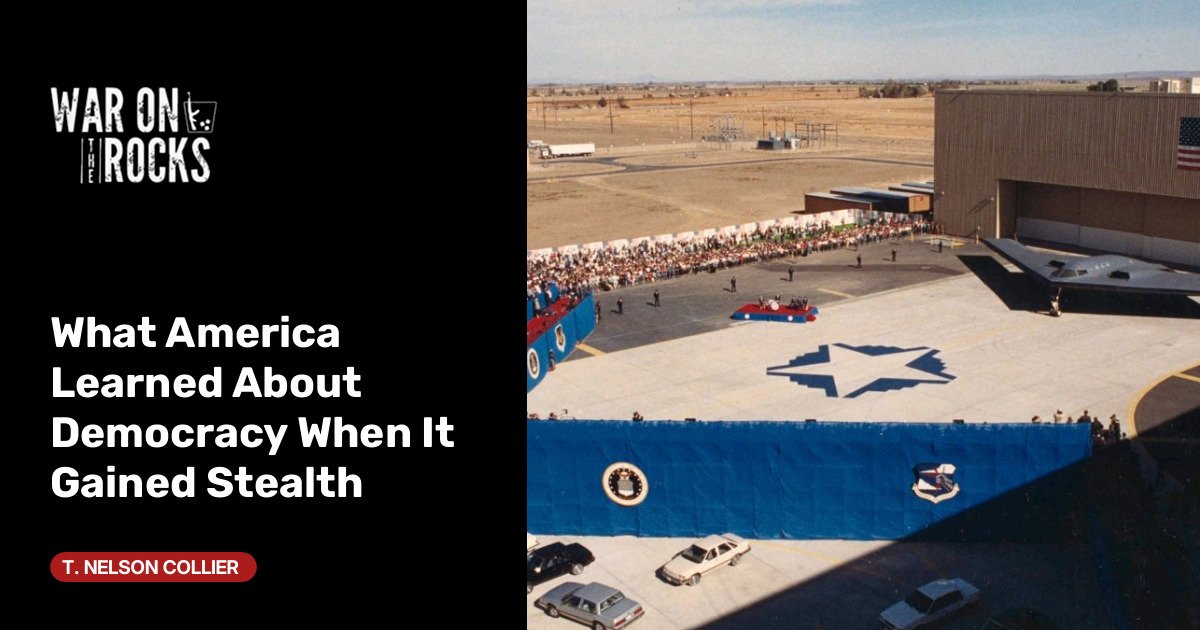
Finally, at its rollout in November 1988, the B-2 emerged from the literal shadows of its hangar at Northrop’s plant outside Los Angeles, at long last public knowledge. Costs had skyrocketed. As Time reported in 1989, Aspin’s estimates had put the total cost per plane at over a billion dollars, which, despite its weight of 70 tons, made each B-2 worth (more than) its weight in gold. Ultimately, total acquisitions were reduced to only 20 planes, with a then-total cost of $44.7 billion. Thus, the B-2 became known as the $2 billion bomber. Proponents of its utility would have to wait a decade for its combat debut in Operation Allied Force.
Although they’re only a part of an intelligence oversight regime that remains incomplete, the reporting requirements that Congress imposed for the B-2 and other special access programs are still in law today. The balancing act between the research and development of national security technologies and principles of U.S. democracy that Eisenhower urged in 1961 was necessary long before the Federal Acquisition Regulation system. The history of the B-2 program suggests a way to achieve an appropriate balance.
“There are many more Mavens”
Today, the tension between the public interests of national-security secrecy and democratic accountability is alive and well, especially with the “militarization” of AI. Take, for example, Project Maven. Maven was a defense initiative launched in 2017 to accelerate the military’s adoption of AI, initially by applying machine learning to analyze drone surveillance imagery. As journalist Katrina Manson recounts, this research and development was first undertaken in secret and intended to include target acquisition. Although many of the program’s operational capabilities remain classified, the Pentagon increasingly acknowledged it publicly, making it an example of the challenge of balancing national security secrecy with oversight and governance. And it’s not an anomaly: “There are many more Mavens.” The Pentagon’s FY2027 budget requests $58.5 billion for AI and combined joint all-domain command-and-control. Moreover, there are gaps in the law on the procurement and use of artificial intelligence. As the controversy surrounding the government’s secret contract with Anthropic and the row surrounding the use of artificial intelligence in targeting decisions suggest, much is at stake.
Conclusion
Pundits applauded the B-2’s performance in Operation Allied Force. As Andrew Krepinevich wrote for the Wall Street Journal in June 1999, “almost alone, American air power broke the back of the Yugoslav military.” For him, as for others, the stealth bomber, paired with precision-guided munitions, had “revolutionized” air power. In the end, it was Eisenhower’s imperative of balancing “cost and hoped for advantage” that most contributed to bringing secrecy into tension with accountability with the B-2 program. AI is different, in that the tension is less about cost than the morality of AI-enabled targeting.
With the procurement and use of artificial intelligence, the administration has signaled a preference for working around that very system. But, as the story of the stealth bomber program suggests, the more the government uses secrecy workarounds — such as classification, other transactions, or, in the case of the stealth bomber, special access programs — the more national security comes into tension with public accountability. To maintain faith with first principles in the government acquisition of national security technologies, congressional oversight is necessary.
With or without it, though, the history of the stealth bomber program exemplifies a perennial problem. What Senator John McCain criticized as the military-congressional-industrial-complex was a development that, to him, undermined congressional oversight of defense acquisitions.
As the White House initiative on defense acquisition reform continues, the defense establishment would do well to heed an admonition from Ben Rich. “We need to safeguard technologies and weapons systems,” he insisted in his memoirs, “but we don’t need to hide behind secrecy as a means to cover up mistakes or to block oversight by outside agencies.”
Write for Cogs of War
T. Nelson Collier is an attorney advisor with the U.S. Department of Veterans Affairs and an officer and judge advocate in the U.S. Marine Corps Reserve. He developed these ideas at the Elliott School of International Affairs at George Washington University while pursuing a master’s degree in history. Views expressed are his own.
**Please note, as a matter of house style, War on the Rocks will not use a different name for the U.S. Department of Defense until and unless the name is changed by statute by the U.S. Congress.
Image: United States Air Force via Wikimedia Commons.
