

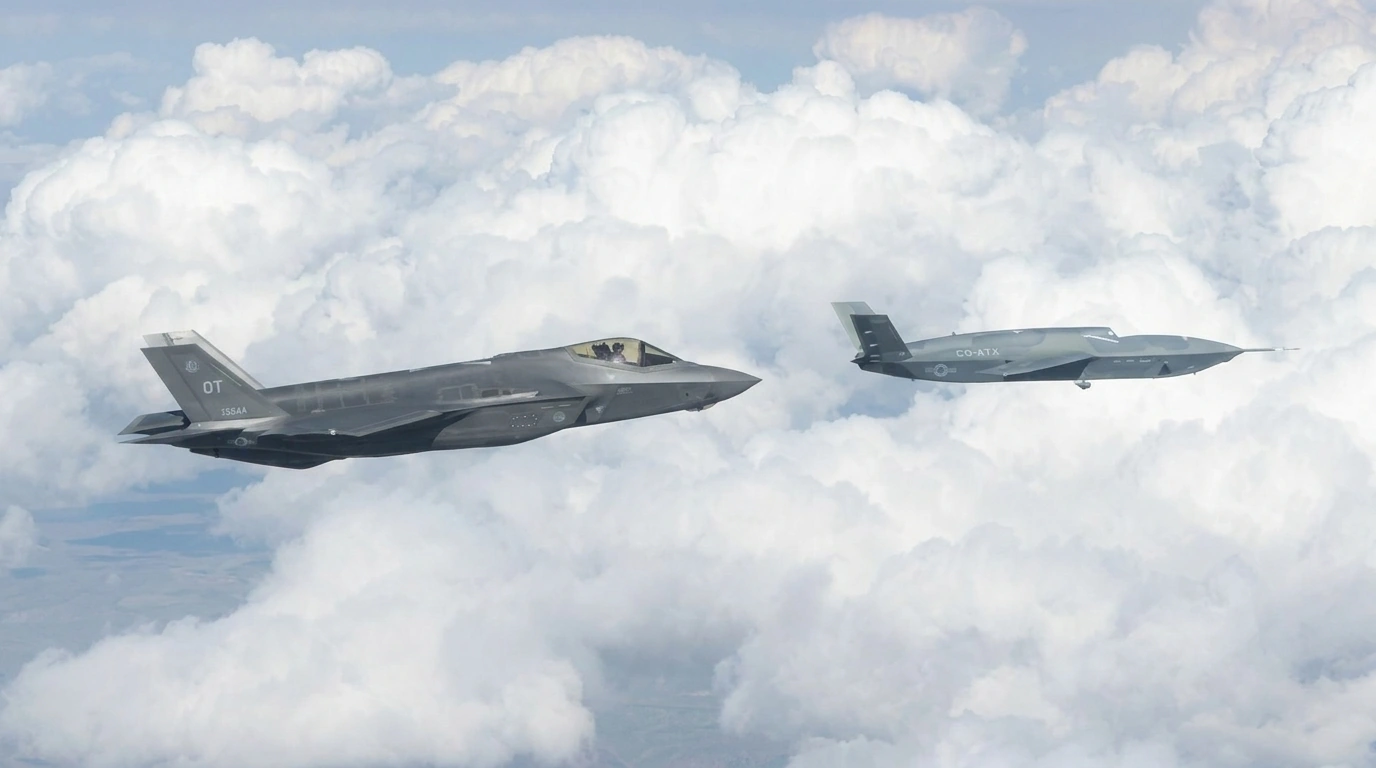
A photo can make a new aircraft look operational long before it actually is.
That’s the trap with the FQ-42 Vengeance right now. General Atomics has shown the uncrewed fighter flying beside an F-35A and an F-15E Strike Eagle, and the image looks like the future has already arrived. It hasn’t. The flight was conducted in preparation for collaborative-control testing, not as proof that an F-35 pilot was already directing the FQ-42 in combat.
Still, the picture matters.
The FQ-42 is being built around a simple idea: put more aircraft into a fighter formation without putting another human pilot inside each one. The U.S. Air Force calls these Collaborative Combat Aircraft, or CCAs. They’re meant to extend the reach, sensing and survivability of crewed fighters while handling some tasks autonomously.
That changes the basic math of an air formation.
An F-35 pilot could eventually have an uncrewed aircraft operating ahead of the formation, collecting information or carrying weapons. An F-15E could gain another aircraft without adding another cockpit. The human still makes key decisions, but the machine handles more of the flying and mission work.
And the scale being discussed is serious. The Air Force says it plans to acquire about 1,000 combat-ready, semi-autonomous systems, with 500 expected by 2032.
The real question, then, isn’t whether the FQ-42 can fly beside a fighter.
We already know it can.
The interesting question is what happens when the pilot stops treating it like another aircraft in formation and starts treating it like a teammate.
What Is the FQ-42 Vengeance?
The FQ-42 Vengeance isn’t a fighter drone built by stripping the pilot out of an F-35. That distinction explains almost everything about its design.
General Atomics built the aircraft from the start as an uncrewed fighter for the Air Force’s Collaborative Combat Aircraft program. It uses a modular design, which lets mission systems and autonomy software be changed without rebuilding the whole aircraft. That’s a much more useful approach than treating autonomy as an add-on.
The timeline is also unusually short. General Atomics began work on production-representative CCA aircraft after its 2024 selection by the Air Force.
The YFQ-42A made its maiden flight in August 2025, and the company received an initial production contract in June 2026. By September, an FQ-42 had arrived at Creech Air Force Base, Nevada, for continued test and evaluation.
Then came the name.
On September 14, 2026, the Air Force officially designated the aircraft FQ-42 Vengeance. The service classifies it as a semi-autonomous CCA intended to operate alongside crewed aircraft.
The physical design tells the same story. The FQ-42 is described as a fifth-generation uncrewed fighter, with an internal weapons bay and features aimed at reducing its detectability and improving survivability. Those choices matter because a CCA that needs to stay far behind the fighter it’s supporting loses much of its value in a heavily defended airspace.
But calling it a “robot wingman” can be misleading.
The textbook version suggests a fighter pilot simply sends an FQ-42 somewhere and the machine handles the rest. Real combat won’t be that clean. The aircraft has to manage navigation, sensors, communications, mission tasks and changing threats while keeping the human crew in control of key decisions.

GA-ASI has already tested its autonomy architecture on several aircraft, including demonstrations involving human fighter pilots in F-22 Raptors and F-35 Lightning IIs. The FQ-42 is now moving that concept into a purpose-built fighter rather than a test surrogate.
That’s the part worth watching.
The Vengeance isn’t interesting because it’s unmanned. It’s interesting because the Air Force is trying to make an uncrewed fighter useful inside the same formation as a human pilot.
How Will the FQ-42 Work With Manned Fighter Jets?
The hardest part of the FQ-42 Vengeance program isn’t getting an uncrewed aircraft airborne. It’s deciding who does what when several aircraft are sharing one fight.
A useful way to picture the system is to forget the old idea of remote control. A fighter pilot shouldn’t need to “fly” the FQ-42 stick by stick. That would turn one pilot into a remote pilot for two aircraft, which defeats much of the point.
Instead, the intended model is closer to mission-level control. A human could assign a task or desired behavior while the FQ-42 manages routine flight and responds to changing conditions through its autonomy system. General Atomics has demonstrated semi-autonomous and autonomous aircraft operating under human direction, including tests involving pilots flying F-22s and F-35s.
That distinction matters in a fight.
Imagine an F-35 formation approaching contested airspace. The pilot doesn’t need another screen showing every control input from an FQ-42. What matters is whether the uncrewed aircraft can carry out its assigned task, maintain a safe position, share useful information and react when the situation changes.
The machine handles the workload. The human handles the judgment.
But there’s a catch. Communications can be disrupted, sensors can disagree, and a planned route can become useless within seconds. A system that depends on constant instructions from a fighter pilot isn’t truly reducing workload.
That’s why autonomy is central to the CCA concept.

The recent FQ-42 flight beside an F-35A and F-15E shouldn’t be mistaken for proof that those fighters were already controlling the aircraft operationally. It was a formation test tied to the next phase of collaborative-control work.
And that gap between flying together and fighting together is enormous.
The real test comes when the FQ-42 has to make useful decisions without turning its human teammate into a full-time babysitter.
How the FQ-42 Could Team With the F-35A
The FQ-42 Vengeance and F-35A pairing makes sense because the two aircraft bring different strengths to the same formation.
The F-35A puts a human pilot inside a highly connected sensor and weapons platform. The FQ-42 adds another aircraft that can potentially move into useful positions without exposing another pilot to the same risk. The point isn’t to make the FQ-42 a smaller F-35. It’s to give the F-35 pilot more options.
Consider a simple contested-airspace scenario.
An F-35A approaches an area where enemy aircraft or surface-to-air systems may be present. Instead of sending the manned fighter straight toward the threat, an FQ-42 could potentially operate farther forward and use its sensors to gather information. That creates another source of data for the formation and could let the F-35 remain in a more favorable position.
The same logic works for weapons.
If the FQ-42 carries weapons internally, the formation gains another shooter without adding another cockpit. General Atomics describes the aircraft as a fifth-generation design with an internal weapons bay, although the company has not publicly laid out a complete operational weapons load for the FQ-42.
That last point gets overlooked online.

A common mistake is to assume that because an aircraft has an internal weapons bay, every possible missile or bomb has already been integrated. It hasn’t. The exact weapons, sensors and mission packages will depend on testing and Air Force requirements.
The bigger advantage may be information rather than missiles.
The Air Force describes CCAs as systems intended to work with existing aircraft and extend their reach, awareness and survivability. For an F-35 pilot, that could mean having another platform collect information from a different location and feed useful data back into the formation.
I’ve always found the “loyal wingman” label a little too tidy. It makes the relationship sound like a fighter with a robot shadow.
The more interesting model is distributed teamwork.
One pilot could eventually direct several autonomous aircraft, each performing a different task. The F-35 remains the decision-making hub, while the FQ-42 expands what that pilot can see, reach and influence.
That is where the pairing starts to make operational sense.
What Role Could the FQ-42 Play With the F-15E?
The FQ-42 Vengeance and F-15E Strike Eagle pairing shows why CCAs aren’t only about fifth-generation fighters.
The F-15E brings something the F-35A doesn’t quite replicate in the same way: a large, two-seat strike aircraft with substantial payload capacity and long experience in deep attack missions. Adding an uncrewed aircraft could let the crew divide some of the sensing, escort, or support work instead of asking the Strike Eagle to do everything itself.
The recent formation flight makes that idea easier to visualize. General Atomics released imagery showing an FQ-42 flying with an F-15E and an F-35A, giving testers a chance to work with the aircraft in the same flight environment.
But don’t read too much into the photograph.

The FQ-42 hasn’t been publicly assigned a fixed combat role such as “F-15E escort” or “F-15E weapons carrier.” Those are possible uses of the CCA concept, not confirmed Vengeance mission sets.
The useful question is what an uncrewed aircraft can do that frees the F-15E to concentrate on its main job.
Suppose an F-15E is tasked with striking a target in a heavily contested area. A CCA could potentially operate as an additional sensor platform or provide support farther forward, depending on its final equipment and rules for autonomous operation. The F-15E crew could then have another source of information without sending another crewed aircraft into the same threat area.
Weapons offer another possibility. An F-15E already carries a heavy load, but every weapon carried by a manned aircraft competes with fuel, range, sensors and other mission demands. A CCA with its own internal weapons could add capacity to the formation without requiring another pilot.
That’s the theory.
The hard part is making the aircraft useful when the network gets messy.
If communications are lost, the FQ-42 can’t simply wait for new instructions. Its autonomy system has to keep the aircraft safe and continue whatever actions its mission rules allow.
That’s why the F-15E relationship isn’t really about replacing the Strike Eagle. It’s about giving a proven crewed aircraft another uncrewed asset that can operate with it.
And if the Air Force gets that control problem right, the same FQ-42 could support very different aircraft without being redesigned for each formation.
What Weapons and Sensors Could the FQ-42 Bring to a Fighter Formation?
The FQ-42’s biggest contribution may not be its speed or range. It could be the extra sensors and weapons that a fighter formation can bring without adding another pilot.
General Atomics describes the FQ-42 Vengeance as a fifth-generation uncrewed fighter with an internal weapons bay. That detail matters because carrying weapons inside the fuselage can help preserve the aircraft’s low-observable shape. It also gives the aircraft a way to carry weapons without relying entirely on external stores.
But there’s a line between what is known and what is often assumed.
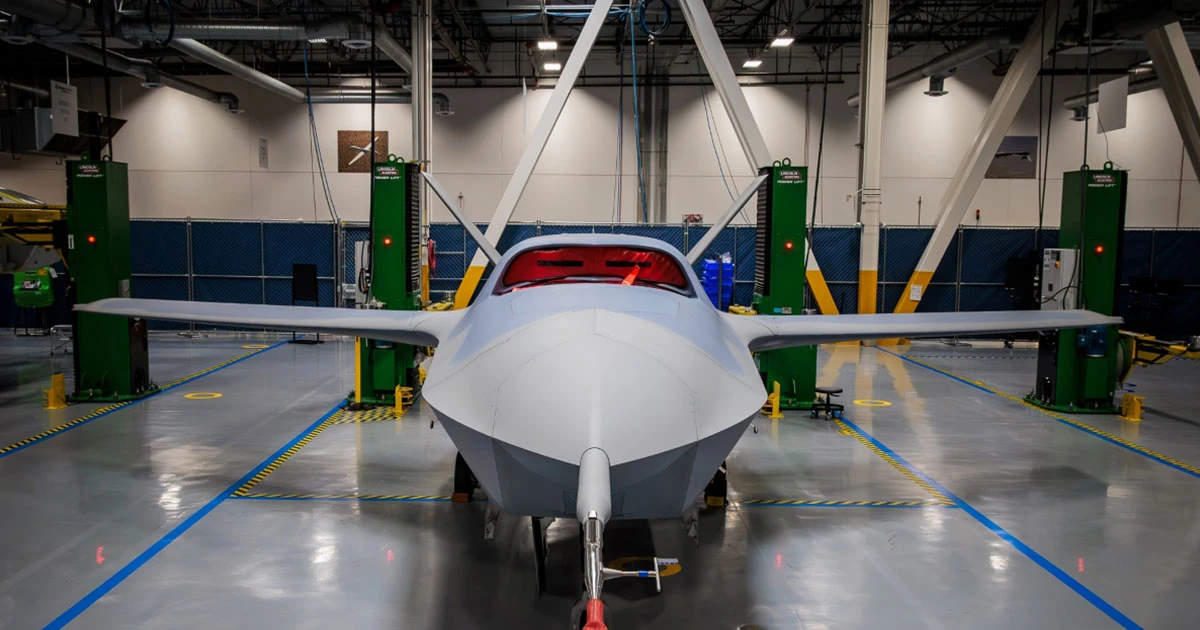
The Air Force has not publicly released a complete FQ-42 weapons loadout. So claims that assign a precise number of missiles or name a final operational bomb mix should be treated as speculation unless tied to an official test or contract.
The sensor side is just as interesting.
A CCA doesn’t need to duplicate every sensor carried by an F-35. In fact, duplication isn’t necessarily the goal. An uncrewed aircraft could carry a mission-specific sensor package and operate from a different position, giving the formation another look at the same area.
That creates a useful division of labor.
| FQ-42 capability | Potential benefit to a fighter formation |
| Internal weapons bay | Adds weapons capacity without another cockpit |
| Low-observable design | Helps the aircraft operate in contested areas |
| Autonomous flight | Reduces the need for continuous manual control |
| Sensor payloads | Provides additional sources of battlefield data |
| Network connectivity | Allows information to move between aircraft |
| Uncrewed operation | Removes the risk to an onboard pilot |
The key word is potential. These are roles the CCA concept is designed to support, not a confirmed list of every FQ-42 mission.
That distinction matters because the aircraft is still moving through testing. A weapons bay on a prototype doesn’t prove a missile has been cleared for operational use. A sensor aperture doesn’t prove how that sensor will be employed.
Still, the concept has a clear logic.
An F-35 could bring its own sensor fusion and human judgment. The FQ-42 could add another set of eyes or another set of weapons. An F-15E could gain an additional uncrewed platform without putting another crew at risk.
The real advantage isn’t simply more hardware.
It’s more ways to distribute the mission.
When Could the FQ-42 Become Part of Fighter Operations?
The FQ-42 Vengeance is moving toward operational use, but the next test isn’t another solo flight. It’s whether the aircraft can function as part of a real combat package.
That test comes in December 2026, when the FQ-42 and Anduril’s FQ-44 Fury are scheduled to take part in Emerald Flag at Eglin Air Force Base, Florida. The Air Force describes this as its first large-force employment exercise involving its own CCA aircraft.
That’s a much tougher environment than flying one drone around a test range.

The exercise is expected to put the CCAs alongside fourth and fifth-generation fighters in an offensive counter-air scenario. Lt. Col. Lyndon Bartlett, who leads the Experimental Operations Unit, described Emerald Flag as the first real step into force integration.
Why does that matter?
Because an aircraft can pass a flight test and still create headaches when inserted into a larger force. The Air Force has to figure out communications, command and control, launch and recovery, maintenance, mission planning and how human crews interact with autonomous aircraft.
Creech testing has already started exposing some of those practical issues. During a July 2026 exercise, FQ-42 and FQ-44 aircraft operated in a more austere setting, with the aircraft refueled and loaded with inert air-to-air missiles.
The production target is just as ambitious. Air Force Secretary Troy Meink said the service wants at least 500 CCAs in service by 2032. General Atomics says its current production setup can support roughly six FQ-42 aircraft per month, with room to increase output.
But 500 aircraft on paper don’t create combat power by themselves.
The harder question is whether those aircraft can be generated, controlled, supported and employed without requiring a huge new support structure.
That’s why Emerald Flag may tell us more about the FQ-42’s future than another impressive formation photograph. The aircraft already knows how to fly.
Now the Air Force has to prove it knows how to use one.
