

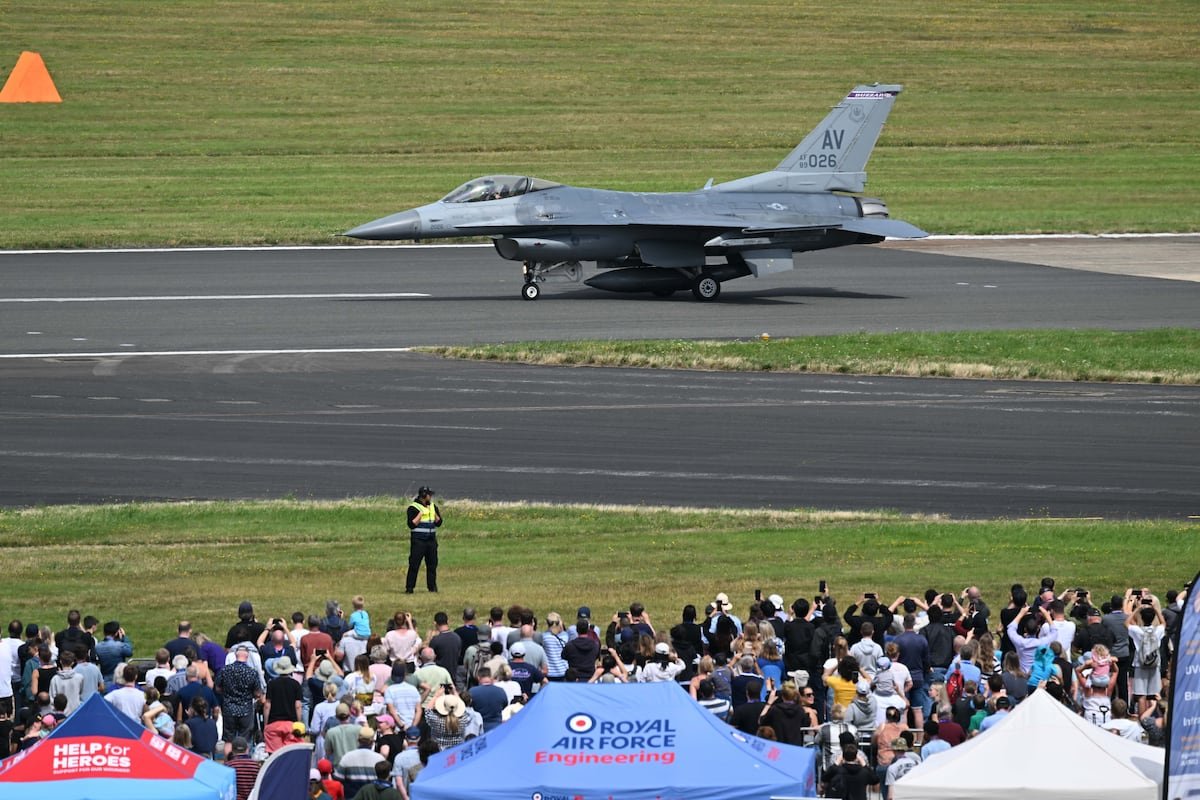
FARNBOROUGH, England, July 17 (Reuters) — Spiraling security risks are expected to push defense to the forefront of Britain’s Farnborough Airshow, as aerospace and arms makers struggle to keep pace with demand for weapons while cementing a fragile recovery in civil jet and engine production.
With the Ukraine war in its fifth year and a ceasefire in tatters in the Gulf, those risks are also likely to move the ritual contest between Boeing and Airbus for jetliner orders down the pecking order at the July 20 to 24 show.
“The global security environment is arguably more complex and volatile today than we have seen in many, many decades, and we are watching security threats evolve at a breakneck pace,” Air Chief Marshal Harv Smyth, head of the Royal Air Force, told an International Air Chiefs Conference ahead of the show.
Weapons makers enter their biennial bazaar witnessing the biggest rise in European defense spending since the Cold War but with unresolved questions about where and how it will be spent.
RELATED
One of the industry’s most influential figures warned the shift to drones and AI systems could disrupt defense as much as SpaceX transformed the launch business, as wars in Ukraine and Iran expose the need for faster developments and mass production.
“I know both worlds and they couldn’t be further apart,” said ex-Airbus CEO Tom Enders, who is co-chairman of German defense startup Helsing and heads foreign policy think tank DGAP.
“We used to have a saying that traditional defense companies … would only pick up a pen if the government paid for it,” he said in an interview on the eve of the show.
“The younger companies are aggressive, not risk-averse. They spend their own money. Procurement agencies and armed forces increasingly understand that this is the way for a dynamic fast-moving industry,” said Enders, who also chairs tank maker KNDS.
While some new budgeted funds will be spent on today’s warplanes like the Lockheed Martin F-35 and the Eurofighter — both performing displays next week — startups like Helsing and U.S.-based Anduril are pushing AI-driven systems like uncrewed fighter cohorts, despite initial setbacks.
“Valuations are tilting in favor of the defense entrants but … most militaries are still spending the vast amount of their resources on manned platforms,” said Byron Callan, managing partner of research firm Capital Alpha.
Organizers said defense will represent half of the record 1,600 exhibitors at the show, up from 40% historically, with a sharp increase in AI, deep-tech and finance companies.
Commercial jet sales, supply chains
On the commercial side, Airbus and Boeing are expected to announce new orders and disclose customers behind previously booked deals.
But with delivery slots largely sold out well into the next decade, the usual scrum of media announcements is likely to attract less attention as investors focus instead on aircraft deliveries, where manufacturers generate most profits.
Air shows can still produce surprises, but industry sources said total deals may struggle to climb far above 300 aircraft, well below some pre-show forecasts of as many as 800 jets. The tally could also include deals that have already been announced.
Separately, Air China said it would order 55 Airbus jets.
“Winning orders is not the question. It’s not the relevant measuring stick that it used to be because of production capacity constraints,” said Jerrold Lundquist, managing director of advisory firm The Lundquist Group.
Aerospace has been wrestling with supply problems since COVID-19, especially for castings and forgings — critical parts made to exacting standards from molten or solid metal.
Fixing such issues is key to a repeatedly delayed target by Airbus to lift single-aisle jet output by about 25% to 75 a month in 2027. Boeing, looking to narrow a gap against its rival and put a floor under declining market share, has signaled it is studying production above currently targeted levels.
“The supply chain…has improved relative to where it was a year or two ago but (not) to the point where Airbus can pursue its goal of 75,” said manufacturing expert Kevin Michaels, managing director of AeroDynamic Advisory.
“And as Boeing raises rates, it’s surely going to cause issues there as well,” he added.
Delays in engines and interiors have also been among the most persistent supply-chain headaches. But the show will open on a more positive note from the world’s largest engine maker.
“I do think the supply chain has really turned the corner,” GE Aerospace CEO Larry Culp told Reuters. “(There is) more work to do.”
