

Japan and Vietnam launch talks on the joint development and production of new fast landing craft, marking a major shift in Tokyo’s Indo-Pacific defense strategy.
Japan and Vietnam have agreed to begin discussions on the possible joint development and production of fast landing craft (高速揚陸艇), marking a significant step in their expanding defence-industrial cooperation and Tokyo’s broader effort to deepen defence-industrial ties with Indo-Pacific partners.
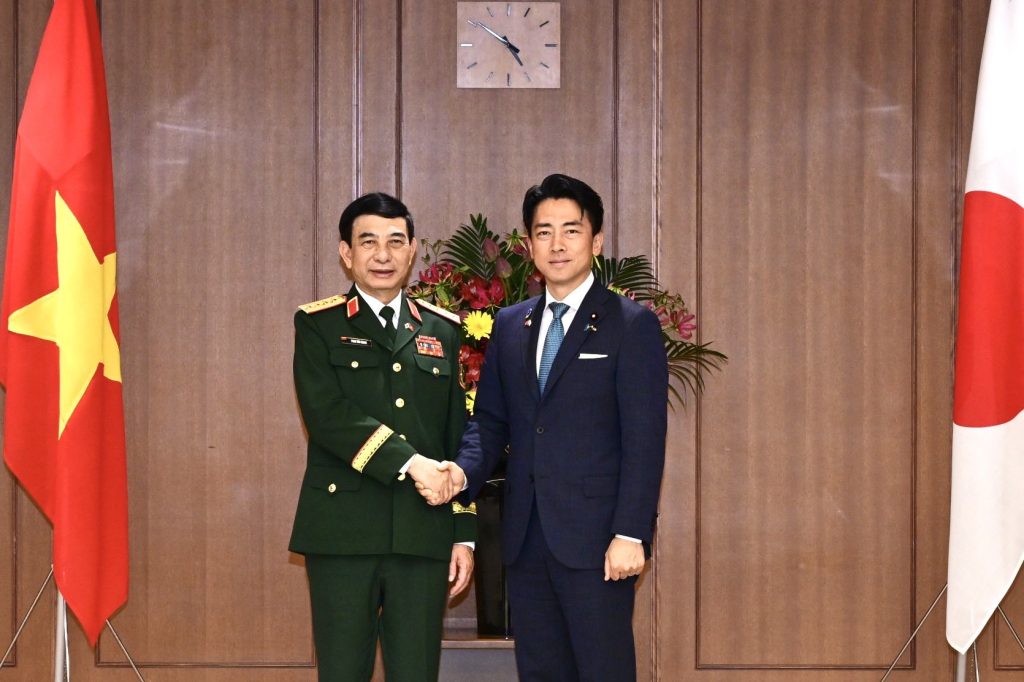
The agreement was reached during talks in Tokyo on July 13 between Japanese Defense Minister Shinjiro Koizumi and Vietnamese Deputy Prime Minister and Minister of National Defence Gen. Phan Van Giang. In a July 15 press release, Japan’s Ministry of Defense said the two ministers had agreed to commence discussions toward realizing concrete defense equipment and technology cooperation, including the possibility of jointly developing and producing fast landing craft.
Speaking at a press conference on July 17, Koizumi confirmed the agreement. Describing the concept only in general terms, he said such craft are intended to transport personnel and supplies rapidly from offshore transport ships to beaches, providing greater mobility than conventional landing craft during amphibious operations and disaster-relief missions. He declined to discuss specific design details, saying technical discussions would be left to working-level officials.
Koizumi also framed the project as part of Japan’s evolving defense equipment transfer policy, arguing that cooperation with allies and like-minded countries is becoming increasingly important as the regional security environment deteriorates.
Responding to questions about the risk of technology leakage given Vietnam’s close ties with China, Koizumi said Japan would protect participating companies’ technologies through strict screening, appropriate information management, and close coordination with the Vietnamese government.
While a political framework has now been established, almost every technical aspect of the project remains undefined. Neither government has disclosed the vessel’s displacement, payload, propulsion system, speed, industrial workshare, development schedule, or participating shipbuilders.
Perhaps the biggest unanswered question is the type of craft envisioned. Although some observers have speculated that the project could involve a successor to the Japan Maritime Self-Defense Force’s Landing Craft Air Cushion (LCAC), neither government has suggested this. Koizumi referred only to a “fast landing craft,” and his description does not indicate whether the future platform will be an air-cushion vehicle, a conventional waterjet-powered landing craft, or another configuration.
Japan’s existing experience provides useful context. The JMSDF operates six LCACs embarked aboard its three Osumi-class landing ships—two per vessel—providing rapid ship-to-shore transport for troops, vehicles, and heavy equipment. The LCAC hulls, built by U.S. defense manufacturer Textron, were commercially imported through a Japanese trading company, while operational and training support, along with information on component improvements, was provided through the U.S. Foreign Military Sales (FMS) program. Japan therefore possesses extensive operational experience with high-speed amphibious connectors but comparatively limited experience in developing such craft domestically.
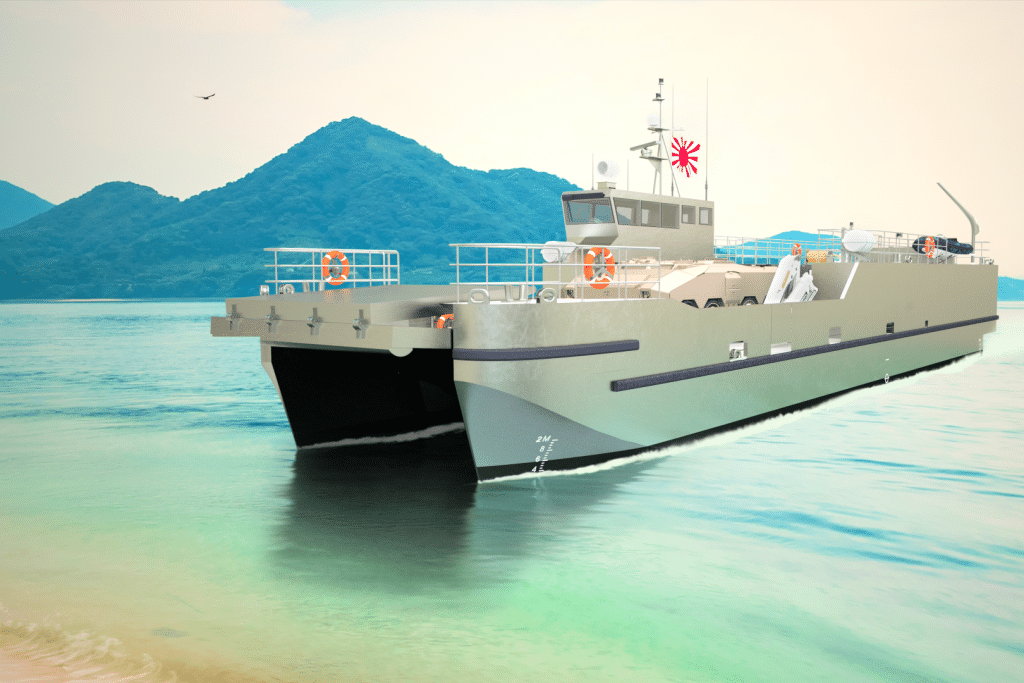
At the same time, Japan is no longer starting from scratch. In February 2025, Japan’s Acquisition, Technology and Logistics Agency (ATLA) awarded a contract to Japan Marine United (JMU) and British naval design firm BMT for the Caimen Japan program, the Self-Defense Force’s next-generation high-speed landing craft(機動舟艇). Under the arrangement, BMT is responsible for the Caimen landing craft design, while JMU will undertake production design and construction in Japan. The approximately 30-meter craft features a tri-bow hull and is designed to exceed 20 knots.

At present, Caimen Japan appears to be the only Japanese program that could realistically be offered for either export or joint development. With support from the Japanese government, JMU has already explored potential export opportunities for the design, including in the Philippines. If the Japan-Vietnam project moves beyond the discussion stage, Caimen Japan would therefore appear to be the most likely candidate.
However, the relationship between Caimen Japan and the newly announced Japan-Vietnam initiative remains unclear, and neither government has indicated whether the two projects are connected.
For Vietnam, the project would support its long-term objective of strengthening domestic defense-industrial capabilities through technology transfer and local production. For Japan, it reflects a gradual shift from exporting finished defense equipment toward collaborative development with trusted regional partners. Whether the eventual platform proves to be a hovercraft, a conventional landing craft, or an entirely new design, the significance of the announcement lies less in its final configuration than in its industrial model. If the project proceeds, it could become an early example of Japan’s shift toward jointly developing amphibious platforms with trusted Indo-Pacific partners rather than primarily exporting finished defense equipment.
