

The genre of strategy has seen its fair share of genre mix-ups in the last two decades. During the late 2000s and early 2010s, we saw the rise of this weird idea that players wanted simpler strategy games, something that, to nobody’s surprise, turned out to not be the case. Well, except for Halo Wars. Halo Wars was pretty good. Fortunately, there have been some widely successful experiments: FTL stacked ship-management on top of roguelike basics of procedural exploration and perma-death. Crusader Kings took grand strategy and turned it into a dynastic RPG. Sins of a Solar Empire and Dune: Spice Wars are tucked in RTS and 4X. Marvel’s Midnight Suns became a cult classic by adding deck-builder elements to the XCOM formula, set against a backdrop of social and role-playing elements with your party.
Genre
My point is, the strategy genre is no longer limited to the basic archetypes of RTS, turn-based, 4X, grand-strategy, and wargames, and we’re all better off because of it. Genres constantly evolve by bringing elements from other games, from other completely different genres. As someone who loves these types of experiments, the idea of a game that put together elements from traditional turn-based strategy and survival horror from the early days of Resident Evil struck me as something weird, but that actually makes sense.
Weird because how can a game be horrifying if you’re playing it in turns? Unless things constantly jump out at you, something that would get very boring, very fast, then how can a game instill this sense of terror? After going back into my memories and thinking about the early days of Resident Evil, I don’t think that’s the right question. At least, in my mind. You see, I might have been a kid, but I was around the early days of Resident Evil on the Sega Saturn and Dreamcast, and the games never struck me as scary in any sort of way. In fact, they were more stressful than anything else, really. Having to constantly make sure you had some sort of way to deal with the threats that might or might not be just around the other end of the corner. In fact, I was a lot more scared while playing the original Doom on the Sega Saturn than Resident Evil. The answer is no- before you ask- I didn’t have a lot of parental supervision while playing games, because my father also enjoyed them as well. So, all that’s left is: How do turn-based mechanics pair up with the constant stress of having to manage limited resources, while having to deal with unforeseen threats in VULTURES – Scavengers of Death? Well, pretty damn good, actually.
- Genre: Turn-Based Strategy / Survival Horror
- Developer: Team Vultures
- Publisher: Firesquid, Gamersky Games
- Price: $17.58 | 17,12€ | £14.65
- Release Date: 13 May, 2026
- Reviewer: Nuno Marques (PC)
- Target Audience: Turn-Based Strategy players; Horror game players; Strategy games lovers
- Final Score: 8/10
VULTURES – Scavengers of Death is a turn-based strategy game inspired by the 90s horror classics like Alone in the Dark, Silent Hill, but above all else, 1996’s Resident Evil. Players take control of a team of two VULTURES operatives being handsomely paid to go back into an infested metropolis to retrieve information that might cure the infection. A very traditional set-up that works well enough, but I have to praise the game’s ability to not fall into the trap of exposition dump, as many others do. Instead, as missions progress, mysteries start to unravel, get solved, and new ones show up. As someone who very often criticizes the way stories are treated in strategy games (just a cutscene at the beginning and at the end of a mission), the constant drip of new information is the perfect breadcrumb for someone like me, who loves piecing things together as they go.

The game’s missions will have you take control of one of the two operatives, each of which has a different skillset- but more on that a bit later on- and explore spacious maps, with dozens of rooms of all shapes, sizes, and purposes: From large, fenced gardens to the most claustrophobic of bathrooms, everything you expect to find is here. Missions are long and multi-staged, and as you uncover the main reason that led you there in the first place, your head-companion will chime in to redirect you somewhere new.
While you don’t have to explore every nook and cranny of the map, chances are, you most likely will. The number one reason is resources, which can be found by exploring the map, gathering them, and keeping them in your inventory until the mission is over, or loading them into the team’s overall storage in a safe room, which is also the location where you can save the game mid-mission. You cannot save the game whenever you want, so keep that in mind if this annoys you. The second biggest reason is that you’re never told where to go, so you can only get there by exploring. While the maps are big and mostly filled with danger, the exploration aspect means that you’ll probably spend at least an hour going through each map, but chances are, if you enjoy turn-based games, this isn’t going to bother you all that much.

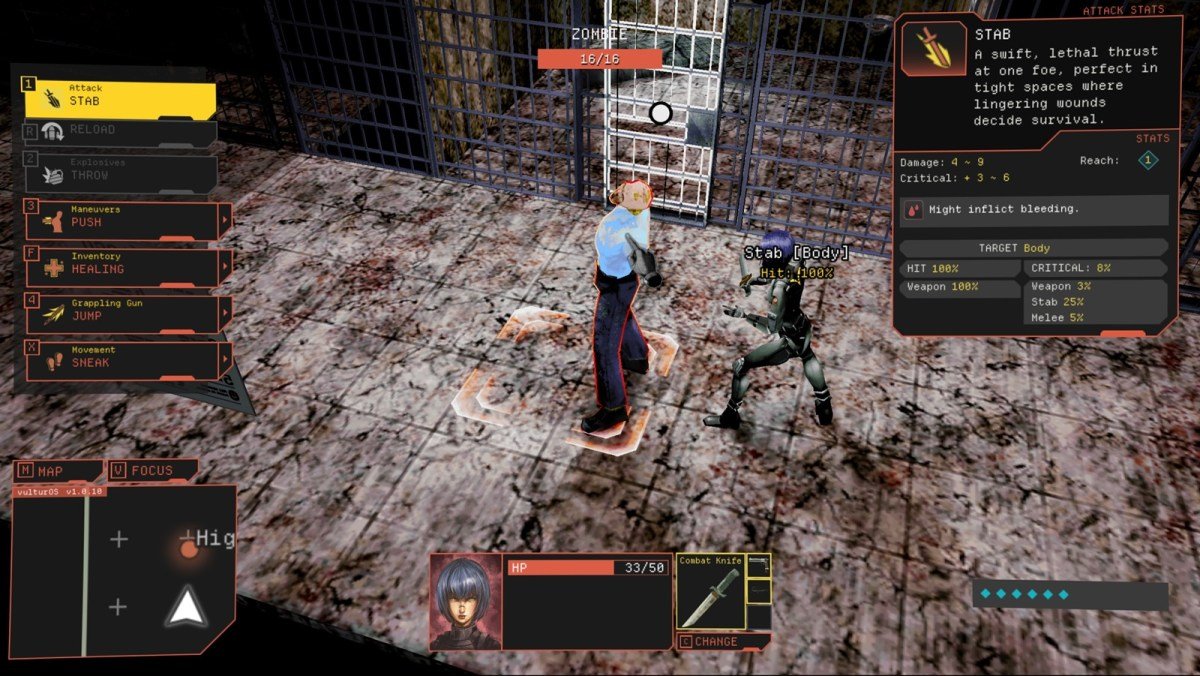
Let’s talk combat, now. When exploring the maps where the missions take place, you’ll inevitably come across some infected undead, and they’re various variants, ranging from borderline innocuous zombies to hulking monstrosities, each with its own attack patterns and strategies to deal with. Before you enter the combat phase of the game, you can sneak behind enemies and get a head start by damaging them first, or immobilizing them with a repositioning move. In some sections, you can even skip combat altogether, while others will start combat as soon as you open the door.
The combat phase starts once a zombie is made aware of your presence, and to beat them, you have to use a mix of action and movement points. I would say these are self-explanatory, but some skills require a mix of both to be used. Combat comes down to keeping your distance from the zombies and using the environment to block and incapacitate them. When firing your weapons, you can target specific areas for different amounts of damage and status effects, and you’ll probably find yourself shooting at their legs so you can keep them away from you. The safest and most resource-effective way of dealing with these unlucky undead is to try to group them together for a shotgun blast, use some environmental hazard, or a grenade. But overall, combat is challenging, and you’ll find yourself having to skirt around the battlefield, taking potshots, doing some stabbing before pushing the zombies away, and retreating. Fighting the regular enemies does become repetitive after a while, but I cannot really fault the game for that, because it’s a compromise you have to reach to make the missions and maps are massive as they are. Of course, as new enemies get introduced, and these end up requiring some specific strategies to deal with, it is a nice change of pace from the average shambler.

As for the tools you use, the game has an inventory system that lets you collect new weapons as you progress through the missions, and each weapon uses a specific type of shell. These weapons can be upgraded in between missions, at your home base, with these newly found powers translating into unlocking new abilities and increased damage, for the most part. Weapons are varied, and they serve different purposes, with the pistol and knife being your workhorses, the crossbow allows you to shoot without triggering the zombies, the shotgun will destroy everything in its cone, you get the gist. Each weapon serves a purpose, and you can change between them mid-mission by finding a safe room and going into the team’s shared inventory.
Lastly, before we talk about the things that VULTURES doesn’t do as well, let me just tell you that combat isn’t all the missions have. There are also puzzles that you need to solve, giving the missions a nice change of pace and further encouraging exploration.

Now, let’s talk about the most striking aspect of VULTURES, which are its PlayStation 1 era graphics. These graphics are the result of the limitations of hardware at the time, and they’re known for texture wobbliness, polygon jittering, mixed with low-poly and low-texture models, which gives it a very special look that a lot of game developers have been trying to emulate using modern techniques, on modern engines. Team Vultures did a fantastic job at that, and the game doesn’t look a day older than 30 years. All jokes aside, props to the team for nailing down not only the aesthetic, but also the stiff animation style and that feeling of near-clipping these games had, which is so difficult to put into words. To be completely fair, we are at a point where it’s actually harder to keep a consistent art style of low-resolution textures all across the game, because you need to rework the entire process of creating a texture by removing everything that isn’t the bare minimum, and still keep some semblance of familiarity. This is made very obvious because the game stumbles here and there, and some higher-resolution objects do not show. Look at the wall signs and compare them to the painting. In the end, this is just nitpicking. The game looks awesome.

Now, while I do enjoy the game quite a lot, and I think this is going to live on as a cult classic, the game isn’t immune to criticism. My major point of contention is one that I’m sure the team could solve rather easily: If you’re facing a single zombie, you can stunlock it until it dies. As we have discussed earlier, the game’s mechanics allow for repositioning and pushing enemies into the environment to cause damage or incapacitate them. Since most encounters happen in fairly crowded rooms, it’s super easy to take a single zombie, push it into a wall. When this happens, it becomes unable to move, but you enter the combat phase. Give it a stab, and the zombie loses its incapacitated status. Push him again against the wall, and he gets incapacitated again, removing you from the combat phase that limits your action points. Stab it again, enter combat phase, push him against the wall, and get out of combat phase. Do the same thing two or three times, and you can take out an enemy with literally no consequences. Finding this a couple of times wouldn’t be a problem, but the thing is, it’s rather frequent. And even when fighting a room filled with zombies, there will come a time when you’ll be fighting the last one, and that’s usually when you should be the weakest, barely making it out alive. This exploit ruins that moment that’s so integral to the whole experience. My advice to Team Vultures would be to permanently lock the player in the combat phase once it starts.
My last complaint isn’t one that happened to me personally, but I can imagine it might happen to others, and that’s the fact that you can get softlocked mid-mission, forcing you to restart the entire mission (which is not small, as we discussed), or to go back to an early save. In some missions, you’ll find yourself being ambushed by enemies in rooms you’ve cleared already, and you might find yourself with lower ammunition stocks than you need. And while I could see the argument that this is part of the survival genre aspect, and agree with it, the fact that the game is generous with the ammunition it hands you just makes it more frustrating than a challenge, because chances are, the ammo you needed is stored in your team’s inventory, and is not a result of mismanagement.
FINAL SCORE – 8/10
The unique premise is met with a spotless presentation, exciting combat, and a well put-together zombie story that doesn’t devolve into the same boring tropes the moment it starts. With all of this being said, I’m of the firm opinion that VULTURES – Scavengers of Death is going to go down as one of the best strategy games of 2026. Well, at least it’s one of my favorite strategy games of 2026.
Support Strategy and Wargaming
I do what I do in Strategy and Wargaming because I love to do this, and I’m never going to stop. If you would like to support me with that, you can buy me a coffee for a dollar if you’re feeling generous. If you can’t, no worries, Strategy and Wargaming will always be free, and I’d love to have you around!
