

For years, the Pentagon has warned that the biggest challenge in future conflicts may not be firepower, but logistics. Supplying dispersed ships and remote forces across thousands of miles of ocean has become a growing concern for military planners, particularly as China expands its naval capabilities and long-range missile systems throughout the Indo-Pacific.
Former Marine Corps Harrier pilot Jason Maddocks believes autonomous aircraft could become part of the solution.
From Harrier Cockpits to Autonomous Aircraft
Maddocks, now vice president of programs at PteroDynamics, has spent much of his career at the intersection of military aviation and emerging aerospace technology.
A combat-decorated Marine pilot, Maddocks previously served as the lead test pilot for the AV-8B Harrier and held senior program management roles within both the AV-8B and V-22 program offices.
After leaving active-duty military aviation, he moved into the commercial autonomous aviation world, serving as a systems engineering consultant at AVIAN, Inc. for Alphabet’s Loon project and later as head of operations engineering for Zipline.
He earned aerospace engineering degrees from both the United States Naval Academy and Massachusetts Institute of Technology and graduated from the United States Air Force Test Pilot School.
Earlier this month, PteroDynamics announced that the Royal Australian Navy selected the Transwing vertical takeoff and landing aircraft to support autonomous maritime logistics operations. The deal marks the company’s first international defense sale and expands years of collaboration with the U.S. Navy.
The agreement comes as both the United States and Australia place increasing emphasis on distributed maritime operations across the Pacific. The U.S. Navy’s Distributed Maritime Operations doctrine focuses heavily on maintaining logistics and coordination across dispersed naval forces operating in contested environments.
Defense analysts have repeatedly warned that sustaining forces across the Indo-Pacific would place enormous strain on traditional logistics systems. Studies from organizations including RAND and the Modern War Institute have highlighted how vulnerable conventional resupply methods could become during a high-end conflict in the region.
How the Transwing Works
That operational problem sits at the center of the Transwing program.
“The original problem was, how do you make an aircraft that can take off and land from anywhere without a runway, without any ground-based launch and recovery equipment, but then fly as efficiently as possible over long distances,” Maddocks said during an interview with Military.com.
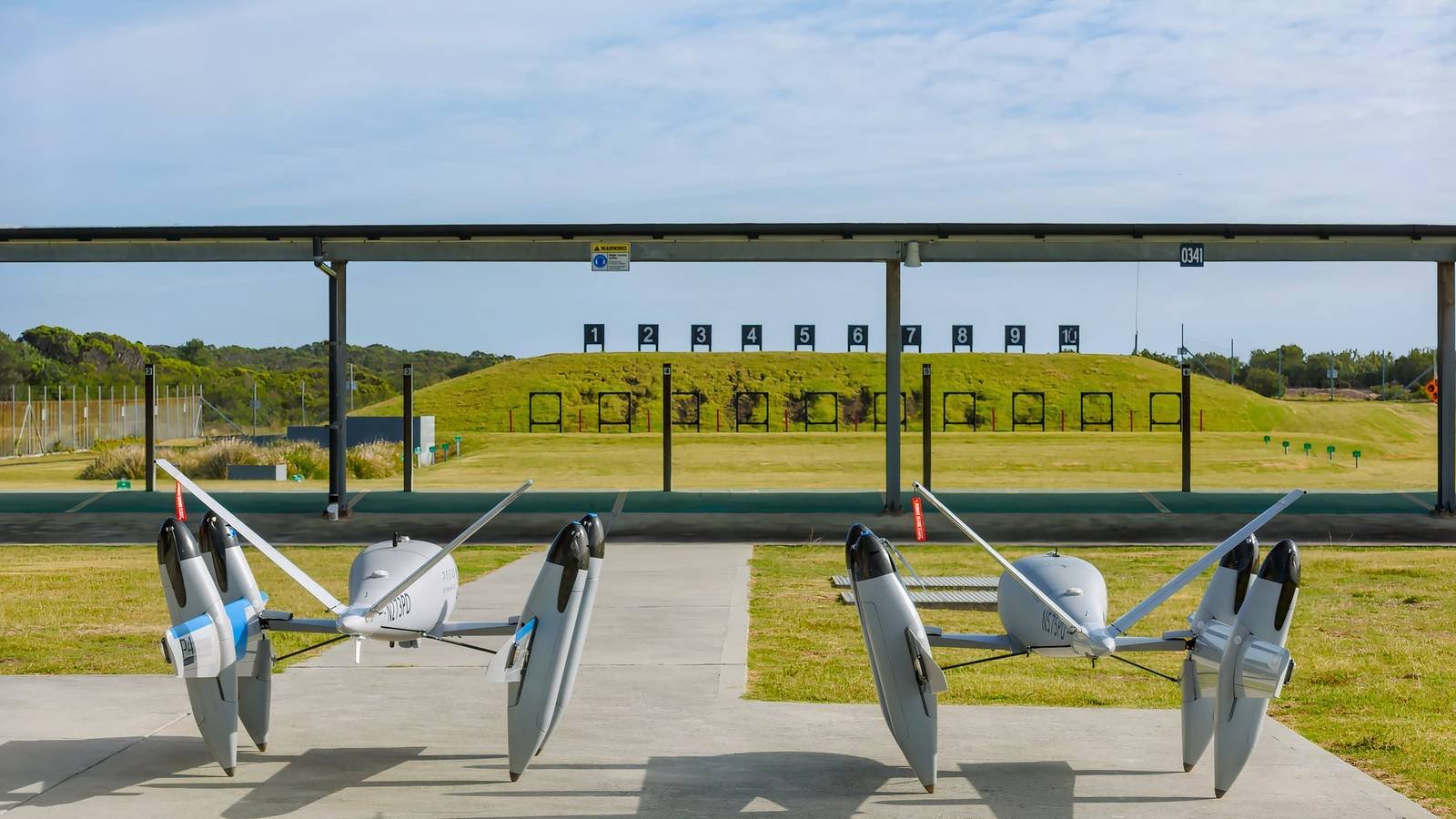
Unlike traditional fixed-wing drones that require launch systems or runways, the Transwing launches vertically with folded wings before extending them mid-flight and transitioning into fixed-wing cruise. The design attempts to combine the flexibility of a multirotor drone with the range and endurance of a conventional aircraft.
According to the company, the larger P5 version currently under development will eventually carry 50-pound payloads more than 400 nautical miles while flying at roughly 70 knots. The aircraft is also designed to operate directly from ships without launch infrastructure.
Why Militaries are Interested
Maddocks said the military’s growing interest in autonomous logistics stems partly from a Navy study showing that roughly 90 percent of critical cargo missions involved payloads weighing 50 pounds or less. Nearly half involved payloads under one pound.
That creates an expensive mismatch when large, crewed aircraft such as the V-22 Osprey or MH-60 Seahawk are used to move relatively small items between ships or remote positions.
“Amateurs talk tactics; professionals talk logistics,” Maddocks said. “Our goal is to perform logistics missions with as few people as possible and with these flying robots that can work on their own 24/7.”
Australia’s interest in the system reflects many of the same strategic concerns driving U.S. military planning. Canberra has expanded defense cooperation with Washington through initiatives such as AUKUS while investing heavily in autonomous systems and long-range capabilities.
Operating in Contested Environments
PteroDynamics demonstrated the aircraft for Australian defense officials in 2025. According to Maddocks, the Royal Australian Navy showed particular interest in the aircraft’s ability to launch and recover from confined shipboard spaces while operating in difficult maritime conditions.
“One of the unique advantages that our aircraft has is that it does really, really well in high winds,” he said. “The captain of the ship, in general, doesn’t need to change course during flight operations with the Transwing.”
Although the aircraft’s primary focus remains maritime logistics, Maddocks said the system could eventually support intelligence gathering, communications relay, electronic warfare, and search-and-rescue operations. The company has also emphasized the platform’s potential civilian applications, including emergency response and cargo delivery in remote areas.
The Future of Autonomous Warfare
Maddocks said his own approach to autonomous aviation comes from balancing traditional military flight-test discipline with the rapid development culture common in Silicon Valley aerospace startups.
“I’ve seen the full spectrum of the cowboy approach and the full-blown, very process-heavy approach,” he said. “The trick is trying to find the right balance between those two methods in a disciplined, risk-based way.”
For Maddocks, the broader significance of autonomous systems extends beyond a single aircraft program. He believes military attitudes toward unmanned technology have changed dramatically over the past decade, particularly after conflicts in Ukraine and the Middle East demonstrated the growing importance of drones in modern warfare.
“There seems to be a willingness to leverage these autonomous technologies with the realization that if we don’t, we’re going to fall behind our adversaries,” Maddocks said.
Looking ahead, he envisions autonomous aircraft operating continuously within carrier strike groups and expeditionary formations, quietly moving supplies between ships and shore with minimal human oversight.
“The vision is a small fleet of Transwings flying 24/7 delivering cargo between ships and shore with minimal human interaction,” Maddocks said.
