

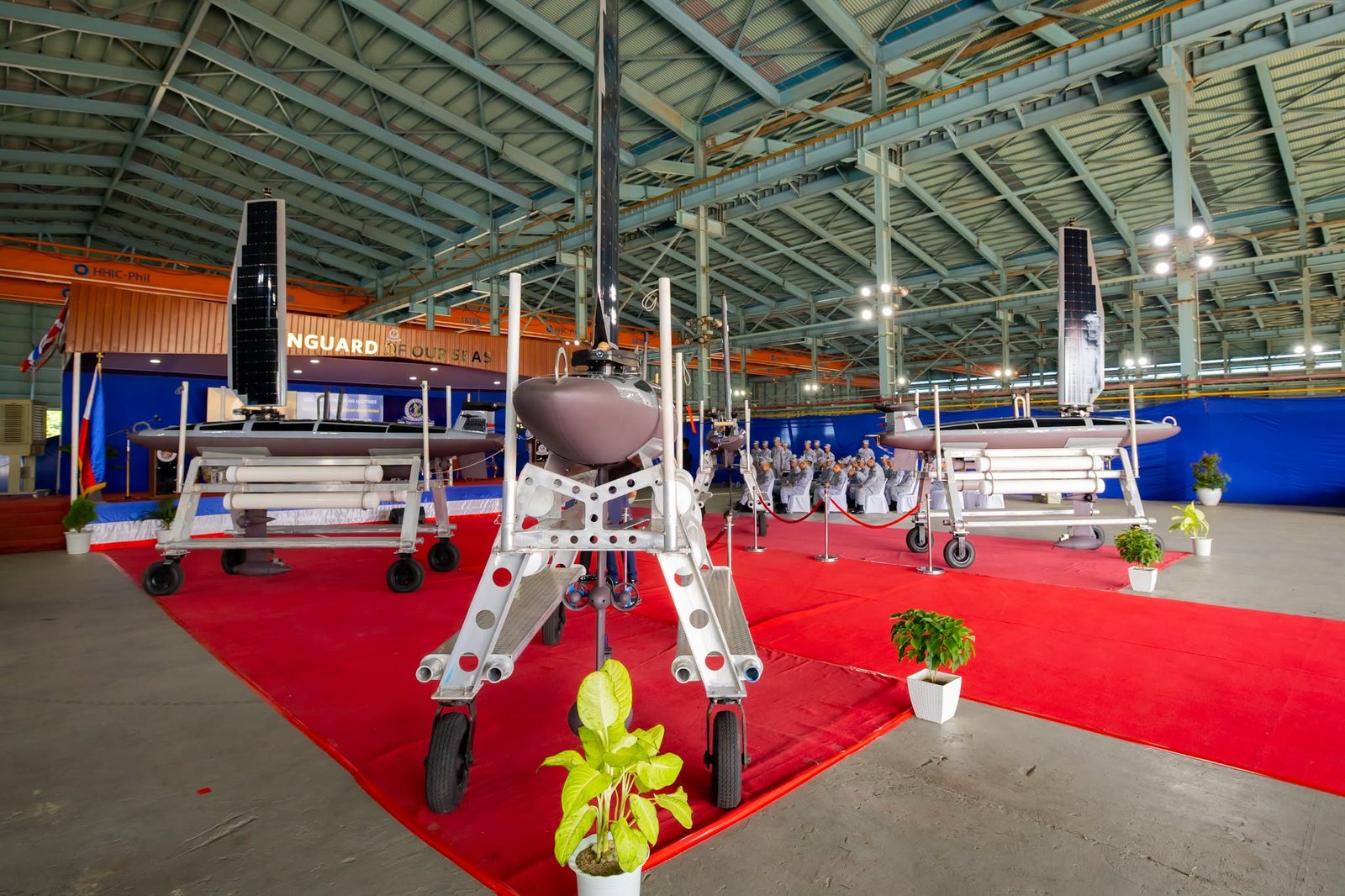
The USA has transferred a quartet of Triton autonomous underwater and surface vessels to the Philippine Navy (PN), with the handover marked by a ceremony at Naval Operating Base Subic on 22 June.
The equipment from US-based Ocean Aero is valued at approximately PHP754 million (US$13 million). The four vessels will be operated by the PN’s Unmanned Surface Vessel Unit that was established in 2024.
Bridgette Walker, the US Embassy Chargé d’Affaires, remarked at the handover: “The four Ocean Aero Triton AUSVs we’re transferring today represent something important: the future of maritime security is not just about platforms – it’s about capability, speed and reach.”
She continued, “The Indo-Pacific’s maritime domain is vast, contested and critical, and the Philippines sits at the heart of it. The ability to monitor and respond to maritime challenges – illegal fishing, grey-zone activities and threats to freedom of navigation – requires persistent, long-endurance awareness that no single ship or aircraft can provide alone.”
Walker said the Tritons will help fill those surveillance gaps in critical waterways. China, especially in places like the South China Sea, has established a robust and aggressive presence, bullying Philippine fishermen and even harassing government vessels and aircraft.
The US Embassy stated in a press release the following day: “The delivery demonstrates how aligned investments, training and shared standards translate into credible, ready capabilities that deter aggression and support regional stability.”
The Triton AUSV measures 4.5m long and weighs 350kg, and they can collect data above and below the ocean’s surface. They can sail on the surface at a maximum speed of 5kt, or, after folding its sail, transition to swim underwater at 2kt speeds like a submarine.
They can stay submerged for more than five days and descend to depths of 100m, meaning they can evade surface threats or radar contacts. In fact, they can hibernate on the seafloor for a period of days.
Each USV is solar- and wind-powered, enabling an endurance of up to 30 days. They transmit collected data, and can contribute to a wider Philippine mesh network that can monitor maritime activity near the Philippine archipelago.
As well as intelligence, surveillance and reconnaissance missions, the Tritons can monitor seabed cables and assist in anti-submarine warfare or mine countermeasures. As the PN eyes submarines in its future fleet, the Tritons may also collect underwater data that will prove useful later.
The USA donated this equipment to the Philippines, and Colonel Daniel Oh, Chief of the Joint US Military Assistance Group – Philippines, remarked, “These unmanned capabilities support the Armed Forces of the Philippines’ transition to territorial defence and improve awareness in critical waterways. The next step is to assist the Philippines integrate these new capabilities in their employment and sustainment concepts.”
The Triton already has a service pedigree, since the US Navy has deployed Tritons in the Fifth Fleet area of operations in the Persian Gulf since 2023.

The US military also employed multiple USVs during two counter-landing live-fire exercises in Palawan and northern Luzon during Exercise Balikatan 2026. These included the HavocAI Rampage USV and the Qinetiq Hammerhead MkII target drone.
During the follow-on Exercise Salaknib in the Philippines, the 125th Intelligence and Electronic Warfare Battalion of the US Army’s 25th Infantry Division also deployed a Rampage to escort a Logistics Support Vessel as it neared port.
Interestingly, a Magura USV from Ukrainian firm Uforce sank a target vessel in the Luzon Strait on 24 April during Exercise Balikatan 2026. It was the first time the US-Philippine allies have struck a maritime target in that waterway. Uforce claims its USVs are the most combat-tested in the world, after chalking up significant kills against Russian vessels in the Black Sea.

As it has done with the Tritons, the USA plans to give the Philippines lethal unmanned systems by 2027.
In another recent use of USVs, the USA famously utilised a 7.3m-long Saronic Corsair USV to rescue two US Army pilots after their AH-64E Apache helicopter ditched in the Persian Gulf after being shot down by Iran earlier this month.
by Gordon Arthur
